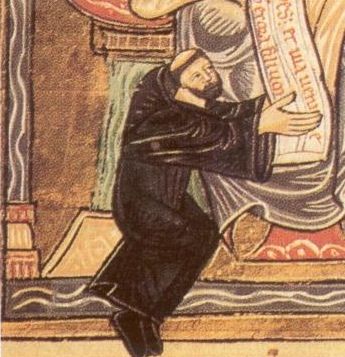
Baring-Gould’s sources: Roman, Gallican, and Benedictine Martyrologies. Authority: — A Life by John of Salerno, a companion of Odo. Another Life by Nalgod of Cluny, written in the nth cent. A third Life by his disciple Godschalk existed in the Carthusian convent at Antwerp in the 16th cent. Where it now is, is uncertain.1 The Life by John of Salerno in Mabillon, Acta SS. O.S.B. ssec. v. So also that by Nalgod.] Odo of Cluny was the son of Abbo, a knight of Frank origin, in attendance on William, count of Aquitaine. As soon as he was weaned, he was given to a priest to be educated for the monastic life, and was dedicated by his mother to S. Martin. However, when he was aged about sixteen, his father changed his mind, and placed him with the count of Aquitaine; and he spent his time in hawking and hunting. But this was an age at which he was growing rapidly. He had not, perhaps, had sufficiently nourishing food at the parsonage, and his strength was not equal to the activity required of him. The hunting and hawking exhausted him greatly, and he was attacked with violent headaches, which troubled him till he was eighteen. He and his father, however, supposed these headaches came from S. Martin, who was angry at his votary devoting his time to secular amusements. Under this conviction Odo was taken away from the court of the count, and given a canonry at Tours, with minor orders. He read the old classic poets with great advantage and satisfaction, but one night after he had been studying Virgil, he dreamt that he saw a noble antique vase full of serpents, and was convinced by this that he would get more harm than good from these ’ u Usuardi Martyrologium, cum additionibus.... opera Joannis Molani.” S. Odo.
…authors. He therefore gave up reading them. As expurgated editions of the classic poets were not then accessible, it is quite possible that he was right. From Tours he went to Paris to study philosopy under Remigius of Auxerre, monk of the abbey of S. Germain, the first to open a public school in Paris, a.d. 900. One bitter winter day as Odo was going to hear mass with the rest of the scholars, he saw a poor man in rags, blue with cold, in the porch. He was moved with pity, and gave him his fur overcoat. After mass he went to his class, but was so cold that he could not endure it, and returned to his bed to snuggle into it and recover warmth. To his astonishment, as he got in, he found a piece of gold among the blankets — enough, and more than enough, to provide him with a new fur overcoat. Remigius died in 908, and probably about that time Odo left Paris and returned to Tours. There he was joined by Adegrin, a knight who was tonsured, and had received a canonry. Adegrin lived with Odo in the practice of every virtue. After a while, however, he retired to Beaume, and was shortly after followed by S. Odo, and was admitted by S. Berno, the abbot, to take the habit.
The great abbey of Cluny was founded in 910, and was committed to the care of S. Berno, who was obliged to govern six other monasteries at the same time. On his death, in 927, the government of three of these monasteries, Cluny, Massay, and Deols, devolved on S. Odo. He made Cluny his residence. He was a strict disciplinarian, and made conformity to the Rule of S. Benedict [father of Western monks (d. c. 547), author of the Rule] a point of supreme importance. When at Beaume he had got into trouble on account of not observing the letter of the rule of the monastery, and this impressed itself on his mind and made him strict with others. The occasion was this. At Beaume it was ruled that no monk should speak with one of the scholars except before witnesses, and that if a pupil should have occasion to leave the dormitory at night he should be attended by the master of the boys, and either another monk or another pupil, and that they should take a candle with them. One night a boy rose from his bed, woke S. Odo, who was master at the time, and announced his intention of leaving the dormitory for a few minutes. Odo at once roused from his bed another scholar, and the two gravely attended the youth on his excursion. As the lamp in the dormitory illumined equally the locality which was the goal of the boy's journey, S. Odo thought it unnecessary to light a candle for him. Next day, when the monks were ranged in solemn chapter, S. Odo was denounced for having infringed the rule by neglect in this particular, immediately on the conclusion of the reading of the martyrology. 1 S. Odo prostrated himself at the feet of the chapter, imploring pardon, and explaining that a light on this occasion had been wholly unnecessary.2 He was sentenced by general acclamation and special judgment of the abbot to be excommunicated, and not to dare ask pardon again that day. Odo had to throw himself before the feet of the brethren with tears of compunction for his crime, before any of them would undertake to intercede for him, and obtain the removal of his sentence of excommunication.
On one occasion he acted most injudiciously. He had left the abbey and lodged one night in the castle of a nobleman, who was then away from home along with his wife. The daughter, however, entertained him, and sat all the evening with him. She confided to him that she was about to be married, and that she did not like to be given to a man whom she detested. Odo advised her to run away with him, and allow him to put her in a convent. Next morning she 1 “Cseperunt ilium graviter increpare, cur sine cereo transacta nocte post puerum isset.” — Vit. a Joan. Sal.
2 “ In terram corruens veniam petiit, sufficere inquiens sibi posse dormitorii lucem.” —Ibid. galloped off with Odo, and he took her to a little oratory near the abbey of Beaume. Then he told Berno, the abbot, what he had done. The abbot was horrified. Odo had acted in a most improper manner. There was no knowing that the girl had a real vocation; all that was clear was, that she was obstinately set against the husband chosen for her by her parents. He bade Odo go to her, carry her daily some food, and satisfy himself by repeated interviews that the vocation was genuine. Odo was quite convinced, after a conversation or two, that she really wished to receive the veil; she was therefore put in a nunnery, and died a few years after in the odour of sanctity, though the rest of the sisters were not quite satisfied of her sanity.1 As abbot, the exhortations of S. Odo were directed towards the observance of the rule in its strictest severity. He was wont to enforce it on his monks by terrible examples. His biographer, John of Salerno, quotes some of his discourses and stories.
“ The sin of deserting the habit of S. Benedict is most grievous. Some years ago the monks of S. Martin [St. Martin of Tours (d. 397), soldier turned bishop] at Tours abandoned their distinctive habit,2 and began to wear their tunics and hoods flowing and coloured, their shoes were also so shining and bright coloured that they looked like glass.3 Instead of rising for lauds in the middle of the night, they left their beds at break of day. One night a monk, who was not asleep, saw two men enter the dormitory, one bearing a sword; the other pointed to each slumbering delinquent, and said, 4 Strike ! ’ He struck, and next morning all the monks weie dead, except he who had seen the vision.”
An awful example, no doubt, if true. 1 “ Ceterae autem earn insanire putabant.” — Vit. a Joan. Sal. 2 “Nativa et assueta vestimenta.”— Ibid. 3 ‘Calceamenta.... erant colorata et nitida, ut vitreum colorem viderentur assumere.” — Ibid.
When the Normans harassed the French coasts the monks were often reduced to great straits. They were obliged to leave their monasteries near the sea, and take refuge with their relatives inland. This occasioned relaxation of discipline. When their old habits wore out, they made shift with such clothes as would be given them in charity. This was a great crime. Better have none at all than adopt a garb not sanctioned by S. Benedict. On one occasion, said S. Odo, a monk thus disguised was with a monk in proper habit. The former fell ill, and the latter saw in vision the soul of the unvested monk appear before the great throne set in heaven, on which sat S. Benedict, surrounded by an innumerable company of monks. And when the poor brother approached, and the monastic choir shouted that for his good deeds he deserved to be numbered with them, S. Benedict said, sternly: “ Depart from me, I know you not, you wear no habit of mine.” The monk, on waking, at once despoiled himself of his own garb, put it on the dying brother, and had the satisfaction of seeing in vision that on this occasion the Patriarch of Monks acknowledged his son. This story enforced the teaching of S. Odo, that “ It does not suffice a monk to have only purity of soul, if he be without the exterior signs of a monk Man may be an apostate from God in two ways, by falling away from the Creator either in faith or in works. Whoever leaves God in faith is an apostate; so also is he an apostate who departs from Him in works. Faith is no good without works, and works are profitless without faith. Therefore let no one be shocked at what I have said of the aforenamed brother: he could not receive pardon, or merit admission into heaven, till he changed his coat.” Another horrible crime committed by too many sons ofS. Benedict was that they ate meat. “ Once a monk arrived at daybreak at the house of one of his relations, and asked for something to eat. The reply given him was, that it was not yet breakfast time. ‘ Hey ! * shouted the monk, ‘ here have I been riding all night long by orders of my abbot, and am I to fast now ?’ They replied that they had some fishes in the house; but he was indignant, and looking here and there saw a number of hens running about the floor. Then he took a stick and struck one on the head, and exclaimed, ‘ This is my fish, to-day !’ Those who stood by were abashed, and said, reddening, ‘ Perhaps, father, it is permitted you to eat meat/ But he said, ‘ Chicken is not meat. Don’t you know that birds and fishes were created together on the same day, and have one origin, as our hymn says ?’ This silenced them. But when the hen was cooked and set before him, he pulled off a piece of meat, and bit into it, and it stuck in his throat, and so he died.”
When Odo was a monk at Beaume it is said that he was eating the crumbs he had made at dinner when the abbot gave the sign for grace. He shut his hand, which was full of crumbs, till grace was over, and was then in sore trouble of conscience what to do. To throw away the crumbs would be a sin, to eat them after meal-time would be also a sin. He looked perplexedly into his hand, and lo ! the crumbs were changed into pearls. Abbot Odo urged with all his eloquence and earnestness the duty of eating crumbs that had been made. He related that a monk’s eyes were once opened, and he saw the devil with a great sack on his shoulder, and was told it was full of the crumbs made by wasteful monks. Odo went with a few monks to a monastery which he was required to bring into better discipline. On Saturday evening, according to the rule of the Cluniac reform, the party he had brought were busily engaged at a tub, washing their drawers (subtulares). A monk of the old monastery passed through, and seeing them thus engaged stood still, and said, “Tell me in what rule did our holy father Benedict lay down that any monk should wash his drawers ?” The Cluniacs kept silence, for this was a time when they were forbidden to speak, but they either hissed oi groaned, for the angry monk exclaimed, “ I was not created a serpent to hiss, or an ox to bellow, but a man to speak with human voice, and I say that you are fine fellows to come here teaching us to keep the rule of S. Benedict, and yet in defiance of his rule to be tubbing your under-linen on a Saturday night !” Next day, when the chapter met, all this was related before the abbot Odo. S. Odo was indignant. But he said, “ To-day is the Lord’s day. We will put off this matter till to-morrow, so as not to have discord to-day.” But next day the wicked monk was taken ill, and in three days was dead without absolution. A monk wras ill, and it was necessary to bleed him, but it was against rule that one should be bled without special licence from the abbot. S. Odo was absent. The case was urgent, so the surgeon bled the sick man. Note the punishment for breaking the rule. The bandage slipped, the vein opened in the night, and the monk bled to death. The vigilance of S. Odo extended beyond the walls of Cluny. Thrice he visited Rome, whither he was summoned by Popes Leo VII. and Stephen VIII. He reformed the monastery of S. Paolo fuori mure, afterwards that of S. Augustine at Pavia, and that of S. Elias at Nepi, in Etruria. He introduced Cluniac discipline into the monasteries of Tulle, Aurillac, Bourg-Dieu, and Massay, of Fleury, Saint Pierre-le-Vif at Sens, of S. Allire at Clermont, S. Julian at Tours, of Sarlat and Roman Moutier. He encountered great difficulties in getting the monks to give up eating meat. At Fleury, when the monks heard he was coming to abolish their meat dinners, they took up arms to oppose his entrance. He died at Tours, and was buried in the church of S. Julian. His relics [the bodily remains of a saint, or objects they used, kept with honor] were scattered by the Huguenots, but the head is preserved at LTle-Jourdain, in the diocese of Auch.
THE PRESENTATION IN THE TEMPLE. After the Picture by Fra Bartolommeo m the Vienna Gallery. Nov. - Part II. 5'. Pontianus.