Baring-Gould’s sources: By the Greeks and Russians on this day, and inserted by Baronius on this day in the Roman Martyrology. Authority A v ry curious account by Paphnutius, the abbot, who made a journey into the wilderness of Egypt, and on his return gave an account of his journey to his monks, his interview with Onuphrius, and the sayings of the hermit. All which, as he dictated, his monks took down in writing. It is not very dear what Paphnutius this was, whether Paphnutius the hermit who converted Thais the harlot, and who lived near Thebes, or he of the same name, abbot of the monastery which received S. Euphrosyne, or another Paphnutius commended by Palladius; or again the Paphnutius who was disciple of S. Macarius, or whether it was another altogether. Another version of the same journey is found in the Lives of the June xa.] S'. Onuphrius.
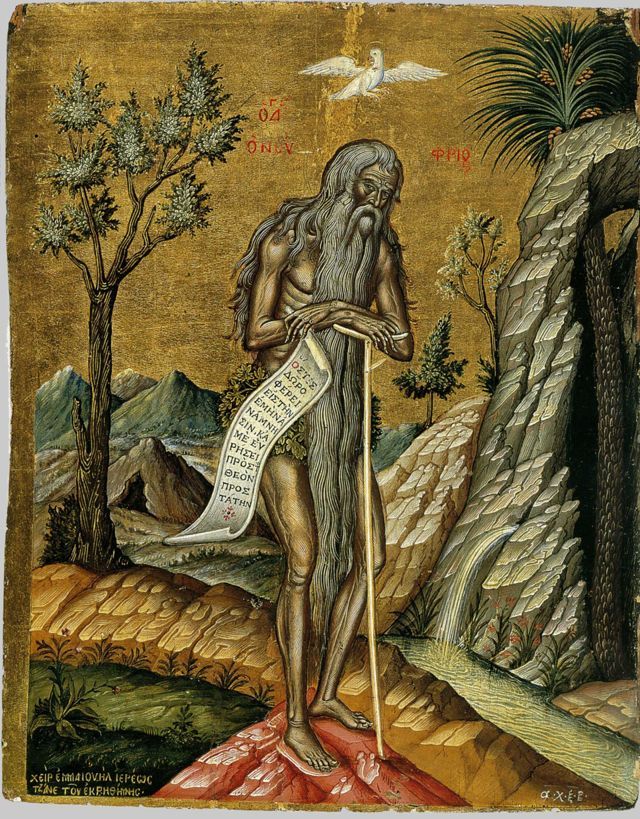
Fathers of the Desert, without the name of Paphnutius, not in the same words, yet relating the same incidents with slight variations. This is perhaps another of the accounts written by one of the monks of Paphnutius. And it is also possible that this is the basis of the “Peregri. nation," which is an amplification. There are so many improbabilities in the latter, that it is impossible to accept it as it stands.] Paphnutius, an abbot in Lower Egypt, went a pilgrimage into the desert to see how the hermits who lived in desolate places were serving God. And after many days* journey he found a cave in a barren and dry land, wherein lay a dead hermit, and he knew not his name. And when he touched him, he crumbled into dust, and his sheepskin that hung against the side of the cave, in like manner fell to dust on being handled. Then Paphnutius stripped off his own coat, and folded in it the bones of the ancient hermit, and scratched up the sand in the cave, and laid him there. After that he went further into the wilds and found a cave, and traces about it, as though it had been inhabited, but none was there. So he opened his psalter and waited. Now when the sun set, he saw a monk coming over the waste towards the cave, driving a herd of oxen. And when the monk opened his door and came in, and saw a man, he was aghast, thinking he beheld a spirit, and he stood still and prayed. But Paphnutius said, 44 Fear not, servant of Jesus Christ.” Then the hermit came in, and told Paphnutius his story, and why he was now alone in the wilderness. And after a while Paphnutius left him, and plunged deeper still into the desert, and after seventeen days he saw a man covered with hair, having only an apron of palm-leaves, and his aspect was so horrible, that Paphnutius thought he saw a satyr, and he ran up the side of a mountain. But the man called to him, 44 Come down to me, man of God, for I am a man also, dwelling in the desert for the love of God.” Then Paphnutius came down and fell at his feet, but the hermit raised him, and said, “ Arise, my son, lor thou also, I perceive, art a father of the saints.” Then the abbot arose, and the desert-dweller told him all his history. “ My name is Onuphrius, and I have spent sixty years in the wilderness, wandering among the rocks like a wild beast, and feeding on herbs and fruit" Then he said how he had been a monk in the Thebaid [the desert region of Upper (southern) Egypt], but, had left the monastery, because he longed to be alone with God, and far away in the desert he found an old hermit who instructed him in the rudiments of the eremitical life, and after that they separated, and met only once a year till the old hermit who had instructed him died. Then Paphnutius asked Onuphrius how he managed about communicating on every Sabbath and Lord's Day. The old man told him that an angel came through the desert on the last day of the week, and also on the first day, to give the Blessed Sacrament to the dwellers in the remote solitudes.
Then Paphnutius and Onuphrius ate together in the cell of the latter, which was shaded by a large date-palm, and they prayed together till late, and then slept. Now when they rose in the morning Paphnutius saw that a change had eome over the countenance of Onuphrius, and that he was evidently dying. The old hermit, noticing his anxious looks, said, “Fear not I am going the way of all flesh, and God has sent thee hither to bury me." Then followed a conversation, which is curious, and which even if not authentic, yet exhibits the belief of the early Christians in the invocation and intercession of the saints.
Onuphrius said, “ Do thou, my brother, when thou returnest to Egypt, call for a memorial of me like incense, in the midst of the brethren and of the whole Christian people. For if any one in my name, and in memorial of Jnneia.] vS*. OllUphriuS. 1 53 me, shall offer aught to the Lord our God, he shall be numbered among the elect, and shall be released from temptation. This is what I have besought of the Lord. And if any one shall give food to one of the brethren, or to a beggar, in my name, I will be mindful of that man before our God in the day of judgment, and he will enter into eternal life.”
Then said Paphnutius, “But what if a poor man have nothing to offer, or have food wherewith to feed a beggar, in thy name, will he be without thy benediction ?” Onuphrius answered, “ If any one shall offer incense in my name to the Lord, he will receive the same advantage.” Paphnutius said, “ But if he be too poor to provide incense ?”
Then Onuphrius made answer, “If there be any too poor to offer incense, or make any oblation, then let him anse and pour forth his prayer to the Almighty God, and let him recite the holy creed in memorial of me, and I will be mindful of that man, and I will pray for him, that he may inherit eternal blessedness.”
Then said Paphnutius, “ Would that when thou art dead I might tarry here, in thy cell after thee.” But Onuphrius answered, “ That may not be, thy work is in Egypt with thy brethren. Return therefore thither and tarry there till God doth call thee.” Then Paphnutius fell at his feet and said, “ Bless me, O father, that I may obtain mercy of the Lord, and that as I have been found worthy to entreat thee here, so may I be worthy to do so in future.”
And Onuphrius blessed him, saying, “ Dear brother Paphnutius, the Lord my God will not forsake thee, because of thy petition, but will bless thee and confirm thee in His love, He will enlighten thine eyes, that thou mayest see His goodness; He will deliver thee from all [June in.
the snares and assaults of the devil, and will finish in thee the good work that thou hast begun. May His angels protect thee in the terrible day of the Lord 1” And then the old man knelt down and said, “Into Thy hands, O Lord, I commend my spirit, ” and he bowed his face to the ground, and was dead.
But when Paphnutius saw that he was dead, he took off the tunic he had upon him, and tore it in half, and with half he clothed the dead hermit, and he made a grave, and buried him. And lo 1 the date palm drooped and died also. So Paphnutius knew that it was God's will that he should leave that spot, and he returned into Egypt, and told what he had seen.
S. CUNERA (date uncertain.) [Venerated in the diocese of Utrecht. Molanus [a 16th-century Flemish scholar who edited saints’ calendars] in his additions to Usuardus [a 9th-century monk of Paris who compiled a list of saints for each day]. Cologne and Lubek Martyrologies, Saussaye in his Gallican Martyrology, &c. Authorities The legend of S. Cun era in the lessons for the church at Rhenen, and other versions, all founded on popular tradition, and all utterly worthless.] The legend of S. Cunera is a wonderful combination of improbabilities and impossibilities, and it is not practicable for any one to say what a foundation of truth may underlie the fabulous character which the story now presents. According to the household tale which was adopted as lecdohs for the festival at Rhenen, “ there is a certain part of Europe, according to Isidore, called the Orcades, consisting of thirty-three islands, which were governed by a king of Orkney, but now by the king of England, in which land is a great royal city, anciently called Orcada, but now Jork (York?)" In this city reigned King Aurelius, who marched at the head of his armies in Jane ia.] 6*. Cunera, crusade against the Saracens [medieval Christian name for Arab and Muslim peoples], but was taken captive, and was carried before the Soldan of Babylon, and imprisoned. But the Soldan’s daughter loved the pale-faced prisoner, and was converted by him and baptized, and then she let him out of prison, and they eloped together to Orkney, and in the capital, Jork, Cunera, their daughter, was born.
Before her birth a Jewish astrologer predicted that the child would be a paragon of virtue, and the astrologer’s wife having made advances towards King Aurelius, which he indignantly rejected, Aurelius also merited to become a saint, and “ is now illustrious through his miracles.” S. Ursula, the British princess, being about to sail with her eleven thousand virgins (Oct 21st), S. Cunera joined her. On the return of the illustrious pilgrims, the whole party was massacred by the Huns [nomadic invaders from Central Asia, led in the 5th century by Attila], but Radbod, king of the Frisians, the great foe of Pepin ot Hestall, happening to be present at Cologne at the time of the massacre, was so struck with the beauty of Cunera, that he hid her under his mantle, and carried her off with him to Rhenen, his capital, on the Rhine, in the diocese of Utrecht But the wife of Radbod was by no means pleased at her husband having thus rescued a young and beautiful girl, and brought her into the palace, and she got one of her attendants to strangle her, and bury Cunera in the stable. But a bright light shone above the grave, and the horses positively refused to enter the stable, and thus the sanctity of the Virgin Cunera was made manifest to alL It is not necessary to expose the absurd anachronisms of this story. Radbod died in 719, the first crusade was in 1096, S. Ursula is generally supposed to have been martyred in the Hunish invasion of 451. Probably the foundation of the legend is the murder of a girl by her mistress out of jealousy, some time in the Middle Ages. [June xa.