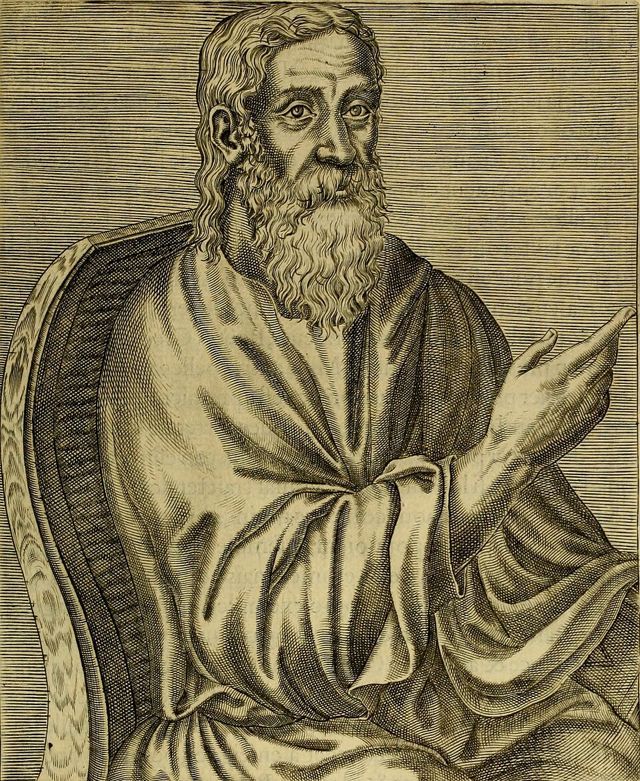
Bishop of Salisbury, died 1099; his feast is kept on 4 December. Osmund held an exalted position in Normandy, his native land, and according to a late fifteenth-century document was the son of Henry, Count of Séez, and Isabella, daughter of Robert, Duke of Normandy, who was the father of William the Conqueror (Sarum Charters, 373). With his uncle, the king, he came over to England, proved a trusty counsellor, and was made chancellor of the realm. The same document calls him Earl of Dorset. He was employed in many civil transactions and was engaged as one of the chief commissioners for drawing up the Domesday Book. He became Bishop of Sarum, virtually William's choice, by authority of Gregory VII and was consecrated by Lanfranc in 1078. This diocese comprised the Counties of Dorsetshire, Wiltshire, and Berkshire, for in 1058 the old Bishoprics of Sherborne and Ramsbury had been united under Bishop Hermann and the see transferred to Old Sarum. This is described as a fortress rather than a city, placed on a high hill, surrounded by a massive wall ("Gest. Pontif.", 183) and Peter le Blois refers to the Castle and Church as "the ark of God shut up in the temple of Baal". In 1086 Osmund was present at the Great Gemot held at Old Sarum when the Domesday Book was accepted and the great landowners swore fealty to the sovereign (see Freeman, "Norman Conquest"). He died in the night of 3 Dec., 1099, and was succeeded, after the see had been vacant for eight years, by Roger, a crafty and time-serving statesman. His remains were buried at Old Sarum, translated to New Salisbury on 23 July, 1457, and deposited in the Lady Chapel where his sumptuous shrine was destroyed under Henry VIII. A flat slab with the simple inscription MXCIX has lain in various parts of the cathedral. In 1644 it was in the middle of the Lady Chapel. It is now under the eastern-most arch on the south side.
Osmund's work was threefold: — (1) The building of the cathedral at Old Sarum, which was consecrated on 5 April, 1092. Five days afterwards a thunderstorm entirely destroyed the roof and greatly damaged the whole fabric. (2) The constitution of a cathedral body. This was framed on the usual Norman model, with dean, precentor, chancellor, and treasurer, whose duties were exactly defined, some thirty-two canons, a subdean, and succentor. All save the last two were bound to residence. These canons were "secular", each living in his own house. Their duties were to be special companions and advisers of the bishop, to carry out with fitting solemnity the full round of liturgical services and to do missionary work in the surrounding districts. There was formed a school for clergy of which the chancellor was the head. The cathedral was thoroughly constituted "the Mother Church" of the diocese, "a city set on a hill". Osmund's canons were renowned for their musical talent and their zeal for learning, and had great influence on the foundation of other cathedral bodies. (3) The formation of the "Sarum Use". In St. Osmund's day there were many other "Uses" (those of York, Hereford, Bangor, and Lincoln remained) and other customs peculiar to local churches, and the number was increased by the influx of Normans under William. Osmund invented or introduced little himself, though the Sarum rite had some peculiarities distinct from that of other churches. He made selections of the practices he saw round him and arranged the offices and services. Intended primarily for his own diocese, the Ordinal of Osmund, regulating the Divine Office, Mass, and Calendar, was used, within a hundred years, almost throughout England, Wales, and Ireland, and was introduced into Scotland about 1250. The unifying influence of the Norman Conquest made its spread more easy. It held general approval until in Mary's reign so many clergy obtained particular licences from Cardinal Pole to say the Roman Breviary that this became universally received. The "Register of St. Osmund" is a collection of documents without any chronological arrangement, gathered together after his time, divided roughly into two parts: the "Consuetudinary" (Rolls Series, 1-185, and in Rock, vol. III, 1-110), styled "De Officiis Ecclesiasticis", and a series of documents and charters, all more or less bearing on the construction of the cathedral at Old Sarum, the foundation of the cathedral body, the treasures belonging to it, and the history of dependent churches. The existing "Consuetudinary" was taken from an older copy, re-arranged with additions and modifications and ready probably when Richard Poore consecrated the cathedral at New Salisbury in 1225. A copy, almost verbatim the same as this, was taken from the older book for the use of St. Patrick's, Dublin, which was erected into a cathedral and modelled on the church at Sarum by Henry de Loundres who was bishop from 1213-28. This is given by Todd in the British Magazine (vols. xxx and xxxi).
William of Malmesbury in summing up Osmund's character says he was "so eminent for chastity that common fame would itself blush to speak otherwise than truthfully concerning his virtue. Stern he might appear to penitents, but not more severe to them than to himself. Free from ambition, he neither imprudently wasted his own substance, nor sought the wealth of others" (Gest. Pontif., 184). He gathered together a good library for his canons and even as a bishop did not disdain to transcribe and bind books himself. At one time Osmund thought Archbishop Anselm too unyielding and needlessly scrupulous in the dispute concerning investitures and in 1095 at the Council of Rockingham favoured the king. But after the Lateran [St. John Lateran, the pope’s cathedral in Rome] Council in 1099, he boldly sided with the archbishop and the beautiful anecdote is related, showing his simple sincerity, how when Anselm was on his way to Windsor, Osmund knelt before him and received his forgiveness. He had a great reverence for St. Aldhelm who 300 years before as Bishop of Sherborne had been Osmund's predecessor. He officiated at the saint's translation to a more fitting shrine at Malmesbury and helped Lanfranc to obtain his canonization. Abbot Warin gave him a bone of the left arm of St. Aldhelm which he kept at Sarum where miracles were wrought. In 1228 the Bishop of Sarum and the canons applied to Gregory IX for Osmund's canonization but not until some 200 years afterwards on 1 Jan., 1457, was the Bull issued by Callistus III. In 1472 a special indulgence was granted by Sixtus IV for a visit to his cathedral on his festival and a convocation held in St. Paul's in 1481 fixed 4 December as the day to commemorate him.
Read the rest of the article
Acta SS., Jan., I; ROCK, Church of Our Fathers (London, 1853); JONES, Register of St. Osmund (Rolls Series, 1883 and 1884), with long and good introductions to each vol.; Sarum Charters and Documents (Rolls Series, London, 1891); MALMESBURY, Gesta Pontif. (Rolls Series), 95, 183-4, 424-429; IDEM, Gesta Regum; BUTLER, Lives, s.v. (London, 1833); EADMER, Hist. Novorum, I and II, in P.L., CLIX; CEILLIER, Auteurs sacres, s.v. (Paris, 1863). For the saint's canonization see WILKINS, Concilia (London, 1737), I, 561; III, 432, 613; BEKYNTON, Correspondence, I, 117 (Rolls Series).