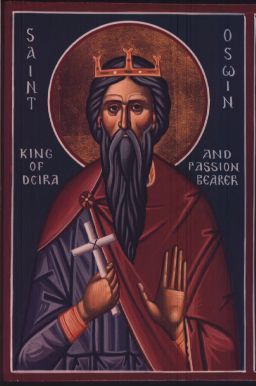
Baring-Gould’s sources: Anciently venerated in Northumbria. Authorities: — John of Tynemouth's Acts of S. Oswin; mention by Bede, H. E. iii. 14; Vita Oswini in the publications of the Surtees Society, 1838. The following is, for the most part, from Montalembert's Monies of the West.] the death of S. Oswald, Northumbria fell a prey, first to the ravages of Mercian invasion, then to the complications and weakness of a divided succession. Like the Merovingian, and even the Carolingian Franks, the Anglo-Saxons, and particularly the Angles of Northumbria, could not resist the inclination which led them to accept or incite the division of a kingdom among several princes, as soon as there appeared several heirs of a deceased king. Oswald left a son in childhood, whose claims were not at that moment taken into consideration. His brother Oswy, still in the flower of his youth, at once took his place in Bernicia — that is to say, in the northern part of Northumbria. As for Deira, it fell to a prince of the Deirian dynasty, grand nephew to Ella, the founder of that race. Osric, after a short reign, had fallen S. Oswin.
…by the sword of Cadwallon’s Britons. His son, called Oswin, had been saved while yet a child by his friends, and sent out of Northumbria [the Anglo-Saxon kingdom of northern England and south-east Scotland], and had passed his youth in exile, like Edwin, and the two brothers Oswald and Oswy. But on hearing of the death of Oswald, Oswin returned to Deira, and claimed his right of succession. The old subjects of his father, Osric, and his great uncle, Ella, received him gladly. The principal nobles met in assembly (a.d. 642), acknowledged his hereditary right, and proclaimed him King of the Deirians, and for seven years he governed them to the satisfaction of all. He was still very young, of lofty stature, endowed with remarkable comeliness and grace — a matter of no small importance in an age and among a people extremely sensible to external advantages. But he had, in addition, all the virtues which were then regarded as proofs of sanctity. His extreme gentleness, his charity, and, above all, his humility, were universally extolled. He was, moreover, so accessible, so courteous and generous, that the noble lords of all Northumbria vied with each other in seeking the honour of serving among those officers of his household whom the Latin historians designate in England, as elsewhere, by the name of “ ministrales.” Although Oswin had been exiled among the Saxons of Wessex [the Anglo-Saxon kingdom of southern England], and not in Scotland, like his cousins and rivals, Oswald and Oswy, he was already a Christian when he returned to Northumbria, and did not hesitate to recognise the episcopal authority of S. Aidan [Irish monk, founder of Lindisfarne (d. 651)], emanating from the Celtic ecclesiastical metropolis of Iona. During his whole reign, this monk of Iona, now Bishop of Lindisfame, continued to labour in the two kingdoms which formed his vast diocese. It was his special pleasure, when in Deira, to rest under the hospitable roof of the young Oswin, with whom he always lived in as tender and thorough a union as that which had united him to Oswald.
An oft-repeated anecdote, which reveals at once the pleasant intimacy of their relations, and the noble delicacy of their minds, has been left to us by Bede [English monk and historian (d. 735)]. Aidan performed all his apostolic journeys on foot, but it was the king’s wish that he should have at least one horse to cross the rivers, or for other special emergencies; he gave him accordingly his best steed, splendidly caparisoned. The bishop accepted it, and made use of it, but being, as Bede calls him, “ the father and the worshipper of the poor,’' it happened ere long that, meeting a man who asked alms, he leaped down from his royal charger, and gave it, harnessed, as it was, to the beggar. The king, being informed of this, said to Aidan, as they were going to dinner together, “ Good bishop, what do you mean by giving my horse to that beggar?” “What is this you ask?” replied Aidan. “Oh. king, the horse, which is the son of a mare, is it more precious than the man who is a son of God ?” As he said this they entered the banqueting-hall. Oswin, who had just returned from the chase, approached the fire with his officers, before sitting down at the table, and while he warmed himself, thought over the words of the bishop; then, all at once, taking off his sword, he threw himself at the feet of the saint and implored his pardon. “No more,” said he, “shall I regret anything of mine that is given away to the children of God.” The words, those few little words, of Aidan, had opened up a new train of ideas in the king’s mind; in one moment he had learned, what it has taken Christian Europe centuries to learn, that the life and welfare of every Christian man, poor and simple, as well as noble and learned, is most precious. As they sat down to dinner after this touching scene, the king was bright and joyous; but the clerks of Aidan saw the tears slowly stealing down the old bishop’s furrowed cheeks. “ Why so sad ?” asked a priest in the Celtic tongue, which Oswin and his nobles did not under.S'. Oswin.
stand. “ I know that this young king cannot live long,” answered Aidan in the same language, “ for never until now have I seen a king so humble, and this turbulent people is not worthy of so gentle a prince.1' The sad foreboding of the saint was realized only too soon. There rose in the heart of Oswy of Bernicia a jealous animosity towards the young king, which ripened into civil war. After seven years of union between the two kings of Bernicia and Deira, occasions of estrangement, ever increasing, began to arise between them. These were owing, it cannot be doubted, to the preference which was shown by many of the Northumbrian nobles for the service of Oswin. Oswy marched against the Deirians. Oswin likewise put himself at the head of his army; but it was much less numerous than that of the King of Bernicia, which was swelled by numerous auxiliaries. Oswin found that he could not possibly oppose an effectual resistance to the invader; that to meet him would be to deliver up his faithful followers to massacre. He therefore disbanded his army at “ WilfarV dun, wlhcfi is almost ten miles to the north-west from Catterick.”1 He himself took refuge with one trusty soldier, named Tondhere, in the castle of Gilling, the habitation of Earl Hunwald, on whom he had conferred much land and whom he trusted as faithful. Hunwald basely betrayed the place of his retreat to Oswy, who sent his officer, Ethelwin, to Gilling, with orders to put the young king and his followers to death. Oswin entreated that his companion Tondhere might be spared, but the gallant soldier chose to die with his master.
The king and his knight thus perished together, on the 20th of August, a.d. 651; and twelve days afterwards Bishop Aidan followed the king he loved to the tomb- The body of Aidan was carried to his monastic cathedral of Lindis1 The position cannot now be fixed.
fame; but that of his royal friend Oswin was deposited in a chapel dedicated to the Blessed Virgin, at Tynemouth. Some years later, on the very spot where Oswin had perished, at Gilling, near Richmond, a monastery was reared in expiation of so foul a crime, by the wife of his murderer. This was none other than Eanfleda, daughter of King Edwin, she whose birth had contributed to the conversion of her father, who had been the first-born of Christ in the Northumbrian kingdom, and who, after the overthrow of Edwin and the Roman mission in the north, had been carried in her cradle by Bishop Paulinus into the country of her mother, Ethelburga, daughter of the first Christian King of Kent.