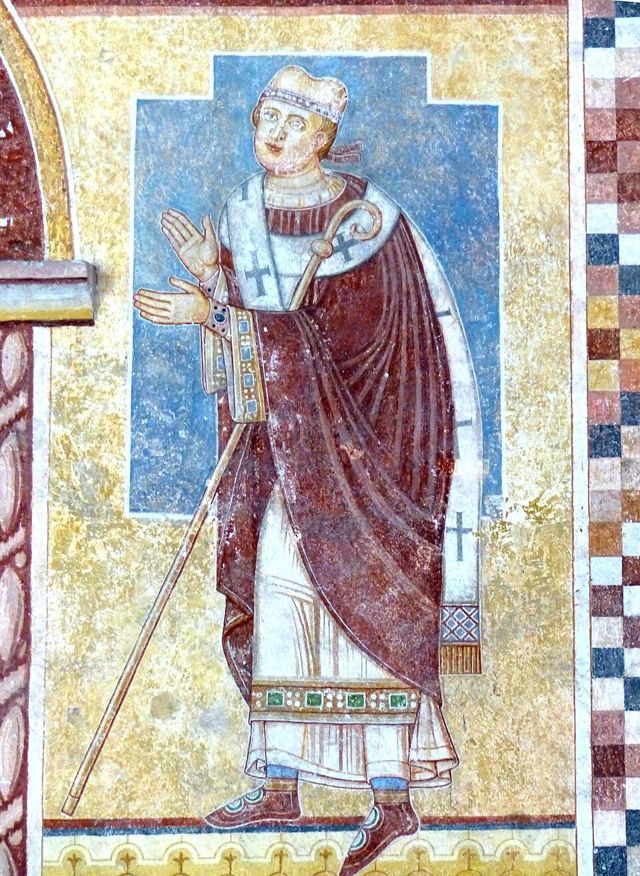
Baring-Gould’s sources: Canonized by Clement III. in 1189. Romin and German Martyrologies. Authorities: — A life by an anonymous contemporary writer. Another life, by an anonymous writer of Prieflingen, before 1x58. I his life is made up of the two to which we are about to allude, by Ebbo and Herbord, with additions by the author, who was a younger contemporary of the bishop. A third life by Ebbo from personal acquaintance with S. Otto, written between 1x47 and 1157. A fourth life by Herbord, written between 1147 and 1157, which has been lately discovered by Giesbrecht at Munich, and published in the 20th vol. of the “ Monumenta Germanise Hist.,’’ by K5phe. It was previously believed to exist only in extracts. A fifth life by Andrew, abbot of S. Michael, near Bambexg (1483 — 1502), compiled from the biographies of Ebbo, Herbord, and two others, Sifried and Tiemo, who were contemporaries and friends of S. Otto, in a Dialogue. The first life is probably a contraction from that of Sifried.] Otto v or Otho, the subject of this memoir 9 was the second son of noble but somewhat obscure parents, in Swabia. Later writers have confidently affirmed that he was the son of Berthold, count of Andechs, and of Sophia, duchess of Ambrerthal, his wife, and therefore of royal connexion. There is, however, no foundation whatever for this assertion, which is in clear contradiction to the words of the contemporary who condensed the dialogue of Sifried. 1 On account of their poverty, the parents of Otto were unable to do more for him than put him to school, and on their death, his brother Frederick was incapable of supporting him. Consequently Otto was left early to provide for himself, 8 and hearing that there was a demand for school-masters in Poland, he went thither, and opened a school for boys, which was well filled, and Otto himself became renowned in the duchy for his learning; acquired a competence, and a knowledge of the Polish language.
After some years spent in Poland, Judith, the wife of Wladislas, duke of Poland, died (a.d. 1086), and in the following year (1087), Wladislas sent Otto with a deputation to the Emperor Henry IV. to solicit the hand of his sister Sophia, widow of Solomon, king of Hungary, and daughter of the Emperor Henry III. His mission was successful, and in 1088, Wladislas married Sophia, and Otto was constituted their chaplain. When, and under what circumstances, Otto returned to Germany is obscure, 1 Sifrid says. “ Pa rentes gas. patrem dico et mat rein, ingennae condition!*, nobilitate clari et bonorabiks, in dhritiis autem et opibus mediocre*.'* Words quite inapplicable to the illustrious house of the counts of Andechs. Again, when the e m pe ror announced to the deputation of Bamberg, that Otto was to be their bishop, they exclaimed, “ Spcrabimns aliqnem ex domini et principibus curls nostra parnoUrtuaa, ac nobis notum, Uominatorum nos acccpturos: nam hunc, qut* sit. aut unde sit, ignoramus** whether he was sent to Henry IV. by Sophia, or whether he left the Polish court on the death of the princess, is uncertain. At any rate, after a few years, he appears at the side of Henry IV. as his chaplain and confidant, probably Henry IV. was still under the excommunication fulminated by Gregory the Seventh, and repeated by Urban II. Urban was at this time busy in endeavours to break up the power of his great antagonist in Germany and Italy. At his persuasion, and to further his political schemes, the pliant Countess Mathilda had, at the age of forty-three, married a boy of eighteen, the son of the duke of Bavaria, and thus had secured an alliance in Germany itself, formidable to the redoubted and abhorred emperor. Urban found a more useful ally in the bosom of the king's own family. Conrad, the eldest son of the old emperor, rose in revolt against him. Henry, desiring to obtain for his son the rich inheritance of his grandmother, Adelhaid of Susa, had conducted him into Italy. There the great enemies of the emperor held out to the unnatural son a more tempting prize — the immediate possession of the kingdom of Italy.
But an excuse for the revolt must be found. Conrad's tempters sought reasons so monstrous that none could credit them whose minds were not prepared to receive it by blind and deadly hatred; one at least, was utterly inconsistent with the conduct of the emperor. One is too horrible to be mentioned here, another was that Henry had threatened to declare Conrad a bastard, and thus insult the memory of his mother Bertha, that memory which Henry cherished with tender reverence to the close of his life.
When the news of his son's revolt, and the nature of the charges assigned to excuse it, reached Henry's JoJj M.J S. Otto.
ears, he was confounded, horror-struck, and broken in heart Conrad stifled the reproaches of his conscience by marrying Iolante, daughter of Roger of Sicily, who had been promised to him, together with the crown of Italy, as the reward of his revolt His coronation took place at Milan. But he perhaps felt that the general voice of humanity would protest against this rebellion, unless the charges against the emperor were in some sort substantiated. For this purpose— not satisfied with having excited his son to revolt, the enemies of Henry prevailed on his wife, publicly, shamelessly, to denounce him.
After the death of his faithful and beloved wife Bertha, Henry had married Praxedes, or Adehaid, a Russian princess, the widow of the marquis of Brandenburg (1089). From some unexplained reason, the emperor threw her into prison. Was it because she was mad or dissolute, or was it out of wanton dislike to the woman ? This is one of those insoluble mysteries history is unable to unraveL From prison she escaped to the duke of Bavaria, Henry's bitterest foe. In his court deep, unscrupulous schemes were formed for the ruin of Henry.
And now a council was summoned at Constance by Gebhardt, the bishop, Urban's legate [an official representative sent by the pope] in Germany (1094), at which the unfortunate empress appeared, and poured forth a string of charges against her husband. But sufficient publicity had not been secured thereby, and she was brought, or hurried of her own accord, into Italy to denounce the emperor before a crowded council at Piacenza, in 1395. Enormous multitudes, bishops and abbots from Italy, France, Bavaria, Burgundy, and most parts of Germany, were present to consult with Urban on his great design of a crusade.
It is said that there were present three thousand clergy, Lives df the Saints. and thirty thousand laymen. This was deemed a suitable occasion for marshalling the wife in witness against her husband. The question forces itself i pon the mind — was there any truth in that horrible story that flowed so glibly from the lips of the passionate empress before the council ? Or was it only the malignant slander of a furious, disappointed woman, whose Russian, half-savage vices had forced Henry to restrain her in confinement ? Henry sent no reply to the charges made against him by his wife. If he were guilty he could not, if he were innocent, he disdained to do so. Perhaps he was taken by surprise.
As there was neither reply nor defence from the emperor, the pope and the assembly united in the condemnation of an emperor whom the Church had reason to regard with abhorrence.
It has been necessary to sketch the condition of the emperor's affairs, the profound discouragement, despair, humiliation, to which he was subjected, that we may understand the position of S. Otto, his chaplain who clave to him, in spite of his excommunication, and ministered to him though denounced as a heretic and an outcast from God, by the occupant of the chair of S. Peter. By so doing he was involved in the excommunication which was comprehensive enough to embrace and blight all who adhered to, and ministered in sacred things to, the excommunicated emperor.
Otto consoled the unfortunate Henry under his severe afflictions. When his wife was exposing him, or certainly herself, to public shame, and his son was in armed and insolent rebellion against him, the emperor found consolation in private prayer, and in the singing of David's psalms. The latter especially proved his comfort Had not David fled before the face of his revolted son ? Otto r®ty ».i drew up for the king’s use a collection of “ psalms and hymns, chapters and prayers for the whole course of the year, that the king might commit them to memory,” and whenever he was with Henry, he had his psalter under his arm, ready to say the sacred offices with him, “ Otto discreetly thinking that nothing should be omitted, whereby he might conciliate the favour of his lord.” The contemporary biographer goes on to say, “ In those days the emperors were wont to give investiture of churches, and as often as a bishop died, it was customary for the church vacated by his death to send the staff and ring of the deceased prelate to the emperor, and to ask of the court a new bishop. Many nobles and great men, therefore, acquaintances, and sons of princes, came to court, in hope of promotion, performing in course the office of chaplain to the emperor. Amongst all these place-hunters, Otto conducted himself so composedly and evenly that he neither drew on himself envy through elation, nor contempt through meanness. At last one of these men, who had been chancellor, being elevated to the episcopate, Otto received the seal of the emperor, and undertook the office of chancellor, which he filled with such industry and goodness, that he was loved by all the court, and by all was deferred to.”
In 1102, Rupert, bishop of Bamberg, died, and the episcopal insignia were transmitted to the chancelry, together with the petition of the church of Bamberg, for a new pastor. But the emperor deferred to appoint for six months. At the end of that time he summoned to him the delegates of the church of Bamberg, and promised them a suitable bishop, promising to give him to them at the approaching feast of Christmas.
On the Sunday before the appointed day the clergy and people of Bamberg, with cross and banners, ascended vol. vn. 4 processionaUy the hill of S. Michael, which rises on the north-west of the cathedral, and is crowned by an abbey founded by Henry II., to obtain the intercession of the archangel and the heavenly host in behalf of the see, that it might be given a suitable prelate.
On Christmas Day, the deputies, consisting of the chief nobles and clergy of Bamberg, appeared before the emperor at Mainz. Henry received them courteously, and said, “ How great is our solicitude in behalf of your church ye may conclude from the fact that we have not hastily and inconsiderately imposed on you a pastor; but after much counsel and deliberation, delay, and careful inquisition. Nor is this marvellous, for your church was founded and endowed with farms and feudal lordships, and enriched and exalted by our kinsmen and ancestors, a thing we cannot assert of other churches, and all these things remain to it untouched and undiverted. Therefore, to such a church, a wise and provident, and not a haughty ruler is befitting. And such a bishop have we sought out for you.”
After further introduction, still without coming to the point, one of the delegates impatiently asked, “ Where, and who is our bishop ?”
“ He is here !” said Henry, catching the hand of Otto. Then all the delegates were aghast, and looked at each other, and cast down their eyes; and the nobles around who had coveted the see for themselves, or for their kinsmen, muttered and nodded, and excited the delegates to speak.
“ We had hoped,” said they, " that your majesty would have given us one of the nobles or princes, known to us, and related to us, as a ruler. But as for this man, we do not know who he is, or whence he comes.” Henry answered haughtily, “ Do you want to know who July *.] S. Otto.
he is? In faith, we are his father, and the church of Bamberg must be his mother. My word is passed, nor think to make me change it We have known this man for long, and have proved his probity, sagacity, patience, and diligence.”
Otto flung himself at the emperor’s feet, and burst into tears. In vain did he protest his poverty, his unworthiness to receive so high a dignity. “ Have you not, sire ! chaplains who are wise, noble and illustrious by birth, powerful and rich, whom such honours would become ?” “See,” said the emperor, “how full of ambition this man is. This is the third see that he refuses. Two have been already offered him, and he has passed them on to his comrades? What think you of him? We designed him for the bishopric of Augsburg, 1 but he thinking it fair that those who had preceded him in the care and anxieties of our court should first have their rest, refused to accept it It was the same with the bishopric of Halberstadt 2 Surely now, the church of Bamberg is divinely reserved to him.” Then he thrust the staff into the hand of Otto, and placed the ring on his finger, and the court with a shout saluted him bishop. The delegates of the church of Bamberg accepted him as their father and lord, and embraced him. Then Henry said, “Receive him with all reverence and honour; for I testify before Almighty God, who knows all things, that I know no mortal man whom I could trust to execute his duties more honestly and conscientiously. As long as I live, he who touches that man, touches the apple of my eye.”
It is deserving of note that Henry should have thus 1 This most have been on the death of Sigfrid II., In 1096. t!ie anti-bishop Hetrard died. Frederick I. had been appointed in 1090, and was deposed In 1105.
advanced a man of such integrity, nor is it a solitary instance; and it is calculated to make us mistrust the indiscriminate charge of veniality and recklessness laid against Henry IV. in his appointments to the German bishoprics. It is also curious to remark how Otto, by receiving the ring and staff from the emperor, again involved himself in the sentence of excommunication proclaimed by several popes against all who should by so doing acknowledge the imperial jurisdiction. But Otto was determined not to be wilfully and defiantly opposed to the pope; and he resolved on the first opportunity to hasten into Italy and make his submission to the pope. After forty days spent with the emperor, by order of Henry, the bishops of Augsburg and Wurzburg conducted Otto to Bamberg on the vigil of the Purification. On coming within sight of the towers and spires of the city, Otto leaped from his horse, took off his shoes, and walked barefoot through the snow to the church of S. George, where he was met by the clergy and people, and conducted with great pomp of banner, blare of trumpet, and chant of choir to the cathedral. The ceremony was necessarily long, the pace of the procession slow, and long the funct on in the minster, with cold stones under foot. Consequently the bishop’s feet were frost-bitten. Some servants, more willing than discreet, hasted to immerse them in hot water, but Otto, whose experiences of frost-bites in Poland served him in good stead, ordered cold water to be brought, and plunged his frozen feet into it A few days after, he sent messengers to Rome, with a letter soliciting the sanction of the pope to his appointment “Bowing my neck devoutly to you, most holy father, and to the holy Roman Church, our mother, I desire help and counsel in my affairs. In the service to S. Otto.
my lord, the emperor, I have passed certain years, and have found favour in his eyes, but holding suspect the investiture from the hand of the emperor, once and again, when offered a bishopric, have I declined it Now, for the third time, he has appointed me to a bishopric, that of Bamberg, but I will by no means retain it, unless it please your holiness to invest and consecrate me." When Pope Paschal received this letter, he was highly gratified, because at that time we are told by Sifried, “few of the German bishops deferred, as was proper, to their mother;" he therefore gladly overlooked the past, and invited Otto to Rome. Three years after, the bishop travelled into Italy, and on the feast of the Ascension (1106), met Pope Paschal at Anagni, and surrendered into his hands the staff and ring, to be re-invested by papal authority with what he had already received by imperial authority; and this was done on the ensuing feast of Pentecost The pope in reward for his obedience conferred on him the right of bearing the archiepiscopal pall and crosier four times in the year in addition to the four times in which every bishop of Bamberg claimed that right 1 Otto set to work in his diocese, building monasteries and in restoring his cathedral which had been burnt down in the days of his predecessor, so that only the walls were standing. He relaid the floor, adorned the pillars with carved work, set up paintings, roofed the church throughout with copper tiles, and gilded the caps of the towers, and the crosses. The church of S. Michael, on the Michaelisberg, had been thrown down by an earthquake. He rebuilt it from the foundations.
Bamberg are thus represented with pall and crosier on their tombs In Bamberg Cathedral. [July a. A curious story is told by his contemporary biographer. The bishop went to the little church of Buchelbach to remove from the altar numerous relics [the bodily remains of a saint, or objects they used, kept with honor] which were inclosed in it, intending to translate them to a better place. He took with him his clergy, and after fasting and prayer, ordered some of them to break the leaded seal which fastened the locker in which were the relics. They hesitated, therefore Otto himself took the crow-bar and struck at the seal, whereupon the red wax under it oozed out on the altar like gouts of blood, and so frightened the bishop that he fainted away. On his recovery of his senses, scared at the thought of having possibly, but unintentionally, committed sacrilege, he fled to the Michaelsberg abbey, and implored his friend Wolfram, the abbot, to receive him as a monk, that he might escape the responsibilities and dangers of his episcopal office. The abbot, seeing him frightened, made him at once take the vow of obedience to him, and then said calmly, “On your obedience I enjoin on you to return to the discharge of your episcopal duties I” and he sent him back to the government of his see.
In 1125, Germany was visited with a pestilence and famine, the result of the wars which had so long devastated it, and destroyed the labours of the husbandman. Otto did all that lay in his power to relieve the starving, and comfort the sick, in his diocese. He was indefatigable in visiting all the streets, villages, cottages, hospitals, everywhere where there was suffering. One hot day, when his chaplain and servants were taking their afternoon slumber, Otto went out with his serving boy to one of the hospitals. On the way he stood still, and said, “ I smell something very offensive; go, boy, and look what is there ?” And he pointed in the direction whence the odour arose. The lad returned with white face, to say that a corpse half July a.J devoured by birds lay festering in a bed of nettles. The bishop went to the spot, and saw that the body was that of a dead woman, and was far advanced in putrefaction. “Take up the feet, and I will hold the head," said Otto, placing his hands under the shoulders.
The boy exclaimed, “ Let me run for help. Do not defile your sacred hands. ” “ God forbid I” answered the bishop. “ God forbid that touching a child of Adam, and a daughter of the Church, should be defilement 1"
The horrible state of the corpse was too much for the boy, and he turned away sick and faint. Then Otto, with an effort, threw the corpse over his back, “ with stopped nostrils, and face averted," and carried it to the cemetery, where he buried it; his attendant following with groans and exclamations at a distance behind.
The biographers of Otto have nothing to say of his conduct during the miserable years of strife which closed the career of Henry IV. Conrad had died. The consciousness of his weakness, and his remorse for his guilty conduct, brought him early to the grave, a.d. iioi. But in 1104, Henry, the youngest and most beloved son of the old emperor, was stimulated by those who had fomented the unnatural rebellion of Conrad, into following his example.
Henry IV. died an exile at Li£ge, in 1106, but the papal interdict clave to him in his grave, and he was exhumed, and lay unburied for five years, till the ban was removed, and his bones were laid to rest beside his faithful wife Bertha, at Spires.
Henry V., the rebel son, was not dutiful to the pontiff who had incited his revolt against his father. He marched to Rome to be crowned, but he stipulated that the right of investiture should be conceded to the emperor. Pope Paschal hesitated, but yielded at length. A treaty was solemnly agreed to on both sides with mutual and solemn protestations of sincerity. But neither was in earnest The pope could not reverse the proceedings of the former popes, and concede so important a point without a struggle, and Henry meditated the complete subjection of the Holy See to his despotic sway. Before a year had elapsed Paschal, complaining that it had been negotiated under constraint, annulled the treaty, and excommunicated the emperor.
This excommunication was at once a ready justification for the revolt of the great ecclesiastical vassals of the empire. Adalbert, archbishop of Mainz, Frederick, archbishop of Cologne, and nearly all the powerful princes of the German Church rose in arms against the emperor. Throughout this eventful period, Otto, noble-spirited, sharing none of the base passions which actuated either party, kept in dignified independence of both. To the king he rendered that allegiance and honour which he esteemed to be his due, whether excommunicated or not; and to the pope he also behaved with becoming respect. Join the malcontents in their revolt, even against a monarch under anathema, he would not, and his abstention called forth an angry letter from Frederick, archbishop of Cologne, 1 and another from the revolted Adalbert of Mainz, who had turned on his benefactor and friend. 8 In 1 1 14 the excommunicated emperor came to Bamberg to celebrate the festival of the Nativity of our Lord. He was dissatisfied with Otto for not openly taking his side in the struggle, but the bishop satisfied him, and the emperor departed admiring the suavity, the wise zeal, and the broad charity of the saintly prelate.
Ten years after, in 1124, Otto's attention was turned to 1 Ap. Gretzcr, “ Diri Bambergenscs,” xoit % p. 50a. * Ibid, p. 468. Pomerania, which had been conquered and annexed to Poland, over which now reigned Boleslas III., whom he had known as a little child in the court of his father Wladislas. Pomerania had remained heathen till that day. Boleslas conquered it with difficulty, in 1121, and with great effusion of blood. If we may believe the chronicler, he killed 18,000 men, and dispersed 8,000 men, women, and children, among the towns of his kingdom, where they remained as captives. Upon the miserable remainder he imposed submission and Christianity. The king had recourse at once to the friend and guide of his youth, and wrote a letter to S. Otto urging him to visit Pomerania, and establish there the foundations of the Church.
An attempt had already been made, but it had proved unsuccessful In 1122, a Spanish priest named Bernard, who had been consecrated bishop at Rome, appeared at the court of Boleslas, and requested permission to essay the conversion of Pomerania. The duke did not conceal from his visitor the difficulties of the undertaking; but Bernard, though unacquainted with the Pomeranian tongue, resolved on making the attempt Accompanied by his chaplain, and an interpreter provided by the duke, he repaired to the town of Julin (Wollin), barefooted, and in the garb of a mendicant The Pomeranians — an easy, merry, well-conditioned race, honest as the day, and warmly hospitable 1 — were accustomed to see their priests present a magnificent appearance, and they regarded the missionary with profound disdain. When he asserted that he had come as the messenger of God, they asked how “it was possible to believe that the great Lord of the world, glorious in power, and rich in all resources, would send his messenger in such ' Hcrbordi *' Vita Othonis,” ii. p. 40, ap. Pertz. rol. xii. 58 Lives oj the Saints. [Ny«.
despicable garb, without even shoes on his feet If He had really desired their conversion, He would surely have sent a more suitable and dignified envoy. As for Bernard, he was an impostor, who pretended to have a mission, that he might live on alms.” Bernard replied by proposing, if they would not believe his words, that a ruinous house should be set on fire, and he himself flung into the midst. “If, while the house is consumed, I come forth unscathed,” said he, “then believe that I am sent to you by Him whom fire and all other created matter obeys.” The Pomeranians, convinced that he was mad, urged him to leave the place; but, instead of heeding the advice, Bernard struck down one of the sacred images, on which a riot ensued, and he was hurried from the place, with the advice, since he was so eager to preach, to exercise his talents on the fishes and fowls. Bernard retired to Bamberg, and there met with S. Otto. About the same time came the letter from Boleslas.
S. Otto could not refuse to respond to this call, though he was now a white-haired man. He called a synod of his clergy, obtained the sanction of Pope Honorius, and started, travelling through Bohemia into Poland. At Gnesen he was cordially received by the duke, or king, Boleslas, and by the clergy.
Boleslas provided the bishop with provisions for his journey, and servants who spoke Sclavonic and German, baggage wagons, horses, and money of the country, three of his chaplains, and last, but not least, a certain officer (centurio), named Paulitius, “a man sturdy, and right Catholic, and with a natural flow of words, so as to be apt to preach to the people.”
Thus furnished, the bishop and his party set forth on their way to Pomerania. Sifried, the biographer of the saint, was of the party; and the narrative assumes a more lively and minute character. Pomerania was separated from Poland by a vast belt of forest, rarely traversed, but Sifried says, never, till a few years before, when Boleslas entered it with his troops to chastise some robbers who had taken refuge under its green arches. The duke had cut down trees, or marked them with the hatchet on the line of his march. Following the track and the scorings on the trees, the bishop and his party crept on in perpetual twilight, scared by the serpents which rustled in the grass, and the innumerable storks which nested in the trees, and disturbed the travellers with their chatter. Ever and anon the baggage horses floundered in swamps, and the waggons sank, and had to be extracted with combined exertions. After six days the party reached the banks of the river Netz, which formed the confines of Pomerania. In the meantime the duke of Pomerania, warned of their arrival, came to the opposite bank with five hundred men, and crossing the river, saluted the bishop, and was saluted in turn by him. He was a Christian at heart, but not openly, because he feared his people, who were all heathen. The duke and the bishop walked off, accompanied by Paulitius, as interpreter, to converse in private, leaving the clerks with the barbarian followers of the duke, who amused themselves with scaring the unfortunate missionaries nearly out of their lives. Sifried gives an amusing and graphic account of the agonies of terror which they — he being one of them — endured.
“The barbarians who had come with the duke, seeing the clergy somewhat frightened, began to harass them with feigned acts to heighten their terror, so that they, thinking their martyrdom was at hand, commended their last hour to the Lord with mutual confession, and with prayers and psalms. For now, for the first time, they saw these pagans, and they knew not in what mood the duke had come. But the horror of the vast wilderness, the unwonted situation, the black density of the forest just left, the approaching darkness, and the frightful appearance of these barbarous men, occasioned them no small amount of terror.”
Besides, these pagans, drawing forth very sharp knives, began sportively to threaten the clerks with skinning, or with stabbing, or they pretended to be about to bury them up to their heads, and to prick and slash their shaven crowns, and to inflict other and varied tortures; then they rushed on them with howls and screeches, so that they were scared beyond measure. But after a while the missionaries breathed freely, when the duke, seeing they were frightened to deathly paleness, revived them with benignant consolation, and bade them take what had occurred as a joke; and the poor clerks recovering their spirits began to preach boldly to those men whom, a few moments before “from terror they had not dared look at.” 1 The bishop then opened his baggage, and produced some presents, chief among which was an ivory walking stick, which he offered to the duke, who immediately, highly delighted, began to march up and down with it, 3 and whisking it before the eyes of his followers, said, “See what a father God has given to us, and what presents he makes 1”
Then the duke retired, leaving a few of his men to serve as guard to the visitors. On the following day the bishop and his party crossed the river, and began their journey to Pyritz, through a country devastated by war, with scarce an inhabitant, and only the ashes of homesteads where inhabitants had been. 1 It is amusing to observe how in the narrative Sifrled, who has been speaking of the journey in the first person plural, suddenly changes here to the third) It is “they '* were frightened, it is **we’* who preached and baptized. 1 “Ipso incurebens, gratulabumlus hue illucque ambulat.” July a.] S. OttO. 6l The few wretched creatures who clung to their ruined habitations, on being asked if they would become Christians, cast themselves tearfully at the feet of the bishop, and besought baptism, and this was readily accorded to about thirty of them, after brief instruction in the Creed and the Decalogue.
The party drew near to Pyritz in the evening of the seventh day, and saw that the sandy plains and shores of the lake were thronged with barbarians, who had assembled to celebrate a great heathen festival with song and game. Their howled-out chants startled the advancing missionaries, and the bishop deemed it prudent not to adventure himself and his companions among the pagans in the hour of jubilation and heathen revel. Accordingly the party drew up at a safe distance, under the shadow of trees, and spent a sleepless night, without daring to kindle a fire, or speak above a whisper. 1 Next morning the interpreter, Paulitius, was sent to the duke, together with an embassy from the duke of Poland. Paulitius seized the opportunity to give rein to his natural flow of speech, and preach to the duke and his court, exhorting them at once to believe and be baptized. They replied that the matter was too serious to be despatched off-hand.* The interpreter thereupon warned them that to reject his preaching might lead to disastrous consequences, and significantly pointed to the traces of havoc left by the recent war. 5 “ Indeed,” said he, “ the bishop arrived last night, but when he heard you were occupied with games and merriment, he declined to enter, and fixed verbis apertioribus ad invicem loqui praesumpserunt.” the whole of the universe was Christian with the sole exception of the Pomeranian people.
his tents in the plain outside. And now it becomes your prudence not to keep him too long waiting, lest haply the duke should find cause of complaint therein.” “ Very well,” said Wratislas, who perfectly comprehended the hint, “ what we must do, let us do it with alacrity and of our own accord. 1 Our Gods seem to be worth very little, as they did not help us lately; and as they deserted us in our hour of need, let us desert them now, and adopt a God who does not desert those who trust in Him.” This was all that could be desired, and the duke promised to agitate the matter amongst the people, whilst the interpreter and the deputies returned to the bishop and invited him into the town. At once the waggon and the whole convoy was set in motion, and approached Pyritz. The people remaining after the festival of the previous day swarmed to meet them, but when they saw “the four-wheeled chariots, the waggons, and the carts bearing their goods, the cattle also, and the numbers who accompanied them,” they began to fear, thinking it was an army on the march to chastise them again. But the duke bade them not fear; and the poor people, relieved of their terror, surrounded the advancing convoy, running alongside of the carts, wondering, examining everything, and chattering in their unintelligible jargon. On reaching the centre of the town, the bishop found a square before the ducal castle, apt for an encampment. He therefore unfurled his tents, the kindly heathen lending a helping hand with the tent pegs and guys. Then the bishop robed in his tent, and stepped forth in all the magnificence of jewelled mitre and cope, before the people, and ascending some rising ground, thus addressed them. “The blessing of the Lord be upon you, blessed are ye of the Lord. Let us bless and thank you all in the 1 “ Faciamns sponte et al acres, quod factor! snmos." July i.J name of the Lord, for you have received us very warmly, jocundly, and well. Now the reason of our coming here is this — you may have already heard it, but I will repeat it — we have come a long journey, and all we seek is your happiness, your beatitude, your joy. Know assuredly that if you acknowledge our Lord, and serve Him, you will be happy, blessed, and right joyous.” And thus he spoke to the people. The rest of his sermon Sifried does not report to avoid tediousness. Suffice it to say that this discourse, and the admonitions of the duke, produced the desired effect, and the bishop and clergy were occupied seven days in catechizing the neophytes. After that, a three-days fast was appointed, and preparations were made for baptism on an extensive scale. The bishop reserved to himself the baptizing of all the men and boys, the women and girls he committed to his assistant priests, and S. Otto was particular that the ceremony should be performed with the utmost propriety. 1 This was the more necessary as the barbarous people of the better class were endowed with so much self-respect and modesty, that unless such provision were made, they would have absolutely held aloof from the fonts.* All the particulars are given with interesting minuteness by the eye-witness, Sifried. The bishop caused several large tubs to be sunk in the ground, which, when filled with water, would cover a man to his knees. Curtains were hung on poles round these extemporised fonts, and strained on ropes. On one side behind a curtain stood the sponsors, on the other, behind a white sheet, stood the priest and his ministers. The catechumen [a person preparing for baptism] undressed beside the tub, and stepped into the water. When the priest heard the splash, he ' "Edocuit, ut nihil indecorum, nihil umquaro, quod alicnti gentium minus placere posset, ibt ageretur.”
drew the sheet slightly aside, and without looking, thrust his arm out, and s dipped the catechumen's head thrice, and then anointed it with oiL The arm was withdrawn, the sheet fell back, and the newly-baptized were clothed by the sponsors in the white robe, and given a candle to hold.
In this manner, says the biographer, did Otto conduct baptism everywhere, whenever he had to do with adults whom the priests could not bear in their arms. “ But in winter it was done in wanned rooms (stubis calefactis), and in warm water, with the same observance of pomp and modesty, with buried tubs and strained curtains, but also with swinging of incense and other odoriferous matters.,, Sifried gives at full length a sermon addressed by the bishop to those who had been baptized, containing an explanation of the seven sacraments. Otto also bade them observe the fasts and festivals in the year, which he enumerated, and after a sojourn of twenty days in Pyritz, went with all h.s retinue to Kammin, 1 where resided the duchess, who had been brought up a Christian, and was mindful of her early teaching. There the bishop remained forty days, and there so many sought baptism that he was nearly exhausted. Sifried says that the bishop was worked so hard, though he only baptized the men and boys, that his clothes were often soaked with perspiration, and his alb was dripping.* He would then sit down panting, till he had recovered his breath, and then rise up to continue his labours, glorifying God that He had given him such a harvest to gather in.
Near Khmmin lived a widow of high rank, who occupied a tower that commanded her pleasant harvest fields. She was a zealous heathen, and scoffed at the teaching of > Near the month of the Diercnow, opposite Usedom Isle. 1 " Saepenumero sudantem aspexerunt; adeo profecto, ut alba ejus ab humeris usque ad umbiculum ante et retro sudore manaret." S. Otto. “ Look what the old gods have given us P said she, pointing to the yellow fields. Otto had expressly forbidden Sunday labour, and on Sunday a stream of people poured by the field-paths between the ripe com to the church at Kammin, where he performed divine service. “Come,” said the lady, “let us reap our com, that is better than idling a day in honour of this new God. I will lead you, prepare my chariot, and give me a sickle.” So the horses and chariot were made ready, a party of reapers set forth, and the widow with her sickle followed, to cut the first armful It was a hot bright autumn day. She turned her sleeves back, girded up her dress, 1 and thrust in the sickle. But the excitement and the heat produced a spasm of the heart She fell down speechless and stiff “ like an image, mute, but looking at those who looked at her.” Her attendants raised her up, her face was livid, her lips moved, but no voice came, and she died in their arms.
This sudden death was regarded as a judgment on the lady for her opposition to the new religion, and tended greatly to advance the influence of S. Otto, and make the people of Kammin very cautious of desecrating the Lord’s Day by manual labour.
From Kammin the bishop went over the salt swamps and lakes to the city of Julin (Wollin.) As they drew nigh the guides hesitated, “ We are afraid for you, father, and for yours; for these people are fierce and cruel. If it be your good pleasure we will wait till dusk, lest our entering before all the people should cause a tumult But when once we are in the place we can take advantage of the right of asylum which the laws of the country afford to any one who takes refuge within the castle of the duke.” As soon as night fell the boats pushed offj and coming 1 “ Rebrachlatis man Ids, sacclntaqae reste.” vol. vn.
under the walls of the ducal palace, the bishop and his followers climbed over them, and found themselves in his court, before the people of the town were aware. Next morning there was great excitement in Wollin, the people crowded to stare at the strangers who occupied the casde, 1 and then furiously attacked it with axes, swords and spears.
The bishop and his clergy took refuge in a strong building called the Stube, where was the fire-place, and which was made of strong beams. In this he had collected all his ecclesiastical vessels and vestments, and everything that was most precious. The people broke into the yard, and assailed this building, tearing off the roof, and chopping the planks out of the sides. The clergy, thinking that death was sure to ensue, burst into tears, but Otto remained composed, and even cheerful.
Paulitius and the ambassadors of the dukes now deemed that affairs were sufficiently threatening for them to remonstrate. Accordingly they opened the door, and rushed forth upon the assailants, with outspread arms. As soon as silence was made, Paulitius found opportunity to exhibit his natural fecundity of speech, and harangue the mob. “What have we done, whom have we hurt? We came peaceably into the ducal house, and must be allowed peaceably to depart.”
“ Your bishop is an impostor 1” shouted the people of Wollin; “he speaks evil of our gods, so we want to kill him. But we are ready to allow him and you to depart unmolested, if you will only rid us of your presence. Quick then ! out of the city with you !” So Paulitius caught the bishop by the hand, and hurried him out of the court, followed by the frightened clerks and 1 •* Curtis** is the word used repeatedly. It is defined by Velius Longus as a court surrounded with buildings, stables, &c. July *.] S. Otto.
ambassadors. Now the streets were unpaved, full of deep mud holes, with boards put across the most treacherous places. As they hasted on, a Pomeranian aimed a blow at the bishop with a ship-roller, which fell on his shoulder, and Otto tumbled over into the deep black mud, which at that spot was up to his waist. The other clerks were similarly treated. But they were allowed to crawl out of the slough and escape from the town without further molestation. And when they were safe among the cornfields, they lay down gasping for breath, and found to their no small satisfaction, that none of the party was missing. There they remained five days, hoping that the Wollin folk would come to a better mind. During those days the Christians went into the city, and the nobles of Wollin came out to, and conversed with them, and apologised for the riot, laying the blame on the common people. Bishop Otto told them that the Duke of Poland would not be pleased to hear of the treatment his envoys had received, and that it might prove in the end disagreeable to themselves, unless they accepted his mission. After long discussion, the magnates of Wollin agreed to be guided by the example of the city of Stettin, the most ancient in Pomerania, and regarded as the mother of all the other towns in the duchy.
The reception of the bishop in Stettin was coldly courteous. He was listened to, but no one offered for baptism. “ Amongst the Christians,” said the magnates of Stettin, “ there are thieves and robbers, who are deprived of their hands and eyes. Indeed, there is scarcely an act of rascality which is not perpetrated in Christendom, therefore no Christianity for us.” 1 The missionaries spent two 1 Among the heathen Pomeranians theft and robbery were unknown. Stfried •ays that they had no locks on their doors or on any box, and that they were amazed at the boxes of the bishop being locked, and asked why it was necessary. He gives a pleasant sketch of the hospitality and honesty of the people. ‘‘There is always a clean cloth and platter on the table awaiting a visitor.” months in Stettin, and finding they were making no way with their spiritual weapons, thought it best to try the effect of a resort to temporal ones. They accordingly drew up a memorial to the Duke of Poland, asking him his wishes, narrating the obstinancy of the people of Stettin, and suggesting his interference. The intentions of the missioners got wind, and the people of Stettin were alarmed. The town council assembled, and resolved to send a deputation also to the Duke of Poland, and to assure him that though it was true they had conscientious scruples against the adoption of a faith new to them, yet that they were disposed to let their interests prevail over their scruples, and should Boleslas consent to mitigate the taxation, would on their part renounce their gods, and accept Christ The two deputations departed together, and the bishop continued his exhortations to the people. Every market day, and that was twice in the week, with cross and mitre and cope, he stood up in the market-place and preached to the country people.
The first converts were two boys. There was a lady in Stettin who had been carried away as a little girl out of a Christian land, and had been married, because she was very fair, to a man of rank in the city. By him she had two sons, fine lads, “with faces like angels,” who had heard at their mother's knee stories of how Christ was worshipped in the home of her childhood; and when the bishop and his clergy came to Stettin, the boys listened to him, visited him, and asked to be instructed and baptised. Their father was opportunely absent The bishop prepared them for the sacred rite; then secretly baptised them and clothed them in white, and kept them with him for eight days.
The mother, at last, heard of what had taken place, and July >.] S. Otto. sent word that she would visit the bishop and her children. S. Otto accordingly came forth to meet her, and seating himself on the turf with his clergy around him, placed the two boys, still in white, at his feet Presently the mother appeared. She stood riveted at the sight, and stretched out her arms. The boys rose, bowed to the bishop, and asked leave to join their mother. Consent was given, and in another moment they were strained to her full breast, and the woman, overcome by her feelings, fainted on the grass. The bishop and the clergy ran to raise her, and when she had recovered breath she blessed God for having allowed her to see her dear sons admitted into the fold of Christ’s Church. Then she told her story, how as a little maiden she had been carried off from a Christian land, and a flood of tears choked her utterance. She invited the bishop to convert and baptize all her household, and she made him a handsome present of an ermine cloak* Otto gave the boys two white shirts (camisise) or tunics, adorned on the shoulders and sleeves with gold embroidery, and with gold belts and painted shoes. The boys went immediately to their fellows and told them how good and liberal the Christian bishop was. An admiring crowd of urchins surrounded and coveted the white shirts, gilt belts, and painted shoes, and then rushed off to the bishop’s lodgings clamouring for holy baptism.
The household of the lady was instructed and received regeneration, but when the husband heard the news he fell sick with dismay, and all feared he would die. However, when he saw his wife and sons and servants again, and heard what they had to say, his alarm abated, and he resolved also to become a Christian.
Almost directly after, Paulitius and the delegates of the city returned to Stettin with a letter from Boleslas, peremptory enough to overcome their lingering scruples, 44 Boleslas, by the grace of God, Duke of Poland, the enemy of all pagans,” thus it began, 44 to the people of Pomerania and of Stettin observing their oath of fidelity, firm and long friendship; but to them disregarding the same, bloodshed and burning, and eternal enmity. If I were looking out for occasion against you, my indignation would be just, because you are not observing your promise, but are going backwards, and because you have not received my lord and father bishop Otto as was fitting, nor have as yet become obedient to his doctrine. All these are enough to serve as accusation against you, but my emissaries and yours have interceded, especially that pontiff now among you, your evangelist and apostle. At his advice I have decreed the lightening of the burden of the tribute, that you may the more readily place your necks under the yoke of Christ And after this manner shall your tribute be: — The land of Pomerania shall pay me annually three hundred marks of silver, and when I am engaged in war, out of every ten householders one shall be equipped and sent to my assistance at the expense of the nine. ” The letter was read to ail the people, who at once consented to accept the favour of the duke, alleviation of tax, and the Christian faith. S. Otto seized the occasion, and mounting a pulpit addressed them. 44 Rejoice in the Lord always, and again I say rejoice. Let your moderation, your faith, and your conversion, be known unto all men, for the whole world mourns over your unbelief. The whole world, dearly beloved, except this corner of earth, acknowledges the light of truth; but ye remain in dark, ness. Let it put you to grief and shame thus long to have remained ignorant of your Creator. And now I know that ye fear the demons who dwell in your temples and idols, and that you dare not pull these down. Therefore we will go forward armed with the holy cross, and do July a.] S. Otto.
you follow us, and having broken down the doors and walls, let these temples be burned with fire.” Thereupon S. Otto celebrated mass and communicated all his priests, and forthwith advanced, armed with axes and crow-bars against the temples. 1 They got on the roofs, tore them up, broke down the walls. There were four temples in Stettin. Three of these were plain, with benches round the interior and tables in the midst, and here the nobles of the city used to assemble for consultation, and for their solemn religious banquets. But the largest temple was sculptured throughout with marvellous skill, with representations of birds and beasts and men, “so exactly like nature that one might have supposed they breathed and lived,” these were painted within the temple and outside, and remained untarnished by the weather* In this temple were heaped up the spoils of war from centuries past, gold and silver goblets, wild bulls'-homs gilded and incrusted with gems — some for drinking, others for blowing, costly raiment, and goodly arms. The bishop discreetly refused to take this vast treasure, but bestowed it on the people of Stettin, thus compensating them in a fashion for their distress at the destruction of the beautiful temple. This destruction went on apace. The carved wood was stripped off, split, sawn up, and stacked for firing. In the temple stood an image of Triglaw, the three-eyed, the god of time, past, present, and future, who was especially venerated as the patron of the three-hilled Stettin. The image had a golden cap, and was clothed to the chin. Otto conveyed it away and sent it to Rome as a trophy.
There was also at Stettin a vast oak tree, at whose roots rose a spring of water. This tree received veneration, and & Otto would have hewn it down had not the people of 1 "Continc,” a. Sclavonic word.
Cluljra. Stettin implored him to spare them the noble monarch of the forest, promising on no account to observe towards it any superstitious rites. On this condition he spared the tree. The method of divination chiefly in vogue before a war was performed with a black horse never mounted by man; it was very large and very fat. When it was desired to know the fate of a projected war, nine arrows were disposed on the ground, and the black horse was led among them, up and down. If he did not stir the arrows with his hoofs, the war promised to be successful Otto took the horse and sent it into Poland or Germany to be sold. All the city now submitted to change its belief and accept baptism, except the priest who used to have charge of the black horse, and who worried Otto with questions and objections, till a timely boil on his stomach reduced him to silence.
Otto now set to work building a church in the marketplace of the town as a tangible memorial of his victory over the national heathenism; and he erected therein an altar, and supplied it with all that was necessary for the conduct of divine worship.
Meanwhile what had taken place was not unknown at Wollin. The townspeople had sent messengers and spies to the Sclavonic capital, who narrowly watched and reported the bishop's proceedings, and the course of events and the conduct and final submission of the people of Stettin. Consequently, when Otto again presented himself at Wollin, he found the populace ready and eager to receive baptism. At Wollin a number of gods were worshipped, some being of gold. Amongst others an “unknown god* the mysterious force of Nature, whose image stood on lofty wooden columns, and which was venerated with a banquet at the beginning of summer. The golden image of Triglaw was saved by the priests before the arrival of Otto who only found in the temple the deserted chair of the god.
With the consent of the chiefs, it was agreed that a bishopric should be erected at Wollin, to which Boleslas subsequently nominated one of his chaplains, Adalbert, who had accompanied Otto on his tour. Having consecrated the chancels of two churches, he left Wollin and visited Klotikow, Colberg, and Belgard. On the river Reg he came on a large town which had been sacked and ruined by Boleslas; it was now a heap of crumbling walls, and ashes strewn with the white bones of its gallant defenders. The scanty relics of population lived in miserable hovels of tree-boughs and willows, till they could set up again the wails of their fallen homes. Otto baptized them and went further.
The autumn was now closing in, and the approach of winter warned the bishop to bring his labours to an end; therefore, after re-visiting the places where he had achieved such rapid success, and exhorting the infant churches to constancy in the faith and in a holy life, he left the country for his own diocese, where he arrived on the 25 th March, Although anxious to resume his labours in the Pomeranian mission-field, Otto found the cares of his own diocese sufficient to claim all his attention. But in the spring of 1127, he determined to set out again, and once more collected, as preliminary to his journey, a number of costly presents.
On this occasion, unwilling to trespass on the kindness of the Duke of Poland, he chose a different course, and passing through Saxony, he laded his vessels at Halle, and dropping down the Elbe, reached the mouth of the Havel, and ascended it as far a6 Havelberg, where he found the heathen inhabitants holding a festival in honour of their idol Wervit Havelberg had been a bishopric since the see had been founded by Otto the Great, in 946, but its bishops either did not live there, or were without sufficient influence to repress the prevalent idolatry. From Havelberg Otto transported his boats and baggage in fifty waggons through the vast forest that stretched north-east through north Brandenburg and Schwerin. After five days journey they reached a large lake — probably the Planer See — where they met a man in a boat, who had fled into this wilderness from Boleslas, and had spent seven years there, without having tasted bread, living with his wife on the fish he caught, and the water of the lake. He supplied the travellers with abundance of fish, but would take no money from them. All he required was salt, from want of which he suffered much. The bishop gave him as much as he could spare, and pursued his journey through the labyrinth of lakes that intersected the country. Crossing part of Schwerin he reached at length Demmin on the Peene. He did not venture to enter the city, which was heathen, but lodged in an old camp outside the town.
Demmin had lately suffered from the incursions of the people of Schwerin, who had burnt the city and carried off many of the inhabitants captive. The citizens had appealed to Wratislas, duke of Pomerania, and he had hasted to their succour. But when the evening was come, the red sky in the west proclaimed that the duke had set fire to some farms in Schwerin, and was on his way back to Demmin. The bishop was warmly received by Wratislas, who conducted him with him to Usedom, where he assembled the principal citizens of Demmin and of other cities. The duke then addressed them as follows: — “ Aforetime others have preached the word of God here, but on account of your malice, ye have slain them. Only July a.] £ Otto.
lately ye crucified a missionary, whose bones my chaplains have reverently collected and buried. But I will have no such treatment of my good father and bishop here, who comes to us an envoy of the pope, and of King Lothar. Therefore know, that if any do him or his an injury, you shall be put to death and your lands laid waste. It is no purpose of mine to force you to this religion, for I have heard from the mouth of the bishop that God loves voluntary, not compulsory, service. So now consult among yourselves if ye will receive the word of God and His messenger.” The result was that all consented to receive baptism. The diet ended, Wratislas suggested to the bishop, now that the reception of Christianity had been formally agreed to by a solemn assembly, that he should send forth his clergy two and two, to the different towns and villages, and prepare the people for his coming.
Accordingly two of his clergy, Ulric and Albin, set out for the town of Wolgast, and were hospitably welcomed by the wife of the burgomaster. No sooner, however, had they explained to her the object of their coming, than in great alarm she informed them that the people were in no friendly mood, that their priests had denounced death as the penalty if any emissaries of the hateful bishop entered the place.
The reason of this unusual hostility soon transpired. One of the chief priests in the town, enraged at the decree passed at Usedom, determined to defeat it by stratagem. Clad in his white sacerdotal robes, he concealed himself in the night-time in a neighbouring wood, and remained there dll dawn. As the day broke, a peasant journeying towards the town heard a voice calling to him from the sombre forest Looking up, he could just discern, in the dim light, a white figure partially concealed by the brushwood u Stand,” said the voice, “and hearken to what I say. i am thy god; I am he that clothes the fields with grass, and arrays the forest with leaves; without me. the fruit-tree cannot yield its fruit, or the field its corn, or the cattle their increase. These blessings I bestow on them that worship me, and from them that despise me I take them away. Tell the people of Wolgast, therefore, that they think not of serving any other god but me, for no other can profit them, and warn them that they suffer not those preachers who are coming to their town to live.” With these words the figure vanished into the depths of the woods. Trembling with alarm, the peasant staggered into the town, and announced to the people what had occurred. The excitement was intense. Again and again he was constrained to tell the tale to eager listeners, amongst whom at length stole in the priest himself. Pretending to disbelieve the account, he bade the man repeat afresh every detail; and when he saw the people were sufficiently moved, “Is not this,” he burst forth, “what I have been telling you all the year long ? What have we to do with any other god ? Is not our own god justly angry with us ? How can we, after all his benefits, ungratefully desert him for another? If we would not have him in righteous anger strike us dead, let us put to death these men who would seduce us from our faith.”
Such was the tale which had roused all Wolgast against the missionaries. The woman, however, though at great risk, concealed her visitors for two days, till Otto made his appearance with a large body of troops, and some of the chiefs from Usedom. Overawed by their appearance, the people did not venture to oppose his entrance, and he was enabled to open his mission as in other towns. But some of his clergy, ridiculing the alarming news of the hostility of the inhabitants which had been spread by Ulric, strayed carelessly into the town to view the idol ioi temples, and were followed by a mob threatening vengeance if they proceeded further. Some, therefore, made their way back to the bishop’s quarters, but one, named Dietrich, undeterred by danger, rushed into a temple dedicated to Gerovit, the god of war, and, arming himself with the golden shield which hung there, and which no one might touch on pain of death, came forth amongst the people, who gave way on every side at this daring instance of impiety. A commotion ensued, but the heathen party found it useless to struggle against the well-known determination of the dukes, and, before he left, Otto laid the foundation of another church, and administered baptism to considerable numbers.
From Wolgast the bishop and his party made their way to Guzkow, where was the most magnificent temple in the country, of marvellous rarity and beauty. The inhabitants implored the bishop to spare it, and offered him money if he would do so. But he indignantly rejected the bribe, and the great work of art was committed to axes and firebrands, amidst the wailing of the people. At the same time a swarm of gnats, bred in the marshes around the town, circled about the blazing pile, and then fled away in a black cloud towards Russia, and the bishop and all his zealous adherents believed it was the devils departing from their ancient fane.
To make some recompense for the destruction of their temple, S. Otto began the erection of a great church, and did not leave the place till it was sufficiently advanced to be dedicated. At the dedication, Mitzlav, the chief of Guzkow, was present, He had been baptised after the diet of Usedom. Otto addressed him through an interpreter, and urged him to release the captives he held in chains, both Christian and pagan. The prince complied with his request And now, on the eve of the dedication of the new Church, it fell out that there were not ashes enough for strewing the floor. 1 Ulric went in search of more, and rambling in the vaults of the castle of Mitzlav, heard a low moaning, and saw an emaciated hand extended towards him. On looking closer, he found a wretched young man laden with irons about his neck, hands, and feet He hurriedly brought the interpreter to the spot, and learned that this was the son of a Danish chief who owed Mitzlav five hundred marks, and because he had not been paid, Mitzlav had carried off the lad. Otto refused to proceed with the dedication till the captive was set free. In the time since their subjection, the Pomeranians had been busily engaged in repairing the fortifications of their towns; their tribute had not been regularly paid, and their zeal for Christianity — at least in Stettin and Julin — had singularly relaxed. Indeed the major part of the population had relapsed into paganism. Boleslas promptly collected troops and marched upon Pomerania. The people were panic-struck, and appealed to S. Otto, who interposed his mediation, and persuaded Boleslas to return to Poland, to the disappointment of his army who were greedy of spoil.
The island of Rugen had become the refuge of the priests and all who adhered most zealously to the old religion. The inhabitants were singularly attached to the worship of their gods; the island with its sacred lake had been revered by the old Teutons with special veneration as the home of their goddess Hertha, and when the wave of Sclavonic immigration swept them westwards, the sanctity of the island had remained undisputed, though it had changed its presiding deity from one of Teutonic to one of Sclavonic origin.
' At the dedication of a church, the floor is strewn with ashes, and the bishop writes in the ashes Ac Greek alphabet up the nave with his pastoral staff*. Jnly t.) S. OttO. 79 S. Otto was anxious to bear the cross to this last stronghold of heathenism; but when he broached the subject, his clergy deserted him, and only Ulric was constrained to accompany him. It was a day's voyage from Usedom. For three hours the wind was favourable, when suddenly it veered round, blew a gale, and the vessel was driven back upon Usedom. The bishop was drenched to the skin, and so exhausted, that he seemed hardly to breathe; but he did not abandon his enterprise. He refused to leave the boat, and waited for a favourable change. When the winds abated he again set sail, but was again repulsed; and when this had happened thrice, he thought he recognised in it the hand of God forbidding him to pursue that path He accordingly turned towards Stettin. But this city had relapsed into idolatry, and when he declared his intention of revisiting it, his clergy refused to accompany him. The brave old man therefore thrust them all forth, and having locked his door, prepared in private to depart. He girded up his habit, folded his chalice, book, and sacred vestments in his cloak, and two hours before midnight, when all slept, stole unperceived from the house, and took the road to Stettin. He was not missed till the clergy rose to sing mattins, and then, full of shame, they mounted horse and pursued him, and caught him unmooring a boat in which he was about to commit himself to the Great Hafii on his way to Stettin. They had not the face now to desert him.
Their presence was greatly needed to revive the drooping church their hands had planted in Stettin. Irritated at the success which had attended the bishop's efforts, the pagan party, whose influence was unbounded with the lower orders, had succeeded in raising a great commotion. A pestilence had broken out, and was readily interpreted by the priests as a sign of the anger of [July a.
the national gods. An assault was commenced against the churches which Otho had erected, when one of the ringleaders in the movement was struck by a sudden fit, his hand stiffened, and his club fell. On his recovery he persuaded his fellow-t owns men, after this proof of the power of the Christians' God, to spare the church, and to erect an altar to one of the national deities by the side of the Christian altar, that so the joint protection of both might be secured.
Such was the state of affairs when the bishop and his party entered the town. The incident just related had somewhat calmed the popular excitement, and now aid came in another shape. During his previous visit, Otto had baptized an influential chief) who had subsequently been captured by the Danes [Viking raiders from Scandinavia], and thrown into prison. One night, so his story ran, having fallen asleep after earnest prayer for release, he dreamt that Bishop Otto appeared to him, and promised him speedy liberation. On awaking, he found the door of his cell unclosed, and taking advantage of this unlooked-for opportunity, he darted forth, escaped to the shore, and, finding a boat, succeeded in reaching Stettin. He could only ascribe his deliverance miraculous interposition, and therefore hung up the boat at the gates of the town, recounting to the people his dream and his escape. His tale, coming so soon after the late mysterious failure in the attack upon the church, made a deep impression on the people of Stettin in favour of the bishop, who had now entered the town.
But the heathen party determined to make one last effort to rouse the popular feeling, and surrounding the church whither the bishop and his clergy had repaired, threatened them with instant death. Had the bishop's courage now failed him, he would in all probability have fallen a victim to their fury. But he ordered the cross to Joly *.J £ Otto.
be uplifted, and went forth at the head of his clergy, chanting psalms, to meet his enemies. Half in awe, and half in admiration, the mob desisted from their attack. At the suggestion of Witsac — the chief who had just escaped from captivity — the bishop on the next Sunday repaired to the market-place, and there preached to the people.
He had just concluded his sermon, when a heathen priest, blowing a trumpet, called on the people to make an end of the enemy of their gods. This was the most critical moment in Otto's life. The lances were already poised to pierce him through, when again the undaunted composure with which he confronted his adversaries struck them with awe, and stayed their hands. Otto seized the favourable moment, and advancing with his clergy to the church, threw down the altar which the heathen party had erected; and commenced the repairs and re-dedication of the sacred edifice. A timely event diverted the attention of the people, and prepared them for good-humoured acquiescence. A huge whale was thrown up on the beach, and the whole town feasted cheaply upon the carcase till it was left a skeleton. As whales were not commonly cast up at that time of the year, the good people of Stettin supposed it was brought them by the virtues of S. Otto, and in hopes of more whale-meat and blubber, expelled the heathen priest from their gates, and expressed the loudest enthusiasm for the doctrines of the bishop. An attempt to cut down a nut-tree which was dedicated to an idol, so exasperated the owner of the field in which the tree grew, that he made aim at S. Otto with a pickaxe, and would have killed him, had not the bishop started aside.
One day Otto, passing through the street, saw a number of little boys playing in it He saluted them, and signed vol vn. 6 Lives of ihe Saints.
them with the cross, and went on his way, but was soon aware of the patter of their little feet behind him, “ ut est mos illi aetate,” curious to study the wonderful stranger and his outlandish costume. The bishop stood still, and collecting the boys about him, inquired if any of them had been baptized, and when he ascertained that several were so, he rebuked them sharply for playing with little unbaptized boys. “ After which,” says Sifried “ the baptized boys began to reject and abominate the unbaptized, and to refuse to associate with them in their games.” Several miracles are recorded as having happened about this time. An old blind woman cried out to S. Otto to recover her of her blindness.
“Go, mother, and pull the bell of the church, and invoke S. Adalbert, to whom it is dedicated.” She did so, and at the first clang of the bell, scales fell from her eyes. On S. Lawrence's Day, a priest belonging to the party of S. Otto saw workmen reaping com. He went to them and rebuked them for thus desecrating the martyr's feast, and prayed to S. Lawrence to avenge his honour. Before the priest was well out of the harvest field, the standing com was observed to be on fire. It is not difficult to discover what hand the priest had in this miracle. But another case cannot be so readily explained.
The feast of the Assumption fell on a Monday. A priest found a peasant reaping his field, and rebuked him. “ What ! not work to-day, nor work yesterday ? Verily, your religion encourages idleness. When are we to gather in our harvest ? You seem to have a horror of active work !” For which blasphemies Sifried tells us he was struck dead. The Russians, having ascertained the conversion of the Pomeranians, refused to have commerce with Stettin. At this time Sifried tells us Russia was subject to the ecclesiastical jurisdiction of the archbishop of Denmark, but when the people are not Christians, he observes “it is superfluous for clergy to litigate about boundaries of parishes.” The indefatigable Otto felt a desire to go into Russia, and preach the gospel there also, ready, should it be God's will, there to lay down his life in testimony to his faith. But he could not attempt this work without the sanction of the archbishop of Lund; he therefore sent one of his priests to him. The archbishop was willing to see his vast diocese Christianized, but would do nothing, and sanction nothing, without the consent of the Danish king and council. This would take time, and the project was abandoned. Otto saw that now the foundations of his work were well laid, and he felt that his diocese reclaimed his attention. He therefore returned to it (1127) through Poland, receiving on his way from Boleslas a magnificent coverlet for his bed on cold nights, made of silk embroidered with gold, and lined with the skins of shrewmice. He gave it as a present to a poor paralytic covered with bedsores, at Bamberg, on his return, to the no small indignation of some other bed-ridden men of noble birth, who grumbled, “surely rabbit-skin or wool is good enough for that pauper, and mouse-skin better becomes us.”
He was received at Bamberg by the citizens and clergy with no little pride and reverence; he settled quietly down to the routine of his former life, but his missionary labours had deepened his character, given greater earnestness to his zeal, and wider charity to his original goodness of heart A smith brought him a collection of arrows and spearheads he had fabricated for inspection, hoping that the bishop would supply his castles with them. Otto looked them over, and admired the execution. Taking up a triple-edged blade, tapering like an adder's tongue, he contemplated it gravely. “ Why so keen and needle-like ?” tuny t.
“ It is so made to work its way between the joints of the armour, and the triple edge will inflict a deadly gash.” “Take them away,” said the bishop; “here is money for your collection; and now let all those blades and arrow-heads be hammered out into nails for fastening tiles on church roofs. I must have their edges turned that they may do no harm.”
One day he went into his stable, and saw two handsome horses. “Whose are these?” They belonged to his steward. “They will go some way towards redeeming captives,” said the bishop, for his mind ran on his Pomeranian converts, and he was sore at heart with the news that had just reached him that the Russians had made a descent on the coast, and had carried off some of those he had baptized at Stettin and Julin. The steward was angry. “How am I to go about your business, without stout horses under me?” “Be not angry,” said Otto, “ I will send you on my business with them. You shall go to Pomerania, and take with you as much cloth as you can collect, of every sort, 1 for cloth good, handsome, and stout, is highly valued in Pomerania, and some you must give as a present to the chiefs, and the rest you must sell, and spend the money in the redemption of captives.” So the steward went as his master bade him, and obtained the liberation and return to their country of many Christian slaves.
The old bishop's health gradually broke up, and he descended honoured and beloved by all to his grave, full of years, as a ripe shock of corn borne to the garner. He died on June 30th, 1139, gently and painlessly, and was buried in the church of S. Michael, where his tomb is still shown. His funeral sermon was preached by Imbrecht, bishop of Wurzburg, on July 2nd, the day of his interment 1 “ Fustani, et purpura, frissati, fritsali quoque." July •*] B. Peter of Luxemburg.
The magnificent shrine which formerly contained the bones of the saint is now in the treasury of the king of Hanover. The relics of S. Otto are preserved in various churches. In the cathedral of Bamberg, in addition to an arm-bone, are the bishop's chasuble, stole, and mitre-lappets, chalice and the veil of his pastoral staff (pedum curvatura); also a book in his handwriting, used during the Pomeranian mission, and his walking-stick. Also a silver gilt vessel, enclosing a portion of the skull of die Saint, from which fever-struck patients are given wine to drink, with remarkable results. It is also believed to afford relief to the dropsical Other portions of his bones are at Rauz, Michelfeld, Prufelingen, and Scharzach on the Rhine. One of his thigh-bones at Reundorff; an arm-bone at Lisbon. The scanty remaining fragments of the bishop are allowed to repose in his tomb on the Michaelisberg at Bamberg.