St. Padarn of Vannes

At the expiration of the twenty-one years he returned to his native country, where he was made bishop of Vannes.

Read the essentials →
April 16 · Bishop

St. Padarn of Vannes

St. Padarn of Vannes

At the expiration of the twenty-one years he returned to his native country, where he was made bishop of Vannes.

Traditional feast

April 16
1914 / pre-1969 calendar, per Baring-Gould (1897)

Current feast

April 15
Secondary source · Wikipedia

Represents

Bishop

Early life

The book says little or nothing about early life. This is how the account begins.

At the expiration of the twenty-one years he returned to his native country, where he was made bishop of Vannes. A dissension, however, broke out between him and the other Armorican bishops; upon which a synod was convened, and a reconciliation effected. Notwithstanding this, he continued to dread their hostility, and retired to the Franks, among whom he remained to the close of his life.

What they represent

How they teach us to live

Drawn from themes in the original account

Make time for silence. Solitude and withdrawal to pray shape this life.

Be a peacemaker. Making peace is part of this story.

Read more

The full original · 102 words

Read Baring-Gould’s full account

Baring-Gould’s sources: Anglican Martyrologies of Porter and Wytford and Alford. Venerated on this day anciently in Wales and in Brittany. Authorities: — A life by John of Tynemouth, (d. circ. 1360); a Latin metrical life by John, son of Sulgen, who was B. of S. David's, in 1070, and mention by Venantius Fortunatus, a contemporary.] Padarn, Pedrwn, or Paternus, as he is called in Latin, was the son of Pedrwn, and Gwen, his wife, at Emyr Llydaw, in Brittany. Padarn, his father, went to Ireland, where he became a monk, leaving the charge of the child to his wife. 61 Padarru When the little Padam asked his mother whether he had a father alive, she answered weeping, “ Yes, my child, but he lives to God and not to the world.” In the year 516, according to Usher, though no ancient authority is given for this date, Padam came to Britain. According to Achau y Saint, Padam, after his arrival in Wales, became a member of the college of S. Iltut (Illtyd.) He afterwards established a religious society, consisting of a hundred and twenty members, 1 at a place in Cardiganshire, called since Llanbadam Fawr, where he also founded an episcopal see, of which he became the first bishop. How long Llanbadam continued to be the capital of a bishopric cannot be ascertained, as very little is known of its history, and the last notice of it, under that character, in the Welsh chronicles, is in the year 720. It is reported, however, to have lost its privileges through the turbulent conduct of its inhabitants, who killed their bishop, and the diocese was in consequence annexed to that of Menevia. From the Latin hexameters of Johannes Sulgenus, it may be learned that Padam presided over the see twenty-one years, during which time he spent his life in prayer, tears, fasting, hospitality, and attendance on the sick; and the Triads assert that he went about the country preaching the faith in Christ without pay or reward to all ranks of people, for which reason he was counted one of M the blessed visitors ” to the isle of Britain. It is mentioned by John of Tynemouth, that he built monasteries and churches throughout the whole region of Ceretica; and that he rebuked Maelgwn Gwynedd, from whom he had received certain injuries in an excursion of that prince into South Wales; but no other incidents of the time spent at Llanbadam are recorded, upon the truth of which any reliance may be placed. 1 John of Tynemouth differs from the Welsh accounts. In saying that this Institution contained 849 monks, who came with S. Paternua from Armorica, or Brittany.

At the expiration of the twenty-one years he returned to his native country, where he was made bishop of Vannes. A dissension, however, broke out between him and the other Armorican bishops; upon which a synod was convened, and a reconciliation effected. Notwithstanding this, he continued to dread their hostility, and retired to the Franks [the Germanic people who ruled Gaul and gave France its name], among whom he remained to the close of his life. He subscribed the decrees of the Council of Paris held in 557, and is commended both as an abbot and a bishop in the writings of Venantius Fortunatus, a Latin poet of Gaul [roughly modern France and Belgium], who was his contemporary.

Feast days

Feast: April 15
Traditional: April 16

Nine days · Free

Pray the novena
with us.

One short email a day for nine days. The day's prayer, a line from St. Padarn of Vannes's story, and a nudge to keep going.

Also on April 16
Sts. Maro, Eutyches and Victorinus

Sts. Maro

April 16 · Martyrs
O

Sts. Olympias and Maximus

April 16 · Martyrs
P

Bl. Peter Gonzalez

April 16 · Priest
← All 1726 saints in the library
Sources & notes

Feast-day sources

Sources

Credits

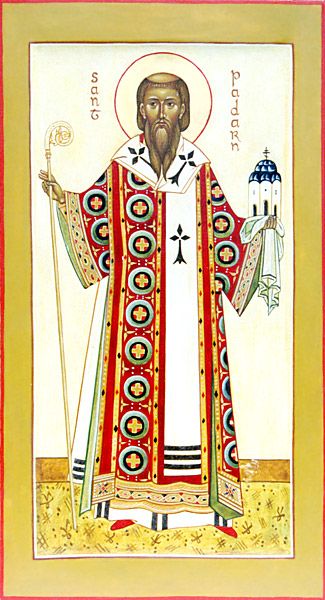
Image: Saint Patern.jpg · Massalim · CC BY-SA 3.0, via Wikimedia Commons

From Sabine Baring-Gould, The Lives of the Saints, new edition in 16 vols. (London: John C. Nimmo, 1897–98); text from the Internet Archive scan (OCR, lightly cleaned; errors possible). Public domain.

Image: Massalim, Wikimedia Commons (CC BY-SA 3.0)

From Sabine Baring-Gould, The Lives of the Saints, new edition in 16 vols. (London: John C. Nimmo, 1897–98); text from the Internet Archive scan (OCR, lightly cleaned; errors possible). Public domain in the United States. Reproduced unedited, except for short bracketed notes in grey that we added to explain names and terms (“S.” is the old abbreviation for Saint). Some history and judgments reflect 19th-century scholarship.