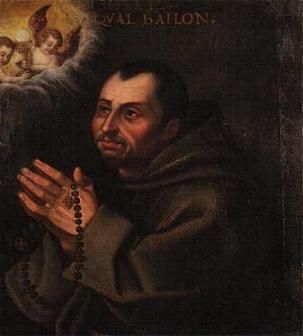
Their story
Adapted in modern English from the Catholic Encyclopedia (1913) · original text below · little is known
Paschal was born at Torre-Hermosa on 24 May 1540, Pentecost Sunday. He was a shepherd from seven to twenty-four, then became a lay brother among the Alcantarine Franciscans (the order of friars founded by St. Francis of Assisi).
His great devotion was to the Holy Eucharist. Sent into France, he defended the Real Presence and narrowly escaped a Huguenot mob. He died at Villa Reale on 15 May 1592 and was canonized (officially declared a saint by the pope) in 1690. Leo XIII named him patron of Eucharistic Congresses.
Early life
The book says little or nothing about early life. This is how the account begins.
Thin entry · the 1897 book gives only 153 words. We have not filled the gap with invented detail.
…of furious Calvinists, who asked him if he believed in the presence of Jesus in the Eucharist. When he boldly confessed his faith, they set on him with stones, and he had great difficulty in escaping. As it was, his shoulder was so injured that he never completely recovered the use of that arm.
From the Catholic Encyclopedia
1913 · 290 words
Born at Torre-Hermosa, in the Kingdom of Aragon, 24 May, 1540, on the Feast of Pentecost, called in Spain "the Pasch of the Holy Ghost", whence the name Pascal; died at Villa Reale, 15 May, 1592, on Whitsunday. His parents, Martin Baylon and Elizabeth Jubera, were virtuous peasants. The child began very early to display signs of that surpassing devotion towards the Holy Eucharist, which forms the salient feature of his character. From his seventh to his twenty-fourth year, he led the life of a shepherd, and during the whole of that period exercised a salutary influence upon his companions. He was then received as a lay brother amongst the Franciscan friars of the Alcantarine Reform. In the cloister, Paschal's life of contemplation and self-sacrifice fulfilled the promise of his early years. His charity to the poor and afflicted, and his unfailing courtesy were remarkable. On one occasion, in the course of a journey through France, he triumphantly defended the dogma of the Real Presence against the blasphemies of a Calvinist preacher, and in consequence, narrowly escaped death at the hands of a Huguenot mob. Although poorly educated, his counsel was sought for by people of every station in life, and he was on terms of closest friendship with personages of eminent sanctity. Pascal was beatified in 1618, and canonized in 1690. His cultus has flourished particularly in his native land and in Southern Italy, and it was widely diffused in Southern and Central America, through the Spanish Conquests. In his Apostolic letter, Providentissimus Deus, Leo XIII declared St. Pascal the especial heavenly protector of all Eucharistic Congresses and Associations. His feast is kept on 17 May. The saint is usually depicted in adoration before a vision of the Host.