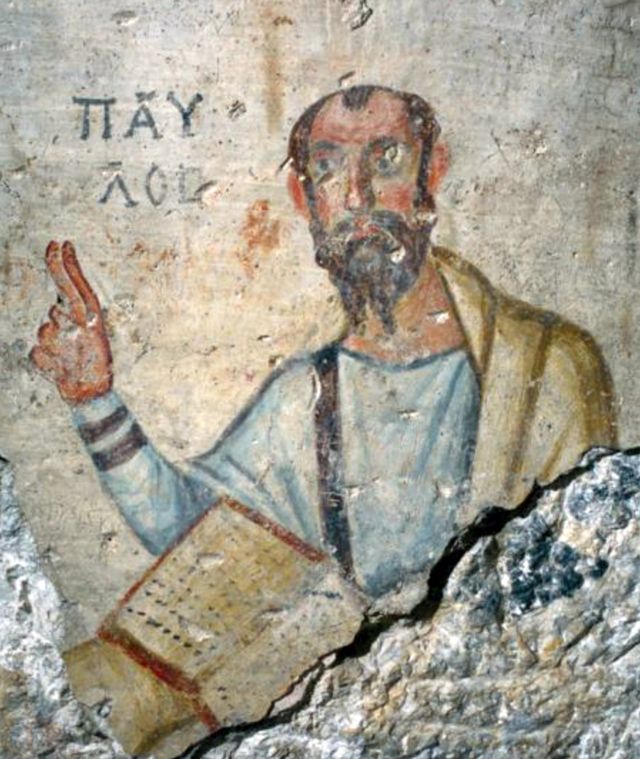
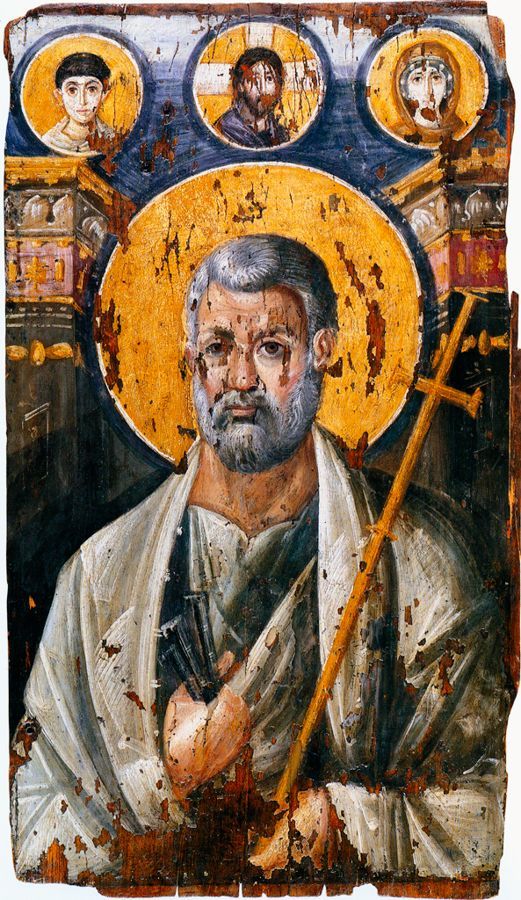
Baring-Gould’s sources: Roman Martyrology. The commemoration of S. Paul is usually transferred till the morrow, June 30th.] S. Paul is known to the time of his going forth as a preacher of Christ to the Gentiles, by the name of Saul. This was the Jewish name which he received from his Jewish parents. He was of the tribe of Benjamin, and a Pharisee. But though a Hebrew of the Hebrews, he was born in a Gentile city, at Tarsus in Cilicia, where he learnt the Greek language and the trade of tentmaker. There was a goat’s-hair cloth called Cilicium, manufactured in Cilicia, and largely used for tents. Saul’s trade was probably that of making tents of this hair-cloth. Whilst yet a youth, he was removed to Jerusalem, where he was brought up according to the traditions of the law in the school of Gamaliel. He became zealous against the Christians, and assisted at the martyrdom of S. Stephen. But the persecutor was to be converted. Having undertaken to follow up the MARTYRDOM OF S3. PETER AND PAUL.— From a Window in the Cathedral at Bourges S. PETER. | S. PAUL.
After Bronzes at the end of the Second or commencement of the Third Century, S. Paul. believers “unto strange cities,” Saul naturally turned his thoughts to Damascus. What befell him as he journeyed thither, is related in detail three times in the Acts of the Apostles, first by the historian in his own person, then in two addresses made by S. Paul at Jerusalem and before Agrippa. He was struck down to the earth, blinded, overcome, and after three days1 suspense was restored to sight and baptized (a.d. 35). From Damascus he retired into Arabia, where he spent three years in preparation for his coming apostleship. The leading events of this apostleship are so well known from the Acts of the Apostles and the Epistles, and are so accessible to all, that it is unnecessary here to give more than a short chronological sketch of his ministry. After his three years spent in Arabia, S. Paul seems to have returned to Damascus, where he proclaimed his conversion, and thereby exasperated the Jews, who lay in wait, intending to kill him, and watched the gates of the city that he might not escape by them. Knowing this, the disciples took him by night, and let him down in a basket from the wall. According to S. Paul,1 it was the ethnarch under Aretas, the king, who desired to apprehend him. There is no difficulty in reconciling the two statements (a.d. 38).
Having escaped from Damascus, Saul betoook himself to Jerusalem, and there endeavoured to join himself to the Church; but was shunned by the disciples, who suspected him of dissimulation, that he might secure their persons. S. Barnabas, however, was convinced of his sincerity. They had been schoolfellows together, apparently at the feet of Gamaliel, and he knew the straightforward integrity of the character of the impetuous Saul. This introduction by Barnabas removed all the VOL. VL 28 [Jane sg.
suspicion wherewith he had been regarded, and S. Paul remained among the apostles, “ coming in and going out at Jerusalem.”
His enthusiasm for the faith he had once persecuted was notable, and it is not to be wondered at that the former persecutor became an object of murderous hostility to his former employers. He was therefore again urged to flee away, and by way of Caesarea betook himself to his native city, Tarsus. In the epistle to the Galatians S. Paul adds certain particulars. His motive for going up to Jerusalem was chiefly, he tells us, to see S. Peter. His stay in the city was of only fifteen days; the only apostles he then saw were S. Peter and S. James, the Lord’s brother.
Whilst he was at Tarsus, a movement was going on at Antioch, which raised that city into importance second only to Jerusalem in the early history of the Church. In Antioch the Gospel had taken root, and a large community believed. Antioch became a centre from which evangelical missions started. There came to Antioch men of Cyprus and Cyrene, at whose preaching many believed and were baptized. S. Barnabas was sent from Jerusalem to consolidate the work begun there. As the work grew under his supervision, he felt the necessity for help, and he sought out his friend Saul at Tarsus, and urged him to assist him S. Paul at once joined him, and they laboured together for a whole year, S. Paul acting in subordination to S. Barnabas, as S. Luke gives us to understand. Many Gentiles had joined the church there, and on a prophet, Agabus, foretelling a famine, these new proselytes eagerly S. Paul.
made contributions for the poorer believers in Jerusalem, and sent the money to them by the hands of S. Barnabas Having discharged their errand, SS. Barnabas an£ Paul returned to Antioch, bringing with them another helper, John Mark, sister’s son to Barnabas. It would seem that it was felt advisable in the Christian Church to have missionaries with roving commissions, like the delegates sent out from the Jewish Sanhedrim (a.d. “Separate me, Barnabas and Saul for the work whereunto I have called them,” was the voice of the Holy Spirit Thereupon the two missionaries were sent forth, with the laying on of the hands of their brethren, and they departed on their first missionary journey. The writer of the Acts tells us that as soon as Barnabas and Saul reached Cyprus, they began to “announce the word of God,” at first only in the synagogues of the Jews. But when they had gone through the island, they were called upon to explain their doctrine to Sergius Paulus, the Gentile pro -consul. A Jew named Bar-jesus or Elymus, a magician and false prophet, had attached himself to the governor, and had no doubt interested his mind, for he was an intelligent man, with what he had told him of the history and hopes of the Jews. Accordingly, when Sergius Paulus heard of the strange teachers who were announcing to the Jews the advent of their Messiah, he sent for them. The impostor, instinctively hating the apostles, did his utmost to withstand them, but was struck with blindness, and the pro-consul dismissed the apostles with expressions of courtesy.
Now the positions of the two apostles were inverted Henceforth Saul is called Paul, and he takes precedence over Barnabas. Though no reason is given for the change of names, it is thought that the name of Paul may have been assumed with some reference to this distinguished convert; but it is more probable that Saul had among the Romans previously been called Paul, and that now he leaves his work in Palestine more especially among the Jews, and labours among the Gentiles, the writer uses the name by which he was thenceforth most commonly known. In that case he would be Saul among his own countrymen, but Paul among the Gentiles. The method adopted by S. Paul throughout his missions was uniform — to go into the synagogues and preach there. But in Cyprus the results had been disappointing. From Paphos “Paul and his company” set sail for the mainland, and arrived at Perga in Pamphylia. Here the heart of their companion John Mark failed him, and he returned to Jerusalem. From Perga they travelled on to Antioch in Pisidia, where they entered into the synagogue of the Jews, and S. Paul made the address given in Acts xiii. 16-44. The interest excited among the Gentiles by the teaching of the apostles alienated the minds of the Jews, and their envy, once roused, became a power of deadly hostility to the Gospel. This opposition brought out new action on the part of the apostles. They laboured to detach the proselytes from the synagogue. Paul and Barnabas next visited Iconium, Lystra, and Derbe. At Lystra the healing of a cripple caused the pagan inhabitants to regard the apostles as gods, and they called Barnabas, who was of more imposing appearance, Zeus, and Paul, who was the chief speaker, Hermes.
June a$.] S. Paul. Although the people of Lystra had been so ready to worship SS. Paul and Barnabas, the repulse of their idolatrous instincts by the two apostles produced a reaction, and the pagans, stirred up by the Jews, attacked S. Paul with stones, and thought they had killed him. He recovered, however, and went next day with Barnabas to Derbe, and so to Iconium and Antioch once more. In order to establish the churches after their departure, they solemnly ordained priests in every city. They then came down to the coast, and from Attalia sailed home to Antioch in Syria, where they related the success of this the first missionary journey, and declared how there had been an opening of the door of faith to the Gentiles.
Whilst SS. Paul and Barnabas were staying at Antioch, “certain men from Judaea” came there and taught that it was necessary for the Gentile converts to be circumcised. This opinion was vigorously opposed by the two apostles, and it was determined that the question should be referred to the apostles and priests at Jerusalem. SS. Paul and Barnabas themselves, and certain others, were selected for this mission (a.d. 52). The apostles, it appears, would have raised no difficulties, but certain believers, who had been Pharisees, thought fit to maintain the same doctrine which had caused so much trouble at Antioch. It became necessary, therefore, that a formal decision should be come to on this matter. The apostles and priests assembled in council, and there was much disputing. Arguments would be used on both sides, but when the persons of highest authority spoke, they appealed to the course of facts as testifying to the will of God. After they had done, S. James, as president, with incomparable simplicity and wisdom, bound up the testimony of recent facts with the testimony of ancient prophecy, and gave judgment upon the question. The judgment was decisive. S. Paul had completely gained his point. The judgment of the Church was immediately recorded in a letter addressed to the Gentile converts in Antioch, and Syria, and Cilicia. It is usual to connect with this period of the history that rebuke of S. Peter, which S. Paul records in Gal. ii. 11-14; but it is possible that it may have taken place before the council, or even later, when S. Paul had returned to Antioch from his long tour in Greece.
S. Paul could not forget the hesitation of Mark on the first journey. He would not associate with himself in the work that John Mark, who had already shown a want of constancy; and a difference of opinion, and even “ strife ” which grew up between S. Paul and S. Barnabas on this point, led to that unhappy estrangement which separated two who had worked together hitherto for so many years. Silas, or Silvanus, thenceforth became the companion of the apostle. The two went together through Syria and Cilicia, visiting the churches, and so came to Derbe and Lystra. There they found Timothy, who had become a disciple on the former visit of the apostle. Him S. Paul took and circumcised. This was done lest by taking an uncircumcised proselyte with them the Jews should close against them the pulpits of the synagogues. It was done out of expediency.
S. Luke now passes rapidly over a considerable space of the apostle’s life and labours. “They went through Phrygia, and the region of Galatia” (xvi. 6). At this time he had not indulged the ambition of preaching the Gospel in Europe. His views were limited to the peninsula of Asia Minor. Having gone through Phrygia and Galatia he intended to visit the western coast; but 44 they were forbidden by the Holy Ghost ” to preach there. Then they passed by Mysia, and came to Troas. S. Paul there saw in vision a man of Macedonia urging him 44 to come into Macedonia and help us.” The vision was at once accepted by the apostle as a heavenly intimation. It is at this point that the historian speaking of S. Paul’s company substitutes 41 we ” for 44 they.” He says nothing of himself, we can only infer that S. Luke, to whatever country he belonged, became a companion of S. Paul at Troas. The party, thus reinforced, immediately set sail and landed on the continent at Neapolis, whence they journeyed to Philippi. There were a few Jewish women at Philippi; and when the Sabbath came round, the apostolic company joined their countrywomen at the place by the river -side, where was an oratory in use by the Jews. The narrative in this part is very graphic (xvi. 13). The first convert in Macedonia was an Asiatic Jewess, a seller of purple* dyed cloths, then most costly, and she invited the apostle and his companions to stay in her house. They could not resist her urgency, and during their stay at Philippi, they were the guests of Lydia.
But a proof was given before long that the apostles of Christ were come to grapple with the powers of the spiritual world, to which heathenism was then doing homage.
A female slave, who brought her masters much gain by her powers of prediction, when in a possessed state, beset S. Paul and his company. The apostle, vexed by her cries, addressed the spirit in the girl, and at his word the demon left her. The girl’s masters saw that [Jnne their hope of gain was gone. Paul and Silas were dragged before the magistrates on the vague charge ol " troubling the city,” and introducing observances at variance with Roman usage. The praetors of Philippi yielded without inquiry to the clamour of the accusers, caused the clothfes of Paul and Silas to be torn from them, and their bodies to be beaten, and then committed them to prison. But in the night an earthquake shook the city, and threw open the doors of the prison. The alarm caused the conversion of their jailor; and in the morning, the magistrates having repented of their injustice, or having done all they meant to do by way of pacifying the multitude, sent word to the prison that the men might be released. But S. Paul denounced plainly their unlawful acts, informing them, moreover, that those whom they had beaten and imprisoned, could claim the privileges of Roman citizens, and call the magistrates to task for their injustice. The magistrates in great alarm came in person to the prison, and begged them to leave the city. Paul and Silas consented to do so, and departed to Thessalonica, leaving S. Luke, and perhaps Timothy also, at Philippi.
At Thessalonica the envy of the Jews was excited; the mob assaulted the house of Jason, with whom Paul and Silas were staying as guests, and, not finding them, dragged Jason himself before the magistrates. Paul and Silas escaped by night. The Epistles to the Thessalonians were written very soon after the apostle’s visit, and contain more particulars of his work in founding that Church, than we find in any other Epistle. When Paul and Silas left Thessalonica they came to Bercea. Here they gained many converts, both Jews and Gentiles; but the Jews of Thessalonica, hearing of it, sent emissaries to stir up the people, and it was thought •S. Paul.
best that S. Paul should himself leave the city, whilst Silas and Timothy who had rejoined S. Paul, remained behind. Some of u the brethren ” went with the apostle as far as Athens, where they left him, carrying back a request to Silas and Timothy that they would rejoin him speedily.
At Athens he witnessed the most profuse idolatry side by side with the most pretentious philosophy. The philosophers encountered him with a mixture of curiosity and contempt. But anyone with a novelty in religious speculation was welcome to them, and they brought him to the Areopagus, that he might make a formal exposition of his doctrine to the assembled audience. Here the apostle delivered that striking discourse, reported in Acts xvii. 27-31. He gained but few converts at Athens, and soon departed for Corinth. Athens was still the intellectual capital of Greece, but Corinth was the head of its commercial and political life. Here, as at Thessalonica, he chose to earn his own subsistence by working at his trade of tent- making. This trade brought him into close connexion with two persons who became distinguished among the faithful, Aquila and Priscilla (a.d. 53). Labouring thus on the six days, the apostle went to the synagogue on the Sabbath, and there expounding the Scriptures sought to win both Jews and Proselytes to the faith. Whilst thus engaged Silas and Timothy came from Macedonia and joined him; and their arrival was the occasion of the writing of the first Epistle to the Thessalonians. What interval of titne separated the second Letter to the Thessalonians from the first, we have no means of judging, except that the latter one was certainly written before the departure of S. Paul from Corinth. These two Epistles are the earliest extant writings of S. Paul. Corinth was the chief city of the province of Achaia, and the residence of the proconsul. During S. Paul’s stay, we find the pro-consular office held by Gallio, a brother of the philosopher Seneca. Before him the apostle was summoned by his Jewish enemies, who hoped to bring the Roman authority to bear upon him as an innovator in religion. But Gallio perceived at once, before Paul could “ open his mouth ” to defend himself, that the movement was due to Jewish prejudice, and refused to go into the question. Then a singular scene occurred. The Corinthian spectators, either favouring S. Paul, or actuated only by hostility to the Jews, seized on the principal person of those who had brought the charge, and beat him before the judgment-seat.1 Gallio left these religious quarrels to settle themselves. The apostle therefore, was not allowed to be 11 hurt,” and remained some time longer in Corinth unmolested.
Having thus founded the Corinthian Church, S. Paul took his departure for Jerusalem, wishing to attend a festival there. Before leaving Greece, he cut off his hair at Cenchraea, in fulfilment of a vow.
When he sailed from the Isthmus, Aquila and Priscilla accompanied him as far as Ephesus. He visited Caesarea and from thence went up to Jerusalem and “ saluted the Church.” It is argued, from considerations founded on the suspension of navigation during the winter months, that the festival was probably Pentecost. From Jerusalem, almost immediately, the apostle went down to Antioch, thus returning to the same place from 1 His name was Sosthenes. It is curious that " Sosthenes our Brother*' should be associated by S. Paul in the sending of the First Epistle to the Corinthians. Some hare supposed that he was the rbler of the Synagogue who was converted.
June ag.] 5. Paul. which he had started with Silas. There he remained “some time.” He was able to fill the brethren with joy at the tidings of the spread of the Gospel (a.d. 55). When he left Antioch, he “ went over all the country of Galatia and Phrygia in order, strengthening all the disciples,” and giving orders concerning the collection for the Saints (1 Cor. xvi. 1). It is probable that the Epistle to the Galatians was written soon after this visit, and was in all probability sent from Ephesus. This was the goal of the apostle’s journeying in Asia Minor. He came down upon Ephesus from the upper districts of Phrygia. Ephesus occupied a central position for the spread of the Catholic Church. It was the meeting-place of Jew, Greek, Roman, and Oriental.
There the apostle entered upon his usual work. He went into the synagogue, and for three months he spoke openly, disputing and persuading concerning “ the kingdom of God.” At the end of this time the opposition of some of the Jews led him to give up frequenting the synagogue, and he assembled the Church u in the school of one Tyrannus,” probably a Greek teacher of rhetoric. This continued for two years.
During this time many things occurred of which the historian of the Acts chooses two examples, the triumph over magical arts, and the great disturbance raised by the silversmith, who made shrines for Artemis; and amongst which we may note further the writing of the First Epistle to the Corinthians.
Whilst S. Paul was at Ephesus his communications with the Church in Achaia were not altogether suspended. There is strong reason to believe that a personal visit to Corinth was made by him, and a letter sent, neither of which is mentioned in the Acts. The visit is inferred from several allusions in the second Epistle to the Corinthians (2 Cor. xii. 14; xiii. 1). The visit he is contemplating is plainly that mentioned in Acts xx. 2, which took place when he finally left Ephesus.
At Ephesus S. Paul found that “ a great door and effectual was opened to him, and there were many adversaries but the tumult that broke out occasioned by the silversmiths thinking their craft in danger through the spread of Christian doctrine, precipitated his departure, and he set out for Macedonia, and proceeded first to Troas.1 But a restless anxiety to obtain tidings concerning the church at Corinth urged him on, and he advanced into Macedonia, where he met Titus, who brought him the news for which he was thirsting. The receipt of this intelligence drew from him the second epistle to the Corinthians.
After writing this epistle, he travelled through Macedonia, perhaps to the borders of Illyricum,* and then carried out the intention of which he had so often spoken, and arrived at Corinth. There is only one incident which we can connect with this visit to Greece, but that is a very important one — the writing of another great epistle, addressed to the church of Rome. The letter was intended as a substitute for the personal visit which he had longed “ for many years ” to pay. Before his departure from Corinth, S. Paul was rejoined by S. Luke, as we may infer from the change in the narrative from the third to the first person. He had resolved to visit Jerusalem with a special purpose, and for a limited time. With this view he intended to go by sea to Syria. But he was made aware of some plot of the Jews for his destruction, to be carried out on the voyage, and he determined to evade •S'. Paul.
their malice by changing his route. Several brethren were associated with him in this expedition, the bearers, no doubt, of collections made in all the churches for the poor at Jerusalem. These were sent on by sea, and probably the money with them, to Troas, where they were to await S. Paul. He, accompanied by S. Luke, went northward through Macedonia. During the stay at Troas the faithful assembled on the first day of the week, that is, after sunset on Saturday evening, for an early communion on the Sunday morning. S. Paul discoursed till midnight, and a youth named Eutychus sitting in a window, overcome by sleep, fell down into the street or court, and was taken up as dead, but was recovered by S. Paul, who then returned to the upper room, and there, after midnight, performed the sacred mysteries. At daybreak, he departed on his journey to Assos, where he went on board ship, and coasting by Mitylene, Chios, Samos and Trogyllium, arrived at Miletus. At Miletus he met and addressed the priests of the church of Ephesus, and delivered to them a characteristic address (Acts xx. 18-35). From Miletus he sailed to Patara, and from Patara to Tyre. From Tyre the apostles sailed to Ptolemais, and thence he journeyed to Caesarea. In this place he became the guest of Philip the Evangelist. Whilst there, the prophet Agabus warned him of danger threatening him. and an effort was made by anxious friends to dissuade S. Paul from going up to Jerusalem (a.d. 58). ! But his resolution was not to be shaken by anticipations of “ bonds and imprisonments.” He came to Jerusalem expressly to prove himself a faithful Jew, and thus remove the suspicions which had interfered with his work among those of his own nation, and remove occasion of slander. Even the faithful at Jeru(June ag.
salem had been alarmed by the prevalent feeling concerning S. Paul. In order to dispel this impression he was asked to do publicly an act of homage to the law and its observances. They had four men who were under the Nazarite vow. The completion of the vow involved a considerable expense for the offerings to be presented in the temple;l and it was a meritorious act to present these offerings for the poorer Nazarites. S. Paul was requested to put himself under the vow with these other four, and to supply the cost of their offerings. He at once accepted the proposal. It appears that the whole process undertaken by S. Paul required seven days to complete it. Towards the end of this time certain Jews from Asia Minor, who had come up for the Penticostal feast, and who had a personal knowledge both of S. Paul himself and of his companion Trophimus, a Gentile from Ephesus, saw S. Paul in the temple.
They immediately set upon him with the charge of having brought Greeks into the temple, and so polluting the holy place, and of teaching men everywhere against the law of Moses.
Neither charges were true; but they served to stir up the people, and S. Paul would have been killed, had not the Roman officer commanding a force stationed in Jerusalem, rescued him, and carried him off into the castle. On the morrow he was brought before the Sanhedrim, as an act of courtesy of the governor to the Jews. But the affair ended in confusion, and with no semblance of a judicial termination. On the next day a conspiracy was formed which threatened his life. Hearing of it, the chief captain sent him under escort to Caesarea, to Felix, the governor, or procurator of •S'. Paul.
Judaea. He was retained by Felix in prison till the accusers came from Jerusalem. S. Paul was thenceforth, to the end of this period embraced in the Acts, if not to the end of his life, in Roman custody. This custody was in fact a protection to him, without which he would have fallen a victim to the animosity of the Jews. He seems to have been treated throughout with humanity and consideration. The governor before whom he was to be tried, according to Tacitus and Josephus, was a mean and dissolute tyrant. The trial was conducted by him at Caesarea, an orator or counsel named Tertullus accused him. The apostle’s answer was straightforward and complete. He had not violated the law of his fathers; he was a true and loyal Israelite. Felix made an excuse for postponing his judgment, and gave orders that the prisoner should be treated with indulgence, and his friends allowed free access to him.
S. Paul remained in custody until Felix left the province. It was probably at this time, and at the instigation of S. Paul, that Luke drew up his Gospel. Felix was succeeded by Festus.
Upon his arrival in the province, Festus went up without delay from Caesarea to Jerusalem, and the leading Jews took the opportunity of asking that S. Paul might be brought up there for trial, intending to assassinate him in the way.
But Festus would not comply to this request. He invited them to follow him on his speedy return to Caesarea, and a trial took place there, closely resembling that before Felix. “ They had certain questions against him,” Festus says to Agrippa, “of their own religion, and of one Jesus, who was dead, whom Paul affirmed to be alive. And being puzzled for my part as to such inquiries, I asked him whether he would go to Jerusalem to be tried there.” This proposal, not a very likely one to be accepted, was the occasion of S. Paul’s appeal to Caesar. The appeal having been allowed, Festus reflected that he must send with the prisoner a report of “the crimes laid against him.” He therefore took advantage of an opportunity which offered itself in a few days to seek some help in the matter. The Jewish prince Agrippa arrived with his sister Bernice on a visit to the new governor. To him Festus communicated his perplexity, together with an account of what had occurred before him in the case. Agrippa expressed a desire to see him. S. Paul therefore was required to give an account of himself to Agrippa, which produced a lively impression on the minds of his hearers. When it was concluded, Festus and the king and their companions consulted together, and came to the conclusion that the accused was guilty of nothing that deserved death or imprisonment. And Agrippa’s final answer to the inquiry of Festus was, “ This man might have been set at liberty if he had not appealed unto Caesar.”
No formal trial of S. Paul had yet taken place. After awhile, arrangements were made to carry “ Paul, and certain other prisoners,” in the custody of a centurion named Julius, into Italy; and amongst the company, whether by favour, or from some other reason, we find the historian of the Acts.
The voyage ended in a disastrous shipwreck off Melita.1 The inhabitants of the island received the wet each has immemorial tradition in favour of Its claim. The evidence for each is as follows: — Malta has been decided by Mr. Howson, in his great work on S. Paul, and by June >9. j S. Paul.
and exhausted voyagers with no ordinary kindness, and lighted a fire to warm them. This particular kindness is recorded on account of a curious incident connected with it. The apostle was helping to make the fire, Mr. Smith of Jordan Hill, in his M Voyage and Shipwreck of S. Paul/* to have been the island on which the apostle was wrecked. And these are their reasons for so thinking s — z. We take S. Paul's ship In the condition in which we find her about a day after leaving Pair Havens (Acts xxvii. x6)t laid on the starboard track, and strengthened with *' undergirders," the gale blowing hard from E.N.E. Assuming that the ship'* drift would be about W* by N., and her rate of drift about a mile and half an hour, we come to the conclusion, by measuring the distance on the chart, that she would be brought to the coast of Malta on the thirteenth day (ver. 27.) а. A ship drifting in this direction to the place traditionally known as S. Paul's Bay, would come to that spot on the coast without touching any other part of the island previously.
3. On Koura Point, which is the south-easterly extremity of the bay, there must have been breakers, with the wind blowing from the N.E. Now the alarm was certainly caused by breakers, for it took place in the night (ver. 37.) 4. Yet the vessel did not strike; and this corresponds with the position of the point, which would be some little distance on the port side, or to the left, of the vessel.
j. Off this point of this coast the soundings are twenty fathoms (ver. a8), and a little further in the direction of the supposed drift, they are fifteen fathoms (16.) б. Though the danger was imminent, we shall find from examining the chan that there would still be time to anchor (ver. 99), before striking on the rocks ahead.
7. With bad holding-ground there would have been great risk of the ship dragging her anchors. The bottom of S. Paul's Bay is remarkably tenacious. 8. The other geological characteristics of the place are in harmony with the narrative, which describes the bay as having in one place a sandy or muddy beach (ver. 39), and which states that the bow of the ship was held fast on the shore while the stern was exposed to the action of the waves (ver. 41.) 9. Another point of local detail is the existence of an island, forming one horn of S. Paul's Bay, with a channel between it and the mainland, so that "two seas met," where the ship ran aground.
10. Malta Is in the track of ships between Alexandria and Puteoli j and this corresponds with the fact that the “Castor and Pollux," an Alexandrian vessel, which ultimately conveyed S. Paul to Italy, had wintered in the island (Acts xxxiii. zz.) This is the most important piece of evidence in favour of Malta. No Alexandrian vessel bound for Puteoli would have visited Meleda. The course pursued in the conclusion of the voyage, first to Syracuse, and then to Rhegium, would apply equally well to either. zt. Malta, when S. Paul was there, was a dependency of the Roman province of Sicily. Its chief officer under the governor of Sicily appears from inscriptions to have had the title of ftimus Melitcnsium, the very title given to him by S. Luke when a viper came out of the heat, and fastened on his hand, but without hurting him. This filled the inhabitants with astonishment, and led to his invitation to stay at the house of the chief man of the island, named Publius, who entertained S. Paul courteously for three days. After a three months’ stay in Malta the soldiers and their prisoners left in an Alexandrian ship for Italy. On their arrival at Rome, the centurion delivered up But, on the other hand, in behalf of Meleda, off Ragusa, it is urged by Dr. Neale t. We are told that the ship was driven “up and down in Adria." It is said that the sea between Malta and Crete was anciently called Adria, but no proof of this assertion has yet been adduced.
s. There are no serpents in Malta; and they abound in the islet of Meleda ) and the same may be said of wood. 3. The sailors must have known Malta, which lay in their ordinary track; and yet we are told of this island that, “ when it was day, they knew not the land j” a statement we can hardly believe, if the place were Malta. 4. Malta was occupied by a Phoenician colony, and it is singular that they should be called a ** barbarous people.** $. There is no crook in Malta ouch as described. The Maltese hypothesis makes the sailors take the Salmonella strait for a creek, in which case they ran the ship head foremost into the rush of the billows rolling up the strait from the open sea. If that had been the case, the fore part of the vessel would have been the first broken. On the other hand, in Meleda, S. Paul’s Bay has a creek just answering to the description.
6. Under the lee of Clauda they had smooth water for some twelve miles, and employed themselves in making all snug; that is, after lowering the mainyard, and perhaps setting up a storm-sail, they hove the ship to a starboard track. Admiral Penrose says, “ To have drifted up the Adriatic, to the island of Meleda, in the requisite course, and to have passed so many islands r, would, humanly speaking, have been impossible. The distance from Clauda to that Meleda is not leu than 780 geographical miles." It is worth noticing that this criticism is worthless, as Admiral Penrose, unaware of the tradition attaching to Meleda off Ragusa, seems to have taken Melada, a little island just north of I sola Grossa, as the one which, according to one hypothesis, formed the scene of S. Paul's shipwreck. The distance from Clauda to Meleda is not 780 geographical miles, but only a it tie more than 6so. Again, not ono single island would be passed by a ship coming lup Adria, instead of Mso many," as the Admiral says. 7. It is about 780 miles from Clauda to Malta, and it would involve a curve to get to it. But suppose that the ship was in as degrees East longitude, 35 degrees North latitude, and the wind shifted, as it so often does, to E.S.E., the course would be then directly straight to Meleda, with no island intervening, S. Paul's Bay and Creek exactly answering the description, being the first land they could make.
S. Paul. his prisoners into the proper custody, that of the praetorian prefect. S. Paul was at once treated with special consideration, and was allowed to dwell by himself with the soldier who guarded him. He was now, therefore, free 44 to preach the Gospel to them that were at Rome and proceeded to act upon his rule — “to the Jew first.” He invited the chief persons amongst the Jews to come to him, and explained to them that he had really done nothing disloyal to his nation or to the law. The reception of his teaching by the Jews was not favourable. He turned, therefore, again to the Gentiles, and for two years he dwelt in his own hired house. These are the last words of the Acts. But S. Paul's career is not abruptly closed. Before he himself fades out of our sight in the twilight of ecclesiastical tradition, we have letters written by him, which contribute some particulars to his external biography, and give us a far more precious insight into his feelings. To that imprisonment of two years belongs the group of letters to Philemon, to the Colossians, to the Ephesians, and to the Philippians. The three former of these were written at one time, and sent by the same messengers.
In the Epistle to the Philippians S. Paul twice expresses a confident hope that before long he may be able to visit the Philippians in person. Indeed it was impossible but that he would be released as soon as his case was heard, so frivolous was the charge, and one so little likely to excite Roman suspicion and resentment.
According to the general opinion, the apostle was liberated from his imprisonment, and left Rome, soon after writing this letter, spent some time in visits to Greece and to Asia Minor, returned again a prisoner to Rome, now not on any charge connected with the Jewish “superstition,” but with teaching revolt against the State religion. On this accusation he was tried and put to death. The first Epistle to Timothy, and that to Titus, were evidently written before his second apprehension. The apostle appears to have been treated on this second occasion, not as an honourable state prisoner, but as a felon.1 But he was at least allowed to write the Second Epistle to his 44 dearly loved son ” Timothy; and though he expresses a confident expectation of his speedy death, he yet thought it sufficiently probable that it might be delayed for some time, to warrant him in urging Timothy to come to him from Ephesus. Once already, in this second imprisonment, he had appeared before the authorities; and 44 the Lord then stood by him, and strengthened him.” For what remains, we have the concurrent testimony of ecclesiastical antiquity, that he was beheaded at Rome, about the same time that S. Peter was there crucified. Dionysius, bishop of Corinth (a.d. 170), says that S. Peter and S. Paul went to Italy and taught there together. Eusebius [Eusebius of Caesarea (d. c. 339), the first historian of the Church] himself entirely adopts the tradition that S. Paul was beheaded under Nero.a Several apocryphal legends, to which no sort of credence is due, must be mentioned.
Some ancient writers suppose that S. Paul was engaged with S. Peter in procuring the fall of Simon Magus, whose story has been already related in the article on the Prince of the Apostles. And they relate that this excited the emperor’s fury against him. S. Chrysostom [St. John Chrysostom, archbishop of Constantinople (d. 407)], on the other hand, records that S from the admirable account iu Smith’s “ Dictionary of the Bible.” •S'. Paul.
Paul had converted one of Nero’s favourite concubines, and, by inducing her to pursue for the future a life of chastity, incurred the rage of the emperor, who commanded him to be cast into prison, and afterwards to be put to death. How long he remained in prison is not certainly known. At last his execution was resolved on: what his preparatory treatment was, whether scourged as malefactors were wont to be in order to their death, is not recorded. As a Roman citizen, by the Valerian [Roman emperor 253–260, who persecuted bishops and clergy] and the Porcian law, he was exempted from scourging; yet, by the law of the XII. Tables, notorious malefactors condemned by the Comitia Centuiiata were first to be scourged, and then put to death. As he was led to execution, S. Paul is said to have converted three of the soldiers that were sent to conduct and guard him, who within a few days after, by the emperor’s command, became martyrs for the faith. Being come to the place of execution, the Aquae Salviae, three miles from Rome, after some solemn preparation, he cheerfully gave his neck to the fatal stroke. As a Roman he might not be crucified — this being accounted a death too infamous for any but the worst of slaves and malefactors — and therefore suffered decapitation, which was considered a more noble kind of punishment. An idle tradition reports, that from the veins of S. Paul, flowed milk instead of blood. S. Paul is said to have suffered in the sixtyeighth year of his age.
It is uncertain whether S. Paul suffered at the same time with S. Peter. Dionysius of Corinth does not say that the martyrdom took place the same day, but only at the same time; which may be so understood, as that there might be an interval of many days between their sufferings. Prudentius says they were both martyred on the same day, but not in the same year; and that there was a year’s space between their deaths. With Prudentius agrees S. Augustine, in his 28th sermon. But Simeon Metaphrastes takes these words of Dionysius as if he said that SS. Peter and Paul were martyred on the same day together.
“ But,” says worthy Dr. Cave, who has collected the narratives of the ancient writers regarding S. Paul and the other apostles, “certainly if he suffered not at the very time with S. Peter, it could not be long after, not above a year, at most. The best is, which of them soever started first, they both came at last to the same end of the race: to those palms and crowns which are reserved for all good men in heaven, but most eminently for the martyrs of the Christian Faith.” S. Paul was buried ©n the Via Ostiensis, about two miles from Rome; and over his grave, about the year 318, Constantine the Great, at the instance of S. Silvester, bishop of Rome, built a stately church, which he adorned with costly gifts and enriched with noble endowments. The emperor Theodosius [name of Roman emperors; Theodosius I (379–395) made Christianity the state religion] deeming this church too little for the honour of so great an apostle, caused it to be taken down, and a larger and more noble church to be built in its stead.