Faithfulness to Christ when it cost everything.
Read the essentials →Faithfulness to Christ when it cost everything.
July 8
Not verified yet
Martyr
…church of Blachernae, a part of Constantinople, where the walls were adorned with painted, or mosaic representations of the whole Gospel story from the Nativity to the descent of the Holy Ghost, and ordered them to be defaced. This so exasperated a zealous Christian layman, named Paul, that he boldly withstood the emperor, and argued the advantage of sacred representations in churches as “ ways leading to Christ.” Constantine answered, il How can one represent the incomprehensible, invisible, inaudible God, who exists not in comprehension, but solely in infinity? How represent the unimaginable by a picture I and the unknown by lines and colours ?” “ Only,” answered Paul, “ because God became Incarnate.” The words of Constantine exhibit at once the main principle of the Iconoclastic persecution; it was a struggle of Deism, exalted altered Arianism, against the reality of the Incarnation.
Stay faithful when it costs you. This account is about holding firm under pressure.
Learn from the kind of life it was. Faithfulness to Christ when it cost everything.
…church of Blachernae, a part of Constantinople, where the walls were adorned with painted, or mosaic representations of the whole Gospel story from the Nativity to the descent of the Holy Ghost, and ordered them to be defaced. This so exasperated a zealous Christian layman, named Paul, that he boldly withstood the emperor, and argued the advantage of sacred representations in churches as “ ways leading to Christ.” Constantine answered, il How can one represent the incomprehensible, invisible, inaudible God, who exists not in comprehension, but solely in infinity? How represent the unimaginable by a picture I and the unknown by lines and colours ?” “ Only,” answered Paul, “ because God became Incarnate.” The words of Constantine exhibit at once the main principle of the Iconoclastic persecution; it was a struggle of Deism, exalted altered Arianism [followers of Arius, who taught that the Son is a created being, not fully God], against the reality of the Incarnation. The monks, and priests, and laymen who suffered horrible deaths and tortures in defence of their images, may little have understood that in reality they were fighting for a fundamental principle of Christianity. For, in fact, through the pictures, the reality of the Incarnation was assailed. Remove the images, efface the pictures, and the great facts of the Gospel story would fade out of remembrance into myths of the past, and Christianity dissolve into a theism, with Jesus as its great prophet. Constantine ordered the nose of Paul to be cut off, and the martyr was led away to prison chanting u In the way of Thy testimonies is my delight; as in all manner of riches. I will speak of thy testimonies even before kings, and will not be ashamed.”
After three days he was agaio brought before the emperor, and ordered to trample on representations of the Saviour and S. Mary. Then Paul, looking on the Inly 8.] Sunni/a.
ground, spread his hands to heaven and cried, “Far be it from me, Lord Jesus Christ, son of the living God, to profane thine image, or that of thy Mother and thy Saints. For by these we are led, as by a road, to the adoration of Thee l”
Then Constantine ordered lighted pitch and sulphur to be poured over his head. He was led away singing psalms, was afterwards deprived of his eyes, and dragged over the stones of the market-place till he was dead. His body was secretly buried by the faithful in a monastery, and was exhumed and honourably enshrined on the cessation of the Iconoclastic persecution, a hundred and twenty-two years later.
In 1326, the body was taken by the Venetians from Constantinople, and placed in the church of S. George the Greater at Venice, where it still remains.
Feast: July 8
One short email a day for nine days. The day's prayer, a line from St. Paul the New's story, and a nudge to keep going.
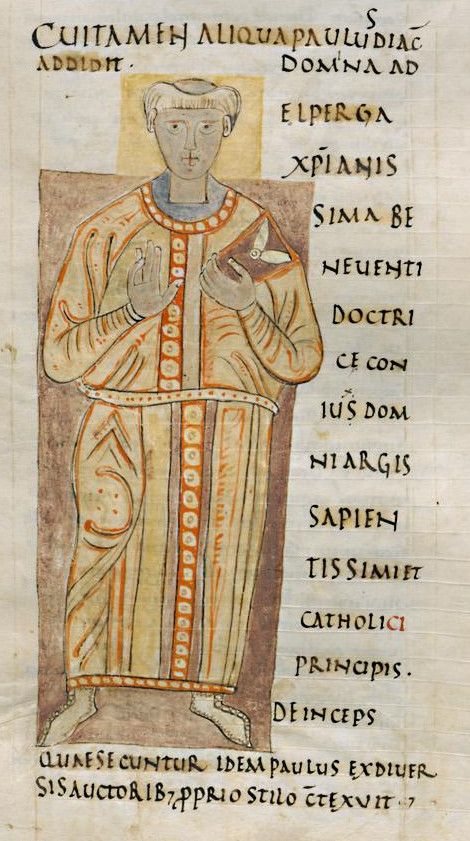
Image: PaulusDiaconus Plut.65.35.jpg · Unknown authorUnknown author · Public domain, via Wikimedia Commons
From Sabine Baring-Gould, The Lives of the Saints, new edition in 16 vols. (London: John C. Nimmo, 1897–98); text from the Internet Archive scan (OCR, lightly cleaned; errors possible). Public domain.
Image: Unknown authorUnknown author, Wikimedia Commons (Public domain)
From Sabine Baring-Gould, The Lives of the Saints, new edition in 16 vols. (London: John C. Nimmo, 1897–98); text from the Internet Archive scan (OCR, lightly cleaned; errors possible). Public domain in the United States. Reproduced unedited, except for short bracketed notes in grey that we added to explain names and terms (“S.” is the old abbreviation for Saint). Some history and judgments reflect 19th-century scholarship.