Baring-Gould’s sources: Roman Martyrology. S. Paula died on Jan. 26th, after sunset, consequently some commemorate her on Jan. 27th. Authority: her life written by S. Jerome, her director, in a letter to her daughter Eustochium.
The blessed Paula was born at Rome in the year 347. Her father was Rogatus, of noble Grecian origin. Her mother, Blesilla, reckoned the Gracchi, the Scipios and Paulus Æmilius among her ancestors. This illustrious birth was made more honourable by her union with Toxotius, of the Julian race, and very wealthy. Her virtues endeared her to the people of Rome, and her modesty, gravity, and prudence caused her to be generally respected. Her husband died when she was aged twenty-three, and grief for his loss nearly brought her to the grave as well. Toxotius left behind him four daughters, Blesilla, Paulina, Eustochium, Julia, and Ruffina; the youngest child was a boy, and he bore the name of his father.
The heart-broken widow at length found repose in submission to the will of God. Filled with a sense of the vanity of all earthly things, she strove to detach her affections daily from all save God. After the death of her husband she would not sit down to table with any man, not even with the bishops, whose advice she sought, and who were most hospitably entertained in her house. By degrees she accustomed herself to plain food, and inexpensive clothing. Instead of a downy couch, she made her bed on the hard floor. "Hitherto all my care has been how I might please my husband," said she, "now I will care for naught save how I may best serve Jesus Christ."
She was now called on to bewail the death of her eldest daughter Blesilla, who died shortly after her husband, to whom she had been married only for a short time. S. Jerome [translator of the Bible into Latin (d. 420)] wrote on this occasion to S. Paula from Bethlehem. After having tenderly recalled the pale and gentle face, bowed with exhaustion after fever on the slender neck, the angelic form, of the departed daughter, S. Jerome adds; "But what am I doing? I would dry the tears of a mother and mingle mine with hers. I do not conceal my emotion. I write weeping. But Jesus wept over Lazarus, because He loved him. It is difficult to console another when one is also overwhelmed with grief, and when the broken heart can find no words. O Paula, I take Jesus Christ to witness, whose Majesty Blesilla now sees; I take the holy angels to witness, whose companion she now is; that I suffer the same anguish of heart as you, for I, having been her spiritual father, had learned to love her dearly."
Paula saw also her second daughter Paulina die, who had been married to Tammachius, a man of noble consular birth, as illustrious for his piety as for his descent, "the first of monks in the first of cities," S. Jerome called him in after years, when he had embraced the monastic life in Rome. She also survived her fourth daughter Ruffina, married to the patrician Aletheus, but this affliction fell upon her when she was no longer in Rome.
Her daughters had grown up, and her son Toxotius, having been secured a careful bringing up, by his sister Ruffina, S. Paula felt that she might now follow at liberty the bent of her desire. The stirring life in Rome gave her no rest. Her noble birth and great wealth made her in great request, and the time, which she desired to devote to God alone, was broken up by the petty business and formalities of social life, which could not be dispensed with in the great city. She therefore resolved to abandon Rome, her palace, her crowds of servants, her numerous acquaintances, many friends, and dear children.
She desired to visit the holy scenes consecrated by Christ, and then to settle quietly down near her old confessor [in old usage, a saint who was not martyred, or who suffered for the faith without being killed] and director Jerome, then inhabiting a cell at Bethlehem. It was no light matter parting with her relations and children, but she had this consolation, Eustochium, her unmarried daughter, accompanied her, one in heart with her mother, desirous of consecrating her virginity, as Paula desired to dedicate her widowhood, to Jesus Christ.
When they left Rome, the kinsmen accompanied them to the port. It was a heart-breaking scene. Paula took her place on the deck of the vessel that was to bear her away for ever. The anchor was drawn up, the moorings cast loose, and the rowers bowed to their task. Then the grief of Toxotius became incontrollable; he stretched forth his arms to her, sobbing, "Mother, mother! do not leave me." The grief of the others was silent, manifesting itself in copious tears. But Paula, raising her dry eyes to heaven, turned her face from the shore, and conquered by a superhuman effort the agony caused by the rending of so many dear ties. On reaching Jerusalem she found that a palace had been furnished for her reception by the governor, with every comfort and even luxury. She, however, chose the meanest chamber therein, in which to lodge, and spent her time in visiting the holy sites. She prayed long and earnestly before the true Cross, kissed the stones on which the body of Jesus had lain, and watered with her tears the dust of the Dolorous Way along which He had borne His Cross.
She then journeyed to Bethlehem, and adored Christ in the cave of the Nativity. Overwhelmed with awe she exclaimed, "Oh, how dare I, a poor sinner, kiss the crib where the Lord wailed as a little babe? How dare I offer my prayer, where the Virgin brought the Word into the world in the substance of our flesh! Let the home of my Redeemer be henceforth my resting place, here will I dwell where He walked the earth as man."
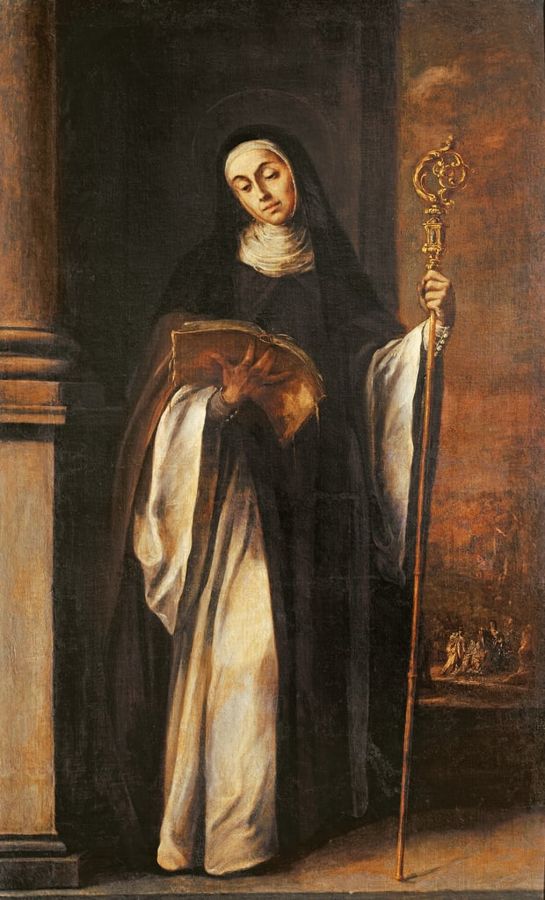
Having settled at Bethlehem into a poor little house, she engaged workpeople to erect on the road to Jerusalem a spacious hospital for pilgrims and sick persons, and also a monastery for S. Jerome and his monks. She then erected three convents for women, with one church in which all the inmates of the three houses assembled for the divine office. There they met to sing prime, tierce, sext, nones, vespers, compline, and the midnight lauds; thus they daily sang the whole psalter, which every sister was required to learn by heart. On Sundays they went to the neighbouring church where the Divine Sacrifice was offered, and where they communicated.
All the sisters worked with their hands, and made clothes for themselves and for the poor. No man was ever suffered to set foot within their doors. Paula governed them with great charity and discretion, animating them by her own example. Neither she nor her daughter, Eustochium, refused to perform the most menial offices in the sisterhood. If any of the sisters proved talkative she was separated from the rest, and made to walk last and to eat alone.
She was gladdened to hear in her retreat of the marriage of her son Toxotius to a pious maiden, named Leta, to whom S. Jerome addressed the first treatise on the education of women which the Christian spirit had inspired, and which prepared for cloistral life the young Paula, her daughter, devoted to the Lord from the cradle, and a nun, like her grandmother and her aunt. He offered with the candour of genius, to educate the child himself, and "old as I am," said he, "I shall accustom myself to infantine lispings, more honoured in this than was Aristotle, for I shall instruct not a king of Macedon, destined to perish by poison of Babylon, but a servant and spouse of Christ, to be presented to Him in the heavens."
But Toxotius and his wife seem to have thought that an aged monk, immersed in study, would not prove so suitable for the nurture of the little maiden as a woman, and they therefore sent her to S. Paula, her grandmother. S. Paula lived to the age of fifty-six years and eight months, of which she had spent in her widowhood five at Rome, and almost twenty at Bethlehem. In her last illness she repeated almost incessantly the verses of the psalms, which express the ardour of the soul to see Jerusalem which is above, and there to be united to her God. When she was no longer able to speak, she formed the sign of the Cross on her lips, and expired in perfect peace, on Jan. 26th, a.d. 404. Her body, borne by bishops, attended by acolytes holding lighted tapers, was buried on the 28th of the same month, in the church of the Holy Manger at Bethlehem.