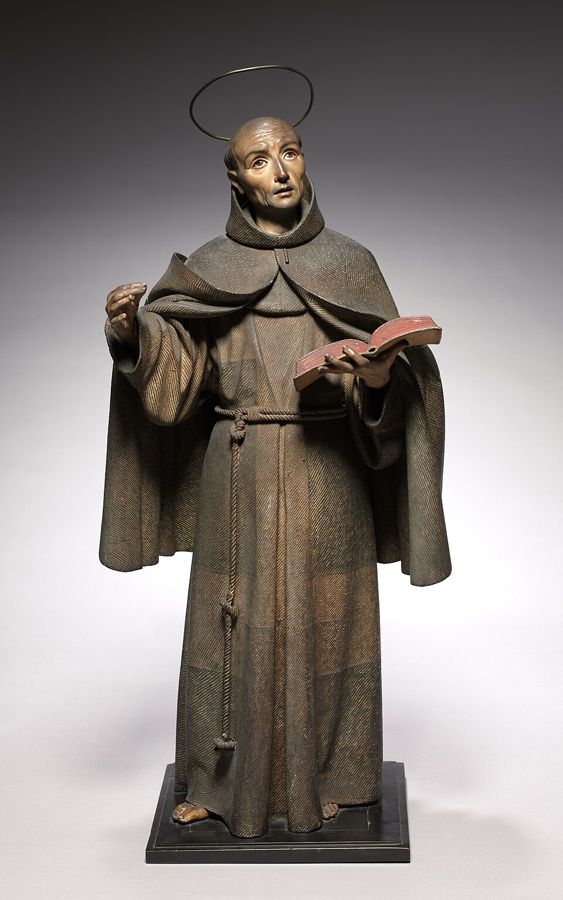
Baring-Gould’s sources: Roman Martyrology. Beatified by Gregory XV. in 1622, and canonized by Clement IX. in 1669. Authorities: — A Life by F. John of S. Mary, written in 1619; another by F. Martin of S. Joseph in 1644. Mention by S. Theresa in her Memoirs, &c.] S. Peter was bom at Alcantara, a small town in the province of Estramadura in Spain, in 1499. His father, Alphonso Garavito, was a lawyer, and governor of the town. His mother was of good extraction, and both were persons eminent for their piety and personal merit in the world. He studied law at the University of Salamanca. In 1513, after two years of university life, he returned to Alcantara, where he deliberated about the choice of a state of life. The result of his deliberations was that he embraced the religious life in the Order of S. Francis in the convent of Manjarez. During his novitiate he laboured sedulously to crucify the flesh with its affections and lusts. He never lifted his eyes from the ground, and was ignorant whether his cell were ceiled or had the bare rafters. For half a year he had charge of the refectory, and allowed the brethren to go without apples and pomegranates because he would not lift his eyes to the trees to see whether there were any ripe for the table. He tutored himself into profound indifference towards every thing and person that surrounded him. He did not even know by sight one of the friars who lived for years with him in the same house; he was unconscious whether the church in which he daily worshipped were vaulted or not He had no other bed than a skin laid on the floor, and on this he knelt for prayer, and crouching on his heels leaned his head against a spike driven into the wall to take a briet and troubled sleep. A few months after his profession he was removed to Belviso, where he built himself a cell with mud and wattles. Three years after he was made superior of a small convent at Badajos. In 1524 he was ordained priest, and the ensuing year made guardian of the convent of Placentia.
He was a strict guardian, cutting off all relaxations, and not allowing the friars to have either relics [the bodily remains of a saint, or objects they used, kept with honor] or sacred pictures in their cells, lest they should regard them as ornaments. He wore only one serge habit with a short cloak, and absolutely no other clothes. So particular was he on this point, that when his habit was torn, and a patch put over the rent, he carefully removed the tattered portion underneath, lest he should have the enjoyment of the double cloth. One day a visitor came to see him, and was told that he was in the garden. The stranger sought him there, and was startled and abashed to light abruptly on a man stark naked, with only a little tippet hanging from his shoulders. S. Peter— for the nude person was he— mildly asked what his visitor wanted with him. “Excuse me,” said the visitor, “ I hardly expected to accost you in a condition which is scarcely decent”
“ Do not blame me, but the Gospel,” answered S. Peter \ Oct tq.] S. Peter of Alcantara. “ that commands us to possess but one coat. I have got absolutely nothing but one tunic, and whilst it is being washed and dried in the sun, as you see it yonder, where it lies on a stone, I am obliged to go stark naked.” His biographer, John a S. Maria, adds shortly after, “ Non erat ille de numero prudentum hujus saeculi.” S. Peter was wont, when much inflamed with his devotions, to roar and howl so that he frightened those who heard him out of their wits. Alban Butler terms it “ singing,” but his biographer distinctly says: “Not infrequently he uttered noises so terrible and terrifying, that the brethren were panic-struck whenever they heard them; and although this happened frequently, each several time they were as frightened as if it were the first time they had heard it.” 1 When he said mass he frequently closed the solemn functions with a prolonged yell, and then dashed off to his cell.* The more vulgar and carnal-minded of the brethren were convinced he was a lunatic, but those most devout believed he was struggling with the devil when he uttered these startling noises. What his biographer asserts, may well be believed, that no sermons ever caused such a lively emotion in the breasts of a congregation as one of these performances of the saint.
Two brethren had been lately ordained, and one of them was to say his first mass on the morrow, so he went into the garden to practise for it And as he was singing, “ In principio erat Verbum,” S. Peter, who was near, heard him, and jumped, curled up like a ball, high into the air,8 and went 1 ** Non raro edebat clamores adeo terribilcs ct terrificos, ut horrore percuterentur ratres, quotfes eos perdperent; et quamvis frequenter id acddebat, singulis tamen vicibus terrebantur, quasi turn primum illos audiissent." — Joann, a S. Maria This Butler gracefully but scarcely accurately renders, “ He sometimes was not able to contain himself from singing the divine praises aloud in a wonderful manner." proripiebat.” — Ibid.
3 “ Dicun t qui prxsentes rem viderant, per aera rap turn, et ad instar pilae contractual, tan to proruisse impetu, ut sclopeto e missus videbatur.” — Ibid, [Oct. i bounding head over heels in and out of the church, through all the four doors, and finally prostrated himself, exhausted, before the Blessed Sacrament. “ What was going on in his soul all this while,” says his biographer, “ it is not given to mortals to declare.’' An instance is recorded of his great forbearance. He rode on an ass to Avila when old, and rested before the Puerto del Pico. Having descended from his ass, he lay down on the ground, wrapped his mantle into a bundle, put it under his head, and went to sleep. The ass, in the mean time, strayed into a poor woman’s garden and made free with her vegetables. The woman, seeing the mischief done, rushed out in violent excitement, stormed at the friars, calling them a pack of idle vagabonds, and finding the owner of the ass asleep, pulled the cloak from under his neck, and his head dropping back on a stone, was bruised and cut. Just then up rode a gentleman with his servants, who had invited Peter to Avila. When he saw what had been done, he was so furious that he prepared to bum the old woman’s house down. But Peter mercifully interceded for her, and even requested him to pay for the vegetables the ass had eaten or destroyed.
The reputation of S. Peter having reached the ears of John III. King of Portugal, that prince sent for him, and Peter of Alcantara visited him twice. In 1538 he was chosen provincial of the province of Estramadura. Upon the expiration of the term of his provincialship, in 1541, he went to Lisbon, to join Father Martin a Santa Maria, who was introducing a reform of the Franciscan Order, and was building a hermitage on the hill of Arabida at the mouth of the Tagus opposite Lisbon. The duke of Aveiro gave the ground and assisted in the erection of suitable cells. The hermits of Arabida wore nothing on their feet, lay on faggots and vine-twigs, never ate flesh or drank wine, and ocl 19.3 •S'. Peter of A Icantara. 49 1 took fish only on festivals. Peter engaged to awake the community at midnight, when they said matins together; after which they continued in prayer till break of day. Then they recited prime, and this was followed by one mass only, according to the institution of S. Francis. After this, returning to their cells, they remained alone till terce, which they recited together, as they did all the other canonical hours. The time between vespers and compline was devoted to manual labour. The cells were very small; that of S. Peter was so much so that he could neither stand up nor lie down in it at full length.
The general of the Franciscan Order having sanctioned this reform, S. Peter was appointed guardian of the convent of Palhaes, in which novices were received. In 1554, not satisfied with this reform, he resolved to institute another on a still more rigorous plan, and for this purpose he obtained a brief from Pope Julius III. The first convent of the Discalced of his reform was erected at Pedroso in the diocese of Valentia, in 1555. This convent was only thirtytwo feet long and twenty-eight feet wide. The cells were mere closets, half filled by the beds, which consisted of three boards.
The Count of Oropeza founded two more convents for the saint, and some other houses received his reformation. In 1561 he formed them into a province, and drew up rules for them, regulating the dimensions of the cells, refectory, church, &c. Each cell was to be seven feet long, and the church not more than twenty-four. The number of friars in each convent was not to exceed eight; they were to go barefoot, without sandals; to lie on hard boards raised one foot above the ground; flesh, fish, eggs, wine were forbidden, and three hours a day were to be devoted to mental prayer.
In 1562, by bull of Pius IV., the reformed convents of S. Peters congregation were freed from the jurisdiction of the general of the Franciscan Order.
He was making the visitation of his convents when he fell sick at Viciosa. He was carried to Arenas, and died there on October 18th, 1562.
“ What an' excellent example,” says S. Theresa, in her u Life,” “ has God recently taken from us, in the person of that blessed man, Father Peter of Alcantara ! The world was no longer able to endure such perfection. Men say that our health is not now so good as of old, so that we do not live in the same manner as people did formerly. But this holy man lived in our days, and he trampled the world under foot as thoroughly as did the saints of old. How great was the soul God bestowed on this saint of whom I am now speaking, which enabled him during forty-seven years to continue a course of such sharp and vigorous penance ! I will say something about it, for I know it is all true.
“ He told it to me and to another, from whom he concealed little; and the reason why he told it, was the great love he bore me; and this the Lord gave him to protect and encourage me at a time of my greatest necessity. He told me how, to the best of my remembrance, he had not slept more than an hour and a half between day and night for the space of forty years; and that this was the most difficult of his penances to acquire. But in order to overcome sleep he always either stood or knelt, and when he slept it was in a sitting posture, leaning his head against a little piece of wood which he had driven into the wall: he told me that he could not lie down at full length in his cell, even if he wished it, for it was not above four and a half feet long. During all these years he never put on his hood, how hot soever the sun, or how great soever the rain might be. He never wore anything on his feet, and his body was clad Oct. ZQ.] S. Peter of Alcantara.
only in a habit of thick coarse sackcloth, without anything next his skin, and this as tight as he could endure, with a short mantle of the same material over it. He told me, that when the weather was extremely cold he was accustomed to put off his mantle, and to leave his door and little window open, so that when he afterwards put on his cloak and shut his door, his body might be comforted by the slight additional warmth. It was usual for him not to eat till the third day. He asked me why I was astonished at this. He assured me it was quite possible for those who accustomed themselves to it. A companion of his told me that sometimes he ate nothing for eight days; this perhaps may have been when he was in prayer, for then he used to have great raptures and impulses of the love of God, of which I myself was an eye-witness. His poverty was extreme, and so also was his mortification from his youth; for he told me he had lived three years in a house of his Order without knowing any of the religious, except by their speech, for he never lifted his eyes from the ground. Hence, when he was forced to go from place to place, he was obliged to follow some other religious. This was the case on journeys. As to women, for many years he never looked at a single one. He told me that it was now all the same to him whether he saw any one or did not see them; but when I became acquainted with him he was very old, and his weakness was extreme. He looked like one cut out of the gnarled roots of trees. With all his sanctity he was very affable, though he expressed himself in few words, unless some question were asked him. His conversation was agreeable, for he had an excellent understanding. I shall add no more, but only that he died as he lived, preaching to and admonishing his friars. When he saw his last end approaching, he exclaimed, 1 1 was glad when they said unto me, We will go into the house of the Lord!1 and so, kneeling down, he expired. Since then our Lord has been pleased to let me enjoy more of him than I did when he was alive, for he gives me advice in many things. I have often seen him in great glory. The first time he appeared, he said, * O happy penance, which has obtained so great a reward ! ’ A year before he died he appeared to me, when we were at some distance from each other. I understood that he was to die, and I warned him of it. When he expired he appeared to me, and told me that he was going to rest. I did not then believe it, but yet I mentioned it to some persons, and within eight days after the news came to us that he was dead; or rather, to speak more properly, that he had then begun to live for ever. Behold here the severe penance of his life, which ended in so much glory that methinks he comforts me now much more than when he was alive. Our Lord told me once, that men who should ask anything of Him in the name of Peter of Alcantara, should of a certainty have their prayer granted; and I have myself recommended many things to him that he might beg them of our Lord, and I always found them granted. May our Lord be blessed for ever.”
S. Peter was the author of a little book on “ Mental Prayer,” which has been much esteemed, and another short treatise on the “ Interior Life.”
oet SS. Caprasius and Comp. October ao. S. Felician, B.M. at Minden; cire. a.d. 95a* SS. Caprasius and Comp., MM. at Agen; arc. a.d. 999. S. Artemius, A f. at Antioch, in Syria; a.d. 363. SS. Martha and Saula, KF. MM. at Cologne; a.d. 451.* S. Brad an, C. in the Isle of Man; 7 th cent. S. Sindulp, H. at A u sconce, near Rkeimt; 7th cent. S. Fintan Morldubh, Ab. at Clonenagh, in Ireland; A.D. 695. S. Irene, M. at Santarem, in Portugal; a.d. 653. S. Vitalis, B. of Salzburg; cire. a.d. 73a S. Acca, B. of Hexham; a.d. 740.
S. John C anti us, P.C. at Cracow; circ. a.d. 1473.