Roman Martyrology, Molanus [a 16th-century Flemish scholar who edited saints’ calendars] in his addition to Usuardus [a 9th-century monk of Paris who compiled a list of saints for each day], Ferrarius, &c. Authority: — A life in Greek attributed incorrectly to Eusebius [Eusebius of Caesarea (d. c. 339), the first historian of the Church] the monk, his companion. The style of the earlier part of this life is certainly ancient, the latter part consists of miracles, and has less appearance of antiquity. There is another life wholly apocryphal, falsely attributed to S. Athanasius [bishop of Alexandria (d. 373), great defender of the Nicene faith]. This was forged at Agyra by some one who was not satisfied with the late date given in the more gennine life to the Saint, and wished to make him a companion and disciple ofS. Peter, being zealous rather for the honour of his city than for historic truth. The following account is 1 from the first life which, in its main outlines, is no douht trustworthy.] In the reign of Arcadius the emperor there lived in Thrace a Syrian named Theodosius [name of Roman emperors; Theodosius I (379–395) made Christianity the state religion], whose wife was a Roman woman named Augia. They had three sons, who were employed in buying and selling horses. Now it fell out that before the feast of the Exaltation of the Holy Cross,1 the young men were driving a number of young colts towards Constantinople, where was a large horse-fair, and as they were traversing the river Sangaris, which was full of water, owing to recent storms, some of the colts were swept down, and the young men were drowned in endeavouring to rescue them. And when the news reached Theodosius, VOT~ V.
1 Sept. 14th according to the Greeks. he was grieved sore, but being full of trust in God, he said, “The Lord's Name be praised, nowand for evermore,'' and he prayed for the souls of his boys, and gave large alms. But Augia could not be comforted, but wept sore night and day. Then the prayers and alms-deeds of Theodosius came up as a memorial before God, and He looked upon His handmaid in compassion, and she conceived and bare a son, and they called his name Philip. Now Augia was comforted, and being full of gratitude to God, she dedicated her child to Him, as of old did the holy Hannah devote the infant Samuel. When Philip was aged twenty-one he was ordained deacon, and he spoke fluently the Syrian tongue, and was well instructed in ecclesiastical discipline. But he had often heard his mother commend the piety of the Romans, how that in the churches at Rome all were serious and recollected, and none turned their heads over their shoulders to see who were coming in at the door, “ and there it was thought a great crime to whisper and giggle on entering the church.'' Hearing this, Philip ardently desired to visit Rome, and he confided his desire to his father. Now Theodosius was a good man who always bent his will to what he considered to be the will of God, and seeing the fixity of his son's purpose, he took his hand and turning to the east, prayed in the Syrian tongue, saying, “ God of Abraham, Isaac and Jacob, into thy hands I commend this thy servant. Do with him as seemeth best in thine eyes ! ” Then they embraced, and he sent him away without having told Augia that she was to lose her son. And when the young deacon's form disappeared on the horizon, the old man came slowly back to his home to break the news to his wife.
But Philip set sail for Rome, and a storm fell on the ship, and it was in sore distress. Then he prayed, standing in the bows facing the wind and rain, “O my God! To Thee did my father confide me. Let me not be lost in the sea as my 6". Philip of Agyra.
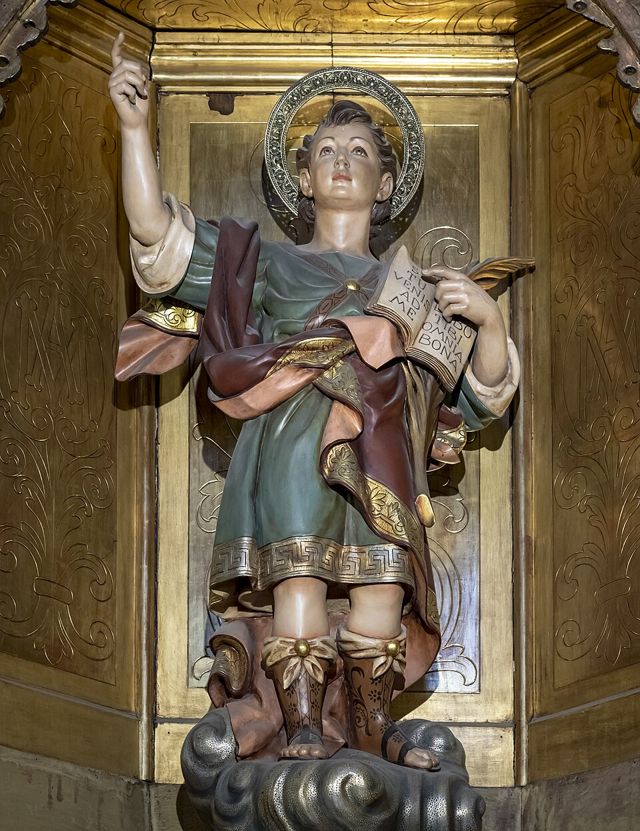
brothers were lost in the river.” And by God’s help the vessel came to land- With Philip travelled a certain Eusebius, a Greek monk, and they came to Rome, and stood beside the door of the basilica of S. Peter. Then the pope was told in the spirit to go to the door, and on the left side he would find a young deacon in a cloak (phelonion) and he was to make him minister that day at the altar. But when the Holy Father spoke to Philip, the young deacon reddened with shame, for he could not speak a word of Latin, V and the pope knew not a word of Syriac. Then the pope signed his lips and bade him serve, and the young man went and ministered to him at the altar, and he responded all in the Latin tongue.1 And the pope was pleased with the young man, and he gave him a book2 written with his own hand, “by the virtue of the Holy Ghost/’ and ordained him priest, and sent him to Sicily, saying, “Take this apostolic book to-day, and when thou hast reached the eastern parts of Sicily, thou wilt find a place called Agyra, in the region of Mount Etna, from which mountain fire breaks forth, and it vomits perpetual flame, and there Satan dwells with his spirits and all his armies, possessing it by a sort of right of inheritance.” So Philip went to Sicily, and he reached the foot of Etna, and saw smoke and flame burst from the summit. Then, taking the book in his hand, he ascended to the crater, and having prayed, he cried, “ Show, O Lord, Thy face, and drive away all this host of devils !” and he signed the cross over the crater with the book. And as he 1 As Eusebius, or whoever wrote the life, gives the responses, and they are from Ihe Greek liturgy and not from the Roman, it is probable that tb«re really was no great marvel wrought, but that Philip responded as he was wont iu the East, and served as well as he could, considering the difference in the rites.
2 What book it was— “ Apostolic volume ” it is called— is not clear. It may have been the Gospels, or the Canonical Epistles, or it may have been, as Henschenius thinks, a book of exorcisms.
ie>4 [May is* came down, the cinders started under his feet and skipped down the cone in great multitudes, and occasionally he dislodged pieces of lava, which went down with bounds, and in his excited imagination he fancied they were demons racing down the mountain before him.
Philip settled at Agyra, the modern S. Filippo d’Aazira, where he wrought many miracles, and died at the age of sixty-three.