Baring-Gould’s sources: Roman Martyr ology. That attributed to S. Jerome, Bede, Hrahanus, Usuardus, Ado, Notker. Ancient and Reformed Anglican Kalendars. By the Greeks on Nov. 14th, also by Copts. The Acts are apocryphal, hut may, and prohably do contain some foundation of truth. The testimony of Papias and Polycrates, quoted by Eusebius, may, however, be relied on; Papias had spoken with the daughters of S. Philip.] AINT PHILIP was bom at Bethsaida, a town near the Sea of Tiberias, the city of SS. Andrew and Peter. Of his parents and way of life the Gospel history takes no notice, though probably he was a fisherman — the ordinary trade of that VOL. V.
[May i* place- He had the honour of being first called to the discipleship, which thus came to pass Our Lord soon after His return from the wilderness, having met with S. Andrew and his brother S. Peter, after some short discourse parted from them; and the very next day, as He was passing through Galilee, He found S. Philip, whom He presently commanded to follow Him; so that He had the prerogative of being the first of our Lord’s disciples. For though SS. Andrew and Peter were the first that came to and conversed with Christ, yet they immediately returned to their trade again, and were not called to the discipleship till above a whole year after, when S. John the Baptist was cast into prison.
S. Clement of Alexandria reports, as a well-known fact, that S. Philip was the one who asked Christ to be allowed to first go and bury his father, before he followed Him, and received from Christ the answer, “Let the dead bury their dead.” (Matt viii. 22.) It is related that, in the distribution of the several regions of the wbrld made by the Apostles, Upper Asia was allotted to S. Philip as his province, where he applied himself with indefatigable diligence and industry to recover men out of the snare of the devil, to the embracing and acknowledgment of the truth. By the constancy of his preaching and the efficacy of his miracles, he gained numerous converts, whom he baptized into the Christian faith, at once curing both souls and bodies, dispossessing demons, settling churches and appointing pastors to them. Having for many years successfully exercised his apostolical office in all those parts, he came at length to Hierapolis, in Phrygia, a rich and prosperous city, but a stronghold of idolatry. Amongst the many false gods to which adoration was there paid was a huge serpent S. Philip was troubled to see the people so wretchedly enslaved to error, and, May i.].S'. Philip.
therefore, continually besought God, till by prayer and calling upon the name of Jesus Christ, he had procured the death of the monster. Upon this S. Philip took occasion to convince the people of the vainness of their superstitions with such success that many renounced their errors. Enraged at this, the magistrates of the city seized the apostle, and having cast him into prison caused him to be severely scourged. After this preparatory cruelty he was led to execution, and having been bound, he was hung up by the neck against a pillar; though others relate that he was crucified. It is further recorded that at his execution the earth began suddenly to quake, and the ground whereon the people stood to sink under them; but when they perceived this and bewailed it as an evident act of Divine vengeance pursuing them for their sins, it as suddenly stopped and went no further. The apostle being dead, his body was taken down by S. Bartholomew — his fellow-sufferer, afterwards executed — and Mariamne, S. Philip's sister (who is said to have been the constant companion of his travels), and decently buried; after which, having confirmed the people in the faith of Christ, they departed from them. S. Philip was married, and had several daughters. Some of them, says Clement of Alexandria, were married.1 Two lived single, and died at a great age, and were buried at Hierapolis, as we learn from Polycrates, quoted by Eusebius [Eusebius of Caesarea (d. c. 339), the first historian of the Church];3 another was buried at Ephesus.3 Sozomen says that the daughters of Philip raised a dead man to life;4 but Papias, whom Eusebius quotes, speaks also of this resurrection, which he says he heard from their lips, but does not say that they raised the man to life.5 The fact of S. Philip having had daughters has led some 1 Stromata III. 3 Hist. Eccl. iii. c. 31. 3 Ibid. 4 Hist. Eccl.vii. 27. 5 Hist, Eccl. iii. 39.
[May x. writers to confound him with Philip the Deacon, who lived at Csesarea, and of whose four virgin daughters mention is made in tire Acts of the Holy Apostles. He was one of the apostles who left no sacred writings behind him, the greater part of the apostles, as Eusebius observes, having little leisure to write books, through being employed in ministries more immediately useful and subservient to the happiness of mankind. But S. Epiphanius relates that the Gnostics were wont to produce a Gospel forged under S. Philip's name, which they abused to the furthering of their strange heresies.
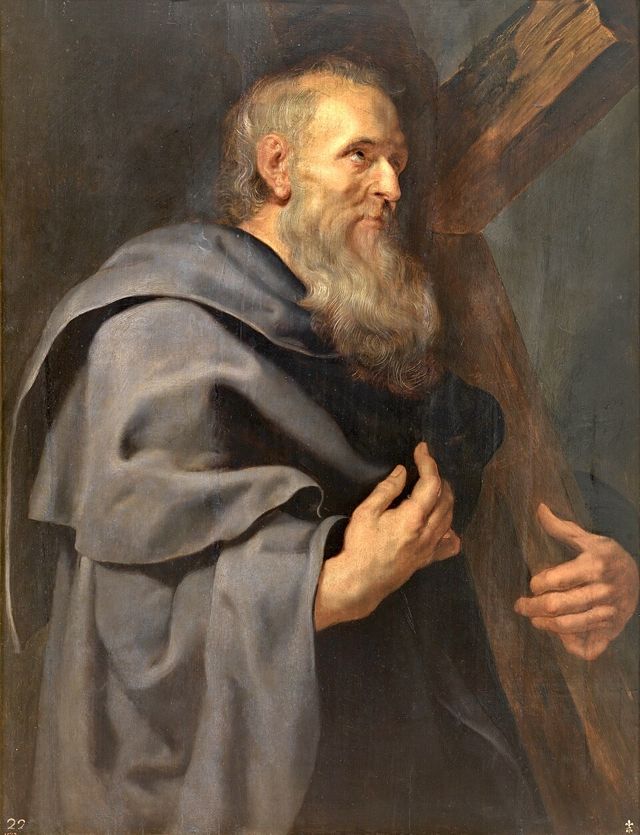
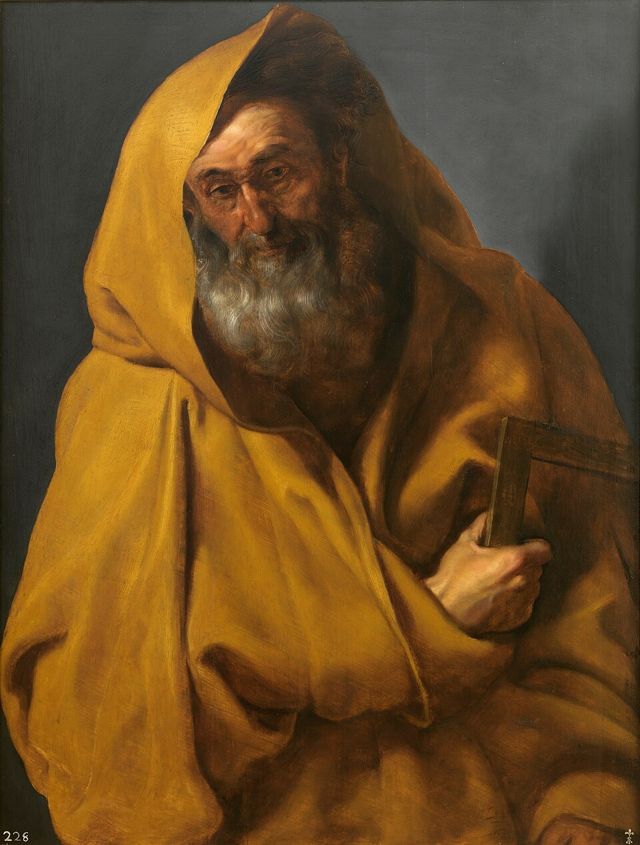
S. Philip appears u young and beardless" in the Greek paintings; in Western art he is generally in the prime of life, but with little beard. He usually carries in his hand a long staff, surmounted by a cross; sometimes it is in the Tau form, and more rarely a double cross; he often bears a basket with loaves and fishes, in allusion to S. John The arm of S. Philip was translated in 1204 from Constantinople to Florence, where it is still shewn. The crown of his head is at Troyes, obtained at the same time, other relics [the bodily remains of a saint, or objects they used, kept with honor] are at Toulouse. The body of the saint is preserved in the church of the Apostles Philip and James, at Rome, which was dedicated by Pope John III. In Cyprus, however, the head is preserved together with several bones; one of the bones was removed in 1616, and taken to Naples. But another head was given by John III., duke of Berry, son of King John II. of France, to the cathedral church of Notre Dame at Paris. Another head is shewn in Portugal, at Montemayor, in the church of S. Francis. This was given to Don Fernando Mascarenhas, envoy of king Sebastian to the council of Trent, by the Pope. The Emperor Charles IV. obtained many relics of S. Philip, which he gave to the churches of Prague, amongst others an arm of the apostle. This arm and another head of S. Philip were brought from Rome in 1355. But the head, and one whole arm, and a portion of another, are shewn in the monastery church of Andechs or Heiligen-Berg, near the Ammer-See, in Bavaria. In 1148, Pope Eugenius III. consecrated the church of S. Matthias, at Treves [Trier in Germany], and relics of S. Philip were then given to it. Gelenius says that relics of the same apostle are preserved in ten or more of the churches in Cologne.
The Spanish historians and martyrologists affirm, without a shadow of evidence, that the Greeks whom S. Philip brought to S. Andrew, and S. Andrew to our Lord (John xii. 20), consisted of a party of Spaniards.