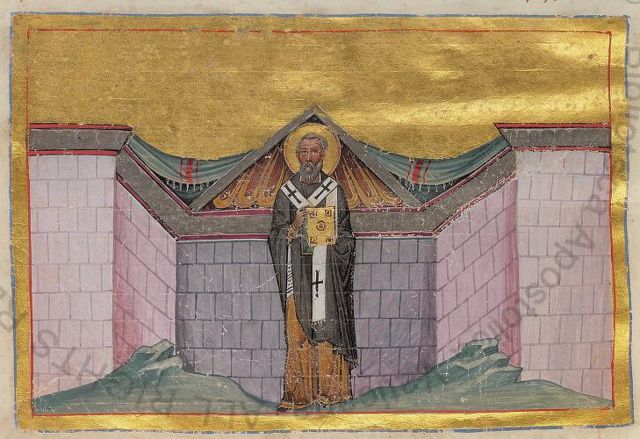
St. Philogonius of Antioch

A shepherd who stayed with his people through hard times.

Read the essentials →
December 18 · Bishop

St. Philogonius of…

St. Philogonius of Antioch

A shepherd who stayed with his people through hard times.

Traditional feast

December 18
1914 / pre-1969 calendar, per Baring-Gould (1897)

Current feast

December 20
Secondary source · Wikipedia

Represents

Bishop

Their story

Adapted in modern English from Alban Butler's Lives of the Saints · Baring-Gould original below · little is known

Philogonius was a lawyer admired for his eloquence and pure life. He was made bishop of Antioch in 318 on the death of Vitalis. When Arius began spreading his teaching, St. Alexander sent Philogonius the sentence condemning him, and Philogonius defended the Catholic faith. He earned the title of Confessor under Maximin II and Licinius (emperor in the East 308–324, who turned against Christians before Constantine defeated him), and St. Chrysostom praised his administration.

Butler gives his death in 322; Baring-Gould, the text on this page, gives 323. The sources differ.
Early life

The book says little or nothing about early life. This is how the account begins.

Thin entry · the 1897 book gives only 46 words. We have not filled the gap with invented detail.

| VOL. xv. (Dec. at. December ai.

What they represent

How they teach us to live

Drawn from themes in the original account

Learn from the kind of life it was. A shepherd who stayed with his people through hard times.

Keep their day. Remember them on December 18 with a short prayer, and ask for their help.

Read more

The full original · 46 words

Read Baring-Gould’s full account

Baring-Gould’s sources: Roman Martyrology. By the Greeks on same day. Authority: — A panegyric on his festival by S. John Chrysostom.] S. Philogonius was brought up to the law, and made himself a name for eloquence and for strict integrity. On the death of Vitalis, bishop of Antioch, in 318, Philogonius was chosen to be his successor. When S. Alexander of Alexandria condemned Arius for his heretical doctrine, he communicated the judgment to Philogonius; and when Arius went into Palestine in 320, he found, as he admits in a letter to Eusebius of Nicomedia, that Philogonius was much opposed to him. Philogonius met with trouble under Maximinus and Licinius. S. Athanasius reckons him among some of the chief bishops of his day, and S. John Chrysostom extols him as a pattern of Christian greatness and perfection.

| VOL. xv. (Dec. at. December ai. S. Thomas, Ap. M, in India; ix/ cent. S. Thkmistocles, M. in Lycia; circ. a.d. S49> S. Glyckrius, P.M. at Ntcomedia; a.d. 303. S. Sxvbkinus, B. of Trivet; 4th cent. S. Anastasius, BM. of Antioch in Syria; a.Dl 609.

Feast days

Feast: December 20
Traditional: December 18

Nine days · Free

Pray the novena
with us.

One short email a day for nine days. The day's prayer, a line from St. Philogonius of…'s story, and a nudge to keep going.

Also on December 18
Sts. Rufus and Zosimus

Sts. Rufus and Zosimus

December 18 · Martyrs
M

St. Moyses

December 18 · Martyr
B

St. Bodagisl

December 18 · Confessor
← All 1726 saints in the library
Sources & notes

Feast-day sources

Story sources

Sources

Credits

Image: Menologion of Basil II - Philogonius bishop.jpg · Authors of Menologion of Basil II (circa 985 AC, Constantinople), Byzantine manuscript illuminators[1]: Pantoleon with G · Public domain, via Wikimedia Commons

From Sabine Baring-Gould, The Lives of the Saints, new edition in 16 vols. (London: John C. Nimmo, 1897–98); text from the Internet Archive scan (OCR, lightly cleaned; errors possible). Public domain.

Image: Authors of Menologion of Basil II (circa 985 AC, Constantinople), Byzantine manuscript illuminators[1]: Pantoleon with G, Wikimedia Commons (Public domain)

From Sabine Baring-Gould, The Lives of the Saints, new edition in 16 vols. (London: John C. Nimmo, 1897–98); text from the Internet Archive scan (OCR, lightly cleaned; errors possible). Public domain in the United States. Reproduced unedited, except for short bracketed notes in grey that we added to explain names and terms (“S.” is the old abbreviation for Saint). Some history and judgments reflect 19th-century scholarship.