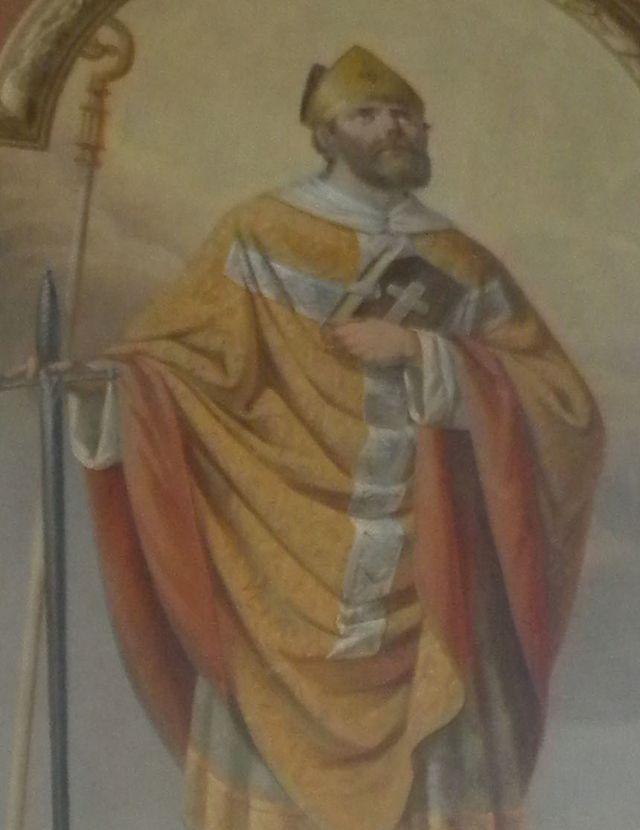
A shepherd who stayed with his people through hard times.
Read the essentials →A shepherd who stayed with his people through hard times.
November 9
November 3
Abbot
Bishop
Li. p. 30-36, utterly unhistorical. Another Life attributed by Mabillon to Bishop Warmann of Constance (d. 1034), and by Surius to Othlo of Surius, Vit SS. Nov. 3, p. 140 153. “Rather a dangerous will-o’-thewisp for the historical student than a true source of historical fafts,” Potthast.
Feed your mind with Scripture and good books. Learning and the Scriptures matter in this life.
Learn from the kind of life it was. A shepherd who stayed with his people through hard times.
Li. p. 30-36, utterly unhistorical. Another Life attributed by Mabillon to Bishop Warmann of Constance (d. 1034), and by Surius to Othlo of Surius, Vit SS. Nov. 3, p. 140 153. “Rather a dangerous will-o’-thewisp for the historical student than a true source of historical fafts,” Potthast. A third, metrical Life, probably by Abbot Heinrich of Reichenau (d. 1234), in Mone, Quellensammlung, i. p. 39-45.] The biographers of S. Pirminus say that he placed his seat at Meltis. Accordingly the Roman Breviary commemorates him this day as bishop of Meaux (Meldae). But he i$ also reckoned among the bishops of Metz (Metae). The Gallican Martyrology says: — " At Metz, S. Pirminus, bishop, who was raised to this seat after having rendered himself illustrious in Germany, with S. Boniface [English missionary to Germany, martyred 754], by the exercise of all apostolic functions. His miracles still render his tomb famous, and his green dalmatic and the cord with which he was girded for the sacred mysteries, are of great help in the pains of parturition. It is thought that S. Pirminus, bishop of Meaux, is not different from this one.” There never was, however, a Pirminus, bishop of Metz, any more than there was one of this name at Meaux. Paul Wamefried composed a book on the succession of the bishops of Metz in 783, and he makes no mention of Pirminus. Had he been bishop twenty-five years before, he certainly would not have been excluded. Moreover, the see of Metz [a bishop’s “see” is his diocese, named from his seat (Latin sedes)] was filled between 743 and 766 by the illustrious Chrodegang, who was preceded by S. Sigibald. The name of Pirminus does not occur in any correct list of the bishops of Meaux.
Hermann the Cripple, a good authority, who wrote in the middle of the nth century, says, under date 724: “Saint Pirminus, abbot and bishop-rural, was led by the princes Berchthold and Vehi to Charles (Martel), and by him appointed to the island of Reichenau, whence he expelled the serpents, and instituted therein during three years the monastic life.”
He seems to have been regionary bishop, without fixed see, and it was only the ignorance of his biographer which planted him among the bishops of Metz, if Metz were intended by Meldis. Chastelain, however, thinks Medlin, on the confines of the diocese of Trfeves, is meant; others suppose some spot now unknown.
Sintlaz, a chief in the neighbourhood of the Lake of Constance, gave him the lovely green island of Reichenau, lying in the lower arm of the Lake or Zeller See, and there he founded the abbey of Reichenau. The story goes that he paid a visit of devotion to Rome, but was treated with contempt by the Pope. Pirminus went to the tomb of the apostles, and set his staff on the pavement at his side, and it remained balanced on its point without falling. The Pope, seeing this marvel, regretted his discourteous reception of the stranger.
The lives of this saint are so untrustworthy that it is not advisable to state much concerning him, except that he is said to have founded a host of monasteries. Altaich, Pfeffers, Murbach, Schutterau on the Rhine, in the diocese of Strassburg, Gegenbach, Schwarzheim, Weissenburg, Neuwyler, Maurmunster, Mansee, Pfaffenmiinster, and Horenbach, all claim Pirminus as their founder. It is exceedingly improbable that this should be so. Horenbach is on the confines of the dioceses of Trfeves and Metz, and there he died and was buried. A book of his, “ Libellum de singulis libris canonicis,” contains some curious notices of the superstitions of his day..S'. EnglcU.
Feast: November 3
Traditional: November 9
One short email a day for nine days. The day's prayer, a line from St. Pirminus's story, and a nudge to keep going.
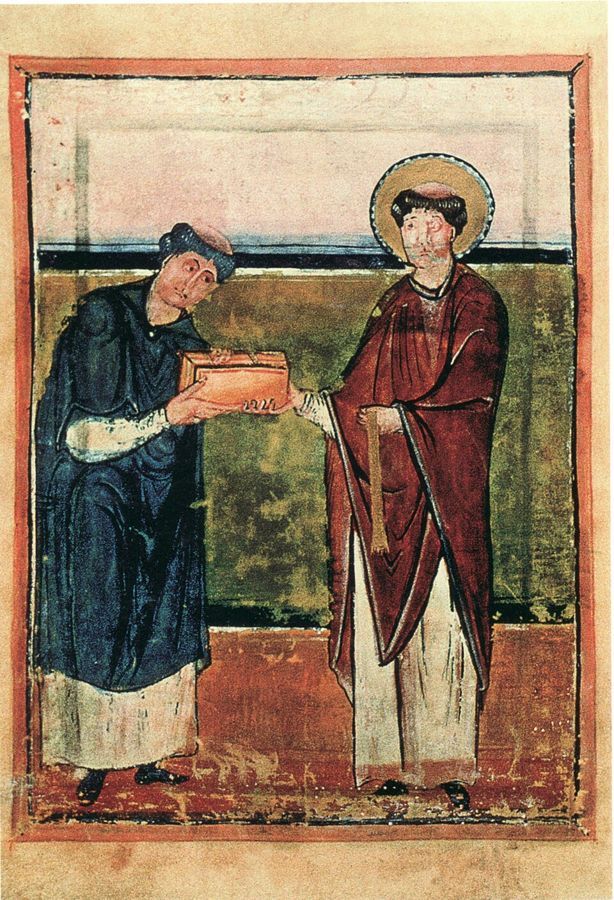
Image: Hornbacher Sakramentar fol. 8v.jpg · Template:Hans G.Christoph · Public domain, via Wikimedia Commons
From Sabine Baring-Gould, The Lives of the Saints, new edition in 16 vols. (London: John C. Nimmo, 1897–98); text from the Internet Archive scan (OCR, lightly cleaned; errors possible). Public domain.
Image: Template:Hans G.Christoph, Wikimedia Commons (Public domain)
From Sabine Baring-Gould, The Lives of the Saints, new edition in 16 vols. (London: John C. Nimmo, 1897–98); text from the Internet Archive scan (OCR, lightly cleaned; errors possible). Public domain in the United States. Reproduced unedited, except for short bracketed notes in grey that we added to explain names and terms (“S.” is the old abbreviation for Saint). Some history and judgments reflect 19th-century scholarship.