F
Sts. Fusca and Maura
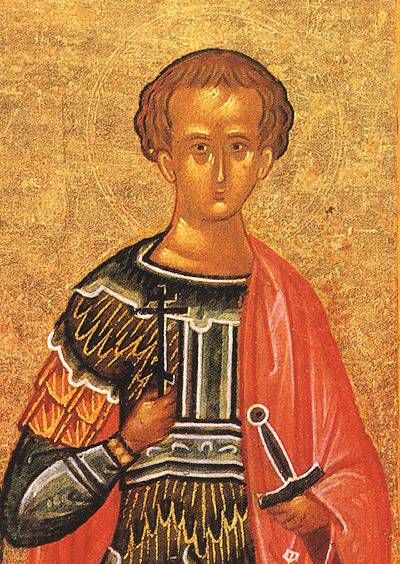
St. Polyeuctus
C
Faithfulness to Christ when it cost everything.
February 13
Not verified yet
Bishop
Martyr
The following fragment is all that remains of the Acts of S. Polychronius, slightly epitomized at the commencement: "In those days the storm rose under Decius Cæsar, and many Christians were slain in the city of Rome. Galba being regent in Rome, Decius went against the Persians.
Learn from the kind of life it was. Faithfulness to Christ when it cost everything.
Keep their day. Remember them on February 13 with a short prayer, and ask for their help.
The following fragment is all that remains of the Acts of S. Polychronius, slightly epitomized at the commencement:
"In those days the storm rose under Decius [Roman emperor 249–251, who ordered everyone to sacrifice to the gods] Cæsar, and many Christians were slain in the city of Rome. Galba being regent in Rome, Decius went against the Persians. Coming to the city Ponticum, he stayed there, but he was warring. Then Decius went up into the Median hill-country, and gained a victory, and took several cities of the Persians, as Babylon, Bactria, Hyrcania, Cordula, where he found many Christians, whom he slew with tortures. At that time he found in the city of Babylon, a bishop named Polychronius, with the priests Parmenias, Elymas, Chrysotelus, and the deacons Luke and Mucius; whom, when he had taken, he ordered to be led forth and to sacrifice to idols. Then Polychronius answered promptly, 'We offer ourselves to the Lord Jesus Christ, and will not bow to devils, or idols made with hands.' Then Decius ordered him and his clergy to prison. And he built there a temple to Saturn, and made a gypsum image, and gilded it.... [48] And when it was ready, he ordered Polychronius, his priests, and deacons, to be led before him, and he questioned them, saying, 'Thou art the sacrilegious Polychronius, who will not keep the commandments of the gods of the Emperor.' But Polychronius answered not. Then Decius said to the clergy, 'Your chief is silent.' Parmenias answered, 'Our chief will not defile his mouth; he keeps the command of Our Lord, Cast not your pearls before swine. Dost thou deem it seemly that what has once been purified should be defiled with dung?' Decius said, 'Ha! we are dung, are we?' and he ordered their tongues to be cut out. Now when they had cut out the tongue of Parmenias, [49] Parmenias exclaimed, 'O blessed father Polychronius, pray for me, for I see that the Holy Spirit rules thee, signs thy mouth, and distils honey thereunto.' Decius said, 'Polychronius, sacrifice to the gods;' but he answered not a word. Then Decius ordered his mouth to be beaten in with stones; and he, as they beat him, raised his eyes to heaven, and spread forth his hands, and so expired."
Feast: February 13
One short email a day for nine days. The day's prayer, a line from St. Polychronius's story, and a nudge to keep going.
From Sabine Baring-Gould, The Lives of the Saints, new edition in 16 vols. (London: John C. Nimmo, 1897), digitized text from Project Gutenberg. Public domain.
From Sabine Baring-Gould, The Lives of the Saints, new edition in 16 vols. (London: John C. Nimmo, 1897), digitized text from Project Gutenberg. Public domain in the United States. Reproduced unedited, except for short bracketed notes in grey that we added to explain names and terms (“S.” is the old abbreviation for Saint). Some history and judgments reflect 19th-century scholarship.