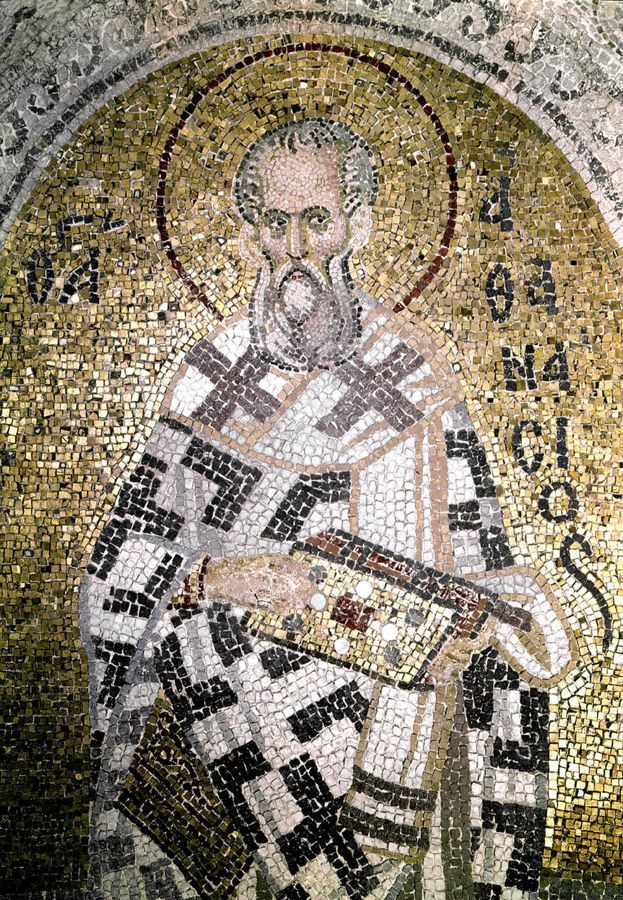
Baring-Gould’s sources: Commemorated by Greeks and Latins on the same day. Authority:—His life, written by Mark the Deacon, his disciple.
Porphyrius , a native of Thessalonica, in Macedonia, was of a noble and wealthy family. The desire of renouncing the world made him leave his friends and country at twenty-five years of age, in 378, to pass into Egypt, where he consecrated himself to God in a famous monastery in the desert of Sceté. After five years spent there in the penitential exercises of a monastic life, he went into Palestine to visit the holy places of Jerusalem. After this he took up his abode in a cave near the Jordan, where he passed other five years in great austerity, till he fell sick, when a complication of disorders obliged him to return to Jerusalem. There he never failed daily to visit all the holy places, leaning on a staff, for he was too weak to stand upright. It had happened that, about the same time, Mark, an Asiatic, and the author of his life, came to Jerusalem with the same intent. He was much edified by the devotion with which Porphyrius visited the holy places. And seeing him, one day, labour with great pain up the stairs in the chapel built by Constantine, he ran to him to offer his assistance; but Porphyrius refused it, saying, "It is not right that I who am come hither to supplicate pardon for my sins should be eased by any one: rather let me undergo some labour and inconvenience, that God, beholding it, may have compassion on me." He never omitted his visits of piety to the holy places, and daily partook of the Holy Sacrament. The only thing that afflicted him was, that his fortune had not as yet been sold for the use of the poor. This he commissioned Mark to do for him, who accordingly set out for Thessalonica, and in three months' time returned to Jerusalem with money and effects, to the value of four thousand five hundred pieces of gold. When the blessed man saw him, he embraced him, with tears of joy. But Porphyrius was now so completely recovered, that Mark scarcely knew him to be the same person: for his body was erect and vigorous, and his face looked full, fresh, and ruddy. Porphyrius perceiving his friend's amazement, said with a smile, "Be not surprised, Mark, to see me in perfect health and strength, but admire the unspeakable goodness of Christ, who can easily cure what man has despaired of." Mark asked him by what means he had recovered. He replied, "Forty days ago, being in extreme pain, I made a shift to reach Mount Calvary, where, fainting away, I fell into a kind of trance, during which, methought I saw our Saviour on the cross, and the good thief hanging beside him. I said to Christ, Lord, Remember me, when Thou comest into Thy kingdom : whereupon he ordered the thief to come to my assistance, and he, raising me off the ground on which I lay, bade me go to Christ. I ran to Him, and He coming off His cross, said to me, Take this wood (meaning the cross) into thy custody . In obedience to Him, methought I laid it on my shoulders and carried it some way. I awoke soon after, and have been free from pain ever since, and without the least appearance of my having ever ailed any thing." Mark was so edified with the holy man's discourse and good example, that he resolved to live with him, for he was endued with a divine prudence, an eminent spirit of prayer, and a complete control over his passions. He distributed all the money and effects Mark had brought him among the necessitous in Palestine and Egypt, so that in a very short time, he had reduced himself to the necessity of labouring for his daily food. He therefore learned to make shoes and dress leather, while Mark, being well skilled in writing, obtained a handsome livelihood by copying books. He therefore desired the saint to partake of his earnings. But Porphyrius replied, in the words of S. Paul, He that doth not work, neither let him eat . He led this laborious and penitential life till he was forty years of age, when the bishop of Jerusalem ordained him priest, though much against his will, and committed to him the keeping of the holy Cross. This was in 393. The saint changed nothing in his austere life, feeding only upon roots and the coarsest bread, and not eating till after sunset, except on Sundays and holy days, when he ate at noon, and added a little oil and cheese; and a small quantity of wine in the water he drank. This was his method of living till his death. Having been elected bishop of Gaza without his knowledge, in 396, John, the metropolitan [the archbishop who heads a group of dioceses] and archbishop of Cæsarea, wrote to the patriarch [the title of the bishops of the great ancient sees: Rome, Constantinople, Alexandria, Antioch, Jerusalem] of Jerusalem to desire him to send over Porphyrius, that he might consult him on certain difficult passages of Scripture. He was sent accordingly, but charged to return in seven days. Porphyrius, receiving this order, seemed at first disturbed, but said, "God's will be done." That evening he called Mark, and said to him, "Brother Mark, let us go and venerate the holy places and the sacred Cross, for it will be long before we shall be able to do it again." Mark asked him why he said this. He answered, "Our Saviour appeared to me the night past, and said 'Give up the treasure of the cross which thou hast, for I will marry thee to a wife, poor indeed, and despicable, but of great piety and virtue. Take care to adorn her well; for, however contemptible she may appear, she is My sister.' This," said he, "Christ signified to me last night: and I fear, in consequence, that I am about to be charged with the sins of others, whilst I labour to expiate my own; but the will of God must be obeyed." When they had venerated the holy places, and the sacred Cross, and Porphyrius had prayed long before it, with many tears, he shut up the Cross in its golden case, and delivered the keys to the bishop; and, having obtained his blessing, he, and his disciple, Mark, set out, with three others. They arrived the next day, which was Saturday, at Cæsarea. The archbishop obliged them to sup with him. After spiritual discourse they took a little sleep, and then rose to assist at the night service. Next morning the archbishop bid the Gazæans lay hold on Porphyrius, and, while they held him, he ordained him bishop. The holy man wept bitterly, and was inconsolable at being promoted to a dignity for which he judged himself unfit. The Gazæans, however, performed their part in endeavouring to comfort him; and, having assisted at the Sunday office, and stayed one day more at Cæsarea, they set out for Gaza, and, late on Wednesday night, arrived there much harassed and fatigued. For the heathens living in the villages near Gaza, having notice of their coming, had so damaged the roads in several places, and clogged them with thorns and logs of wood, that they were scarcely passable.
That year happened to be one of great drought, and this the pagans ascribed to the coming of the new Christian bishop, saying that their god Marnas had foretold that Porphyrius would bring public calamities on their city. In Gaza stood a famous temple of that idol, which the emperor Theodosius [name of Roman emperors; Theodosius I (379–395) made Christianity the state religion] the Elder had commanded to be shut up, but not demolished, on account of its beautiful structure. The governor afterwards had permitted the heathens to open it again. As no rain fell the two first months after the arrival of S. Porphyrius, the idolaters, in great affliction, assembled in this temple to offer sacrifices, and make supplications to their god Marnas, whom they called the Lord of rains. These they repeated for seven days, going also to a place of prayer outside the town. But, finding all their endeavours ineffectual, they lost all hopes of a supply. A dearth ensuing, the Christians, to the number of two hundred and eighty, women and children included, after a day's fast and a night's vigil, by the order of their bishop, went in procession to S. Timothy's church, in which lay the relics [the bodily remains of a saint, or objects they used, kept with honor] of the holy martyr, S. Meuris, and of the confessor [in old usage, a saint who was not martyred, or who suffered for the faith without being killed], S. Theis, singing hymns. But, on their return to the city, they found the gates shut against them, and the heathens obstinately determined not to open them. In this situation, the Christians addressed Almighty God with redoubled fervour, imploring Him to send them the blessing so much wanted. Presently the clouds gathered, and there fell such a quantity of rain, that the heathens opened their gates, and, joining them, cried out, "Christ alone is God: He alone has overcome." They accompanied the Christians to the church, to thank God for the benefit received; and this miracle resulted in the conversion of one hundred and seventy-six persons, whom the saint instructed, baptized, and confirmed, as he did also one hundred and five more before the end of that year. The miraculous preservation of the life of a pagan woman in labour, who had been despaired of, occasioned the conversion of that family and others, to the number of sixty-four.
The heathens, perceiving their number decrease, grew very troublesome to the Christians, whom they excluded from commerce, and all public offices, and annoyed in various ways. S. Porphyrius, to screen himself and his flock from their outrages, had recourse to the Emperor's protection. On this errand he sent Mark, his disciple, to Constantinople, and went thither, afterward, himself, in company with John, his metropolitan, archbishop of Cæsarea. At Constantinople they applied to S. John Chrysostom, who joyfully received them, and recommended them to the eunuch Amantius, who had great credit with the Empress, and was a zealous servant of God. Amantius, having introduced them to the Empress, she received them with great distinction, assured them of her protection, and begged their prayers for her safe delivery, a favour she received a few days after. She desired them, in another visit, to sign her and her new-born son, Theodosius the Younger, with the cross, which they did. The young prince was baptized with great solemnity, and on that occasion the Empress obtained from the Emperor all that the bishops had requested, and in particular that the temple of Gaza should be demolished. An imperial edict was drawn up for this purpose, and delivered to Cynegius, a patrician full of zeal, who was charged to see it executed. They stayed at Constantinople during the feast of Easter, and, at their departure, the Emperor and Empress bestowed on them great presents. When they landed in Palestine, near Gaza, the Christians came out to meet them, with a cross carried before them, singing hymns. In the place called Tetramphodos, or Four-ways-end, stood a marble statue of Venus, on a marble altar, which was in great reputation for giving oracles to young women about the choice of husbands. As the two bishops, with the procession of the Christians, and the cross borne before them, passed through that square, this idol fell down of itself, and was broken to pieces; whereupon thirty-two men and seven women were converted.
Ten days after, arrived Cynegius, having with him a duke, or general, with a strong guard of soldiers, and the civil magistrates of the country. He assembled the citizens, and read to them the emperor's edict, commanding their idols and temples to be destroyed. This was accordingly done, and no less than eight public temples in the city were burnt; viz., those of the Sun, Venus, Apollo, Proserpine, Hecate, the Hierion, the temple of fortune, and that of Marnas. The Marnion, in which men had been often sacrificed, burned for many days. After this, the private houses and courts were all searched; the idols were every where burned or thrown into the common sewers, and all books of magic and superstition were cast into the flames. Many idolators desired baptism; but the saint gave them a long probation, and prepared them for that sacrament by daily instructions. On the spot where the temple of Marnas had stood, was built the church of Eudoxia, in the figure of a cross. The empress sent for this purpose, precious pillars and rich marble from Constantinople. Of the marble taken out of the Marnion, S. Porphyrius made steps and a road to the church, that it might be trampled upon. Before he would suffer the church to be begun, he proclaimed a fast, and the next morning, attended by his clergy and all the Christians in the city, they went in a body to the place, from the church Irene, singing the Venite exultemus Domino , and other psalms, and answering to every verse, Allelulia; the procession being led by a cross. They all set to work, carrying stones and other materials, and digging the foundations, according to the plan marked out and directed by Rufinus, a celebrated architect, singing psalms and saying prayers during their work. The church was begun in 403, when thirty high pillars arrived from Constantinople, two of which, called Carostiæ, shone like emeralds, when placed in the church. It took five years to build, and, when finished in 408, the bishop performed the consecration of it on Easter-day, with the greatest pomp and solemnity. His alms to the poor on that occasion seemed boundless. The good bishop spent the remainder of his life in zealously instructing his flock in the doctrine of God, and in all virtuous living.
The heathen, on one occasion, rose in sedition, attacked the house of the bishop, and set it on fire, so that he and his deacons were obliged to escape over the roof, and take refuge in the room of a maiden of fourteen, an orphan, named Salaphtha, and a heathen. The girl showed them every kindness, keeping their place of retreat secret, and supplying them with bread and cheese and vegetables. The bishop took the opportunity of infusing into the young mind of the girl the first principles of Christianity, and when the tumult was abated, and he with his companions were able to go forth in safety, he left her earnestly desiring baptism. The maiden afterwards became a zealous Christian, and was consecrated to a life of virginity by the old bishop, whom she had saved from the rage of his enemies.