A shepherd who stayed with his people through hard times.
Read the essentials →A shepherd who stayed with his people through hard times.
Read the essentials →A shepherd who stayed with his people through hard times.
March 23
December 9
Bishop
Saint Proculus was the fourth bishop of Verona. During the persecution waged by Dioclesian and Maximian against the Church, Anulinus the consul came to Milan breathing out threatenings and slaughter against the faithful. And when he had laid his hands on SS. Firmus and Rusticus, the holy bishop Proculus went to them into their prison to encourage them to strive manfully for Christ.
Stay faithful when it costs you. This account is about holding firm under pressure.
Learn from the kind of life it was. A shepherd who stayed with his people through hard times.
Saint Proculus was the fourth bishop of Verona. During the persecution waged by Dioclesian and Maximian [Diocletian’s co-emperor in the West, 286–305] against the Church, Anulinus the consul came to Milan breathing out threatenings and slaughter against the faithful. And when he had laid his hands on SS. Firmus and Rusticus, the holy bishop Proculus went to them into their prison to encourage them to strive manfully for Christ. And he kissed them and said, "Be strong in the Lord Jesus, and receive me, my brethren, as your fellow in death; for I desire greatly to be your companion, that we may have but one will and one struggle for the Lord, so that we may merit to enter into His glory and sing His praises eternally?" And they answered, "So be it." Now Anulinus had sent to have the martyrs brought before him; and the officers came to the door, and saw the old man sitting with Firmus and Rusticus, and they laughed, and said, "What does that old man want with these condemned criminals?" Then the blessed Proculus answered, "They are not condemned criminals, but crowned victors of the Lord; and would that I might share their glory!" So saying he held out his hands to the officers that they might be bound; so they bound him.
Anulinus sat on his judgment seat, and they brought before him Firmus and Rusticus, and after them the venerable Proculus. "Who is this old man?" asked the magistrate; and when they told him, Anulinus said, "He drivels, send him off." So they unbound him and beat him about the face, and drove him out of the city.
So far from the Acts of SS. Firmus and Rusticus, other accounts of S. Proculus are less authentic. According to these latter, he went to Jerusalem together with some companions, when the persecution was at an end, and was taken captive and sold as a slave; but was released, on account of his advanced age. On his way home he passed through Pannonia [a Roman province roughly covering western Hungary and parts of Austria and Croatia], and an odd story is related of the journey. The old man felt the want of a razor, and was ill-content at remaining unshaven so long. At length, passing through a country where there was no water, and unable to endure the growth on his chin and place of tonsure [shaving part of the head as a sign of entering the clergy or monastic life] any longer, he summoned water out of the rock, and giving an old blunt knife to his attendant bade him shave boldly. Then wondrous to relate the bristles on the old man came off lightly, as though mown by the keenest razor.
The relics [the bodily remains of a saint, or objects they used, kept with honor] of the saint were discovered on the rebuilding of the confession or church of S. Proculus, in 1492.
Feast: December 9
Traditional: March 23
One short email a day for nine days. The day's prayer, a line from St. Proculus of Verona's story, and a nudge to keep going.
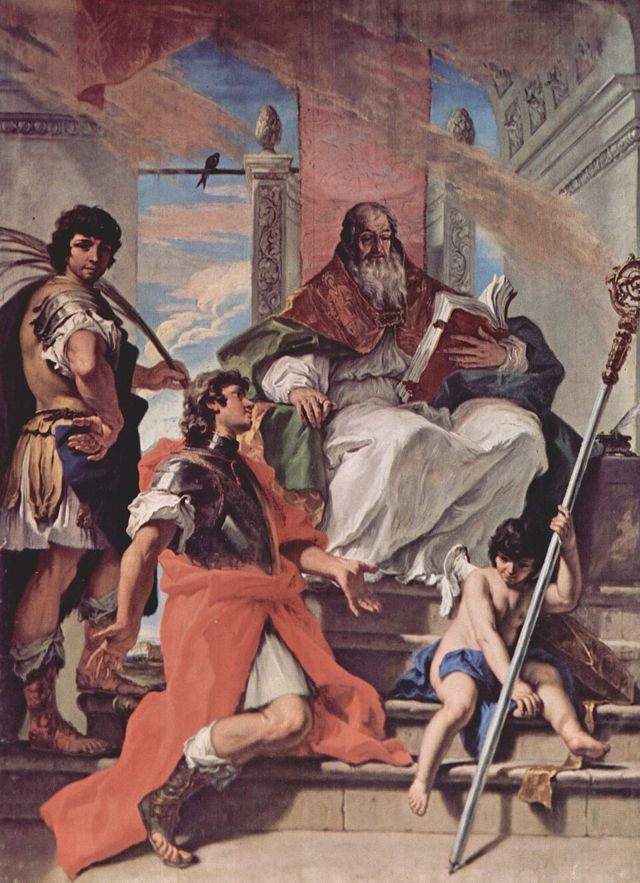
Image: Sebastiano Ricci 042.jpg · Sebastiano Ricci · Public domain, via Wikimedia Commons
From Sabine Baring-Gould, The Lives of the Saints, new edition in 16 vols. (London: John C. Nimmo, 1897), digitized text from Project Gutenberg. Public domain.
Image: Sebastiano Ricci, Wikimedia Commons (Public domain)
From Sabine Baring-Gould, The Lives of the Saints, new edition in 16 vols. (London: John C. Nimmo, 1897), digitized text from Project Gutenberg. Public domain in the United States. Reproduced unedited, except for short bracketed notes in grey that we added to explain names and terms (“S.” is the old abbreviation for Saint). Some history and judgments reflect 19th-century scholarship.
