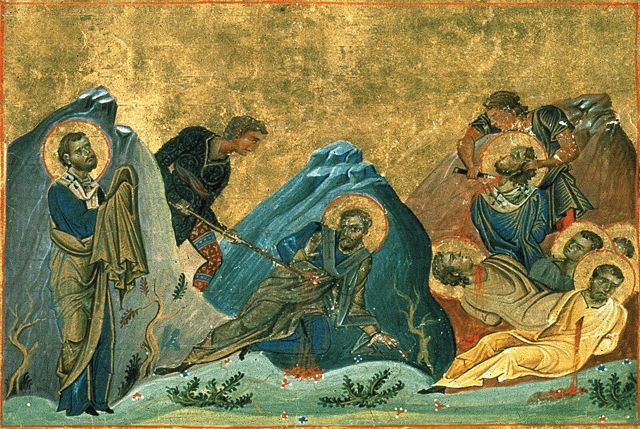
Baring-Gould’s sources: Roman Martyrology. Gallican Martyrologies, Usuardus, Ado, Notker, Wandelbert. Sarum, York, Hereford, and Durham Kalendars. Scottish Kalendar of Adam King, &c. Authority: — The Acts, a late mediaeval and worthless fiction.] S. Quintin is said to have come into Gaul with S. Lucian of Beauvais, but to have chosen Amiens as the sphere of his labours.
Rictiovarus was governor of Gaul [roughly modern France and Belgium] under Maximian [Diocletian’s co-emperor in the West, 286–305] and Diocletian [Roman emperor 284–305, who began the ‘Great Persecution’ of Christians in 303], and was a cruel persecutor. He came to Amiens and at once ordered the arrest of S. Quintin. When brought vol. xii. 24 before the. tyrant, he was asked his name. “ I bear the name of Christian,” answered Quintin, “ because I believe with the heart, and with the mouth make confession of Christ. My parents gave me the name of Quintin.” The prefect said, “ Of what race are you?” The martyr answered, “I am a Roman citizen, the son of the senator Zeno.”
The prefect asked further, “ How is it that one come of a noble race should adopt such a superstition as to adore one who was crucified by Jews?”
Quintin answered, “ The highest nobility consists in knowing God and obeying his commandments.” The governor said, “Quintin, quit this delusion, and sacrifice to the gods.”
The martyr answered, “ I will not sacrifice to the gods, for the gods of the heathen are but devils.” The prefect said, “ If thou wilt not sacrifice, I will make thee endure cruel torments.”
Quintin replied, “And I promise the Lord my God that I will not fulfil thy commands. As for thy threats, I fear them not. Do what thou wilt to my body, I commit my soul to Christ.”
Rictiovarus ordered him to be scourged. So far probably the narrative is genuine and a transcript somewhat amplified of the old Acts, but all that follows is pure invention. He was perhaps racked, certainly decapitated. Such a simple death did not suit the manufacturers of martyr-legends. They always went to work the same way, with wearisome deficiency of original genius, and their coarse and common interpolation of outrageous tortures and miraculous deliverances may be cut out without compunction. They are the same in scores of Acts amplified in the same way.
Quintin, says the legend, was being scourged, when the S. Quintin. executioners were struck with sudden paralysis and staggered like drunken men. The sight amazed Rictiovarus, who ordered Quintin at once to be cast into the innermost prison, and none of his friends to be allowed to see him. In the dungeon an angel came to him, broke off his chains, and brought him forth from the prison. He went into the market-place and began to preach. The guards on awaking from a supernatural sleep sent to seal their eyes found the prison open and Quintin in the market-place preaching. They were at once converted. Rictiovarus had him again arrested, put on the rack, his limbs dislocated, and then boiling fat and oil poured over him. Torches were also applied to his sides. But none of these tortures injured him. Then Rictiovarus ordered his mouth to be filled with quicklime, mustard, and vinegar, so as to destroy his power of speech, but this also was ineffectual. The prefect then ordered him to be conducted in chains to Augusta Vermanduorum, where stands the present town of Saint Quintin; there to have two iron spits run through him from his head to his feet, and also two iron nails driven into his fingers. As he survived this torture, and, indeed, was able to make a prayer of considerable length after the spits had been withdrawn, the prefect ordered that his head should be struck off. We learn that he was able to walk to the place of execution.
When his head was struck off a white dove issued from his severed throat and flew to heaven. His body was flung into the Somme, and remained fiftyfive years under water. At the expiration of that period a lady named Eusebia recovered it, having been instructed by an angel where to find it. She built an oratory to contain it, and this formed the nucleus of the church and town of Saint Quintin.
The church still boasts of containing a considerable portion of his relics [the bodily remains of a saint, or objects they used, kept with honor] — to be exact, the right parietal bone of the skull, with a portion of the left; part of the right upper jaw, a portion of the left upper jaw. and a small fragment of the lower jaw, with one molar tooth in it; four fragments of the occipital bone; two spinal vertebrae, fragments of the omoplates, a portion of the rotula and of the calcaneum; the major portion of the sternum. Also a left rib and a fragment of a right rib, and two false ribs; a portion of the left thigh, the left tibia, and the right hand mummified.1 S. Quintin is usually represented in military costume, holding two spits, or with a palm in his hand, and the spits thrust into his shoulders.