St. Raymond of Peñafort

St. Raymond of Peñafort (c. 1175–1275) was a Dominican priest, a great canon lawyer, and co-founder with St. Peter Nolasco of the Mercedarians. He is patron of lawyers.

Read the essentials →
January 23 · —

St. Raymond of Peñafort

St. Raymond of Peñafort

St. Raymond of Peñafort (c. 1175–1275) was a Dominican priest, a great canon lawyer, and co-founder with St. Peter Nolasco of the Mercedarians. He is patron of lawyers.

Traditional feast

January 23
1914 / pre-1969 calendar, per Baring-Gould (1914)

Current feast

January 7
Verified · General Roman Calendar

Represents

Feast

Their story

Adapted in modern English from Baring-Gould (1914) · original text below

Raymund was born in 1175 at Pennaforte, a castle in Catalonia. At thirty he went to Bologna to perfect his study of canon and civil law. In 1219 the bishop of Barcelona brought him home and made him archdeacon, and in 1222, eight months after St. Dominic's death, he took the Dominican (the Order of Preachers founded by St. Dominic) habit.

He worked hard, by preaching and example, to convert Moors and heretics, and the source says with great success. He also persuaded King James of Aragon to bring the Inquisition (the Church tribunal that investigated heresy and claims of the supernatural) into his kingdom against the Waldenses and Albigenses. Pope Gregory IX called him to Rome and made him his confessor. In 1235 he was named archbishop of Tarragona, but his tears persuaded the pope not to force it on him. In 1238 he was elected master general of the Dominicans. He visited the order on foot and put its constitutions into a more complete form.

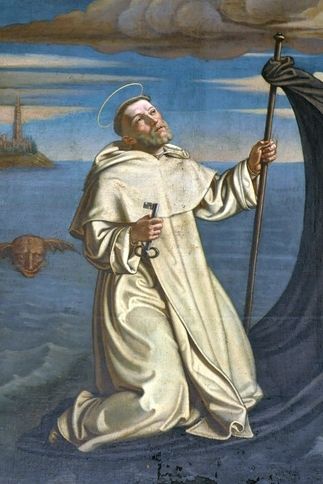
In Majorca with the king, Raymund found that James was living in adultery with a lady of his court. When the king would not give her up, Raymund asked leave to go. The king refused and forbade any ship to carry him. The story goes that Raymund spread his cloak on the sea, stood on it and was carried across to Barcelona, and that the frightened king sincerely repented. Raymund died on January 6, 1275, at the age of a hundred.

Early life

Selected sentences from the original account, unaltered.

S. Raymund was born in 1175, at Pennaforte, a castle in Catalonia.

What they represent

How they teach us to live

Drawn from themes in the original account

Share your faith, in words and by example. Preaching and conversion are central here.

Learn from the kind of life it was. A brilliant mind who used it to serve prisoners and penitents.

Read more

The full original · 535 words

Read Baring-Gould’s full account

Baring-Gould’s sources: Roman Martyrology. Authorities: The bull of his canonization, by Clement VIII., in 1601, and a life by Leander Albertus.

S. Raymund was born in 1175, at Pennaforte, a castle in Catalonia. At the age of thirty he went to Bologna, in Italy, to perfect himself in the study of canon and civil law. In 1219 the Bishop of Barcelona, who had been at Rome, took Raymund home with him and made him archdeacon of Barcelona. In 1222 he took the religious habit of S. Dominic, eight months after the founder had died. James, King of Arragon, had married Eleonora of Castile within the prohibited degrees, without a dispensation. A legate [an official representative sent by the pope] of Pope Gregory IX., in a council of bishops held at Tarragona, declared the marriage null. Acting on the mind of the prince, by his great sanctity and earnestness, Raymund persuaded him to introduce the inquisition into the kingdom to suppress the Waldenses and Albigenses, who had made many converts to their pernicious doctrines. The object of S. Raymund doubtless was that it should serve as a check to the diffusion of heresy, and be a protection to simple souls against the poison which the ministers of Antichrist strove to infuse into them. The inquisitors were to be the dogs protecting the sheep from the wolves. S. Raymund laboured diligently, by exhortation and example, to convert the Moors [the Muslims of North Africa and Spain] and heretics, and his efforts were attended with extraordinary success.

Pope Gregory IX., having called S. Raymund to Rome, made him his confessor [in old usage, a saint who was not martyred, or who suffered for the faith without being killed]. In 1235 he was named to the archbishopric of Tarragona, but, by his tears, he persuaded the Pope not to enforce his acceptance of the responsible charge. In 1238 he was chosen general of the Dominican order. He made the visitation of the order on foot, and reduced the constitution to a more complete system than heretofore. Being in Majorca with the king, he discovered that King James was living in adultery with a lady of his court. As the king would not dissolve the sinful union, the Saint implored leave to depart; the king refused, and forbade any shipper taking him into his vessel. Thereupon Raymund boldly spread his cloak on the water, and standing on it, was wafted across to Barcelona. This miracle so alarmed the king, that he became a sincere penitent. Raymund died on Jan. 6th, 1275, at the age of a hundred.

FOOTNOTES:

[115] From the mines in the Cassiterides, Devon and Cornwall.

[116] We see here an instance of the manner in which some stories of miracles were formed. Leontius, who heard the story from the clergy acquainted with all the circumstances, says that the bearer of the pots told the Patriarch that they contained money; but that, for greater security, they were labelled honey. But Metaphrastes, in telling the story, says that, miraculously, the honey was converted into gold.

S. Timothy , B. M. at Ephesus , a.d. 97. SS. Babylus , B. , and Companions , MM., at Antioch, 3rd cent. S. Felician , B. M. of Foligni, in Italy , a.d. 250. S. Macedonius , H., in Syria, beginning of 5th cent. S. Eusebia , V., at Mylasa, in Caria (Asia Minor), 5th cent. S. Cadoc , Ab., in Wales, and M., 6th cent. S. Zosimus , B. of Babylon, in Egypt, 6th cent.
Feast days

Feast: January 7
Traditional: January 23

Nine days · Free

Pray the novena
with us.

One short email a day for nine days. The day's prayer, a line from St. Raymond of Peñafort's story, and a nudge to keep going.

Also on January 23
A

St. Asclas

January 23 · Martyr
C

St. Clement of Ancyra…

January 23 · Bishop, Martyrs
St. John the Almsgiver, Patriarch of Alexandria

St. John the Almsgiver

January 23 · Feast
← All 1726 saints in the library
Sources & notes

Feast-day sources

Story sources

Sources

Credits

Image: St. Raymond of Penyafort (cropped).jpg · Tommaso Dolabella · Public domain, via Wikimedia Commons

From Sabine Baring-Gould, The Lives of the Saints, new and revised edition (Edinburgh: John Grant, 1914; first edition 1872). Public domain.

Image: Tommaso Dolabella, Wikimedia Commons (Public domain)

From Sabine Baring-Gould, The Lives of the Saints, new and revised edition (Edinburgh: John Grant, 1914; first edition 1872). Public domain in the United States. Reproduced unedited, except for short bracketed notes in grey that we added to explain names and terms (“S.” is the old abbreviation for Saint). Some history and judgments reflect 19th-century scholarship.