Baring-Gould’s sources: Not in any Marty rologies. But of considerable local veneration in Yorkshire. Authority: — An account by M. Walbran in his Memorials of Fountains Abbey, published for the Surtees Society, 1863, from MS. unpublished sources.] S. Robert was the son of John Thorne of York, and Siminima, his wife, persons of such social position in the city in the latter half of the twelfth century, that, as we have learned from Leland, the father “ had been 2 tymes maire.” His peculiar character seems to have developed itself in early life, but no other incidents of that period are recorded than that he proceeded no further in holy orders than the office of sub-deacon, and, that after he had been an inmate of Newminster Abbey in Northumberland for eighteen weeks, he retired to the place which has ever been associated with his fame. Leland, however, had been told that he forsook “ the lands and goodes of his father, to whom he was heire as eldest sonne.”
When Robert arrived at Knaresborough he found a certain knight ensconced in a solitary place, which though but a cave in a rock by the side of the Nidd, was dignified by the name of S. Giles’ Chapel. But it was a brief association; for the recreant recluse, “ instigante diabolo,” by-andby left Robert in sole possession, and “ returned like a dog to his vomit ” — namely, his wife and family. A benevolent lady residing in the neighbourhood — a Plumpton, perhaps, or a Percy — now bestowed upon him a chapel dedicated to S. Hilda, and as much adjacent land as he could dig. Here he enjoyed nearly a year in the mortification of the flesh; but one evening, while he was wrapt in meditation, five “latrunculi” having stolen “hys bred, his S. Robert of Kna resborough.
chese, hys sustenance,” the trial so far overcame his patience that he left the place — his biographer justifying the step by the command — “ When they persecute you in one city, flee ye into another/' Robert, therefore, fled to Spofforth, a village hard by; but oppressed by the crowds that followed him, he yielded to the invitation of the monks of Hedley, a cell of the Cluniac Priory of the Holy Trinity at York, in the adjacent parish of Bramham. Being dissatisfied, however, with their conversation, he returned to his former retreat at S. Hilda’s, where his patroness built him a barn with a suitable place of abode. He had now also four servants. Two were employed in agriculture, another in general purposes, while another accompanied him in collecting alms in the county for distribution among his needy clients; for, "To begge and lorynge pore men of baile This was hys purpose principale.”
One day while he was sleeping in a flowery mead, his mother, who had been sometime dead, appeared to him, wan and deformed, to tell him that ' For mettes and meseres maid unlele,’"
she was doomed to great torment, unless eased by his prayers. For a whole year, Robert interceded incessantly, and then saw her again with a joyful countenance, and the assurance that she was relieved — blessing him for his pious pains.
Robert continued here, until one day William de Stuteville, Lord of Knaresborough, coming by saw the buildings, and asked to whom they belonged. The servants replied that one Robert, a hermit and most devoted servant of God, lived there. “ Rather,” cried the Baron, “an abettor and receiver of thieves and swearing by God’s eyes that he should be expelled the forest, ordered his men to raze the place, and, if necessary, to eject the inmates by fire. The men hesitated. A few days after, he came again, like an infuriated lion, and swore by his usual oaths that he would put out their eyes if his mandate was not obeyed. ' * Yan yai durst na langer byde.
Both vnto Roberd housynge hyed, And dang them downe, bath lesse and mare; Nathyng left yai standand yair.” It is, however, by no means unlikely that the foundations of an ancient fabric, which were removed within memory from the chapel-field at S. Hiles Nook, in the township of Rofarlington, to be used in building the Roman Catholic chapel at Knaresborough, were a memorial of that day’s proceedings.
Our hermit now returned to the chapel of S. Giles— a mere hut, formed by winding the branches of trees over stakes, in front of a little cavern — " Highe and lawe unto hym hyed In faitb for to be edified and he had a garth given to him between the rock and the river. But, one day, his old enemy Stuteville passing by, “ wyth hond and hauke upon his hand,” saw smoke ascending from the hut; and having been told who dwelt there, swore, in a drunken rage, he would not close his eyes in sleep till the tenant was ejected. He postponed his purpose, however — " And rushed and bouned hym to hys bed.” Appeared to him then three men, “ blacker than ynd,” of grim and horrible aspect, two of them with an iron “ trayle,” blazing with fire and beset with burning spikes, with which they harrowed his sides as he dreamt, while the other — a vS. Robert of Knar esborough.
giant in stature — rushed to his bedside, brandishing two iron dubs, and addressed him thus. “ Cruel prince, and instrument of the devil ! rise forthwith. Take one of these clubs and defend thy neck, for the wrongs with which thou spites t the man of God; because I am sent here to fight thee on his part/’ The baron threw up his arms in wild alarm, exclaiming, “ Pity me, O man ! and spare my life; let me atone for all the ills I ever brought him, and I will do so no more.” The terrible vision then vanished; but not so the contrition. The wolf was turned into a lamb. When the morn at last came, he hastened to the cell, and with bended knees and suppliant hands, sought pardon of the holy man, who raised him, saying, “Approach, William, and receive the kiss of peace.” William then gave him all the land between the rock and Grimbald Kyrkestane; and, lest it should remain untilled, bestowed also two oxen and two horses, with as many cows. Thenceforth, too, every year, from Christmas to the morrow of the Epiphany, Robert had from the castle meals for thirteen poor men, and always alms for the needy.
Among others who came to visit him was his brother, Walter, then Mayor of York, who, being displeased with the meanness of his cell, wished him to join some religious society. Perceiving from Robert's reply — “ Here shall be my rest for ever; here will I dwell, for I have a delight therein” — that his counsel was unavailing, he sent artificers from the city, of divers kinds, who built a little chapel, in honour of the Holy Cross, of hewn stone, and prepared a house, where he might receive pilgrims and the poor. He now associated himself with a kindred spirit — meek and mild — called Ivo; but this worthy, yielding one day to Satanic temptation, ran away, and, in passing through a wood, broke his leg, and fell into a ditch. Robert, aware of the mischance, hastened to the spot, and smiling at Ivo’s plight, was reminded of his profession “ to laugh with those who laughed, and to weep with those who wept” His friend told him he laughed because this accident had been sent for his good; that “ No one putting his hand to the plough, and looking back is fit for the kingdom of God and then restored the backslider to his former condition. They never parted more, till Robert died, and were worthy brothers in asceticism; for it was remembered of Ivo that when he went, barefoot, to York, to gather alms for the poor, in the winter his blood-stained footsteps might be traced on the frozen road.
While collecting alms, Robert once asked a person of station for a cow. He granted the request; but in the sort of one ranging in the forest, so wild and vicious, that none of the donor’s servants durst approach her. Robert put his arm round her neck, and brought her home like a lamb. One of the servants, envying the facility of the capture, proposed to reclaim her by subtilty; but being forbidden, he disguised himself as a mendicant, and with limping gait, contorted eyes, and contracted hands, piteously implored her of the holy man. “ God gave, and God shall have; but it shall be to thee as thou hast presumed to feign,” was the reply. So when the “ counterfeit cripple” would have driven off his prize, he found his pretence was reality; until, confessing his fault, he was relieved, and delighted to escape alone. This was once so popular a story, that a picture of the scene, in stained glass, was set up in one of the windows of Knaresborough church, so late as the year But Robert performed a more wonderful feat than this. He suffered greatly from the intrusion of stags from Knaresborough forest among his corn, and went to the lord to pray that they might be restrained. “I give thee full permissi on, Robert,” said he, “ to shut them up in thy barn until 5. Robert of Knaresborough.
thou hast received full restitution for thy losses. ” Robert, taking a switch, drove them like lambs into his barn, and told the lord what lie had done. Finding that he had promised more than he had intended, he offered the hermit three of the stags, to be used instead of oxen, in his plough. Robert yoked them, and their submission and conduct in tilling the land was the admiration of all who passed Envious of his merits, the devil appeared to him one night as he watched in his cell, and had “thoughte to teyne hym wyth a type but meeting with discomfiture — " Aboutte hys house yis harlott hyede Hys devociouns he defyed; All the vessells yat he fand He tyfled and touched yaim with hys hand His pott, hys panne, his sause, his foule, Wyth hys fyngers fatt and foule.”
With his usual perseverance, however, after some time, he came again, with his appearance-proper modified to that of a begrimed rustic, with grinning teeth. But Robert, seizing the sprinkler, soused him with holy water, and was relieved from further annoyance, except the stench with which “ Sir Gerrard” had filled his cell. The next device was to torment the good man in his orisons, under the guise of a child; but his laughter and gambols were unheeded, till the saint, seeing the straw on the chapel floor on fire, and the house in danger, turned the plot into smoke, through the holy sign. “ Sathanas” at last, with a sad want of sagacity, assumed the form of a lad of sixteen, intending to frighten Robert by gaping and “gryning’' at him; but this was so contemptible a delusion that Robert condescended only to belabour him with his staff.
The hermit’s fame at length became so great that even King John, at the request of Sir Brian L’Isle, was induced to visit his cell, accompanied by his court. At the time of their arrival, Robert was prostrate in prayer before the altar of his chapel, and did not desist, though he was aware of the quality of his visitors. Seeing that he did not rise, and exhibit proper reverence to the king, Sir Brian said, “Brother Robert, rise quickly; behold, our lord, King John, is here.’7 Then asked Robert, rising forthwith, “ Show me which of these is my king?”
Brian answered, “This is my king, John, the most illustrious of kings.” The holy man, taking in his hand an ear of corn, held it towards the tyrant, saying, “Thou art not able, O lord my king, by thy power, to create such a thing out of nothing.”
Certain of the bystanders thereupon said, “ This man is mad, as his acts show.” It was answered by others that he was wiser than they, since he was the servant of God, in whom is all wisdom.
The king said to him, “ Robert, ask of me whatever is necessary for thee, and it shall be given.” The holy man told him that he needed nothing earthly. When the king was gone, Ivo having found that alms for the poor had not been asked of him, prevailed on his fellow to follow him; and he was granted as much of the adjacent wood as he could till with one plough. The Rector of Knaresborough afterwards demanded its tithe, but all he received was Robert's malediction for seeking to lessen the patrimony of the poor.
The last incidents that are recorded of the hermit’s life are of a prophetical character. When Sir Brian LTsle was summoned to do service in the south of England, he sought Robert’s blessing before he departed. When he gave it, S. Robert of Knaresborough.
he said he should go and prosper, but he would return no more; and it was so. At length, when his end was nigh, the monks of Fountains hastened to his cell, bringing their habit in which to invest his body for burial But he said, “ My own garment is sufficient for me, nor do I covet another.” Soon after, having bestowed his blessing on Ivo and others, who stood by, he expired. He had previously foretold that, after his death, the monks of Fountains would endeavour to take possession of his body, and expressed a wish that they should be resisted, for he would be buried where he died. They came as he had predicted, saying it was but decent and convenient that the body of so excellent a person should rather be buried in a solemn than in a sterile and desolate place. They were met by the expression of his own wishes 3 and, as soldiers had come from Knaresborough to enforce them, the men of Fountains returned sorrowing. Doubtless they had intended to have enshrined him in the new choir which they were then erecting. When he was to be committed to the tomb, a great company of persons, both rich and poor, flocked to the chapel, passionately kissing the coffin; lamenting for one who had so often afforded them consolation in their troubles, yet rejoicing that he had ascended where he might still aid them by his prayers. According to his own desire, he was buried in the Chapel of the Holy Cross, which his brother Walter had built, in a tomb before the altar, in which never man before had lain. But his influence long survived, and many bodily afflictions, said to have been cured by a visit to his tomb, were the subjects of inscriptions and pictures which, two centuries after his death, were to be seen there. The precise period of that event is not mentioned in the MS. whence the preceding particulars are derived, but in the Chronicles of Lanercost it is said that he died on the 24th of September, 1218. Although he was styled a saint within twenty years after his decease, I believe that he was never canonized.
Tumba tamen protestatur, Ubi vir hie veneratur, Haec non falsa ut affatur, Preciosa pagina. Licet non canonicatur, Adhuc autem operatur, Per hunc pater, cum precatur, Plura beneficia.
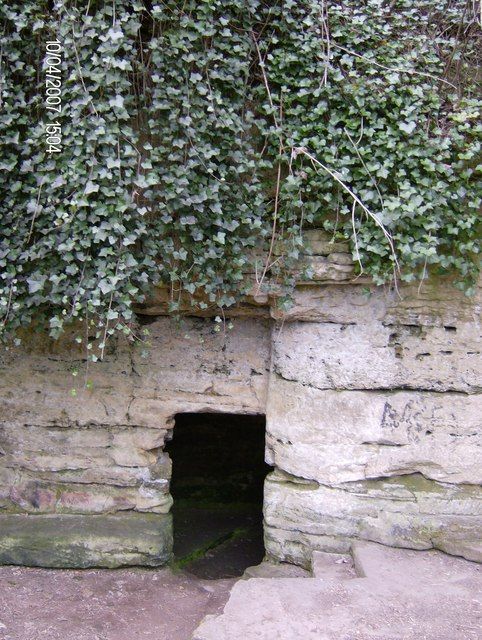
The place in which this pious and benevolent man passed the greater portion of his existence has been pointed out by tradition as a cave hewn in the rocky bank ot the river Nidd, about a mile eastward of Knaresborough. It has, however, obtained a far more extensive celebrity through the eloquent fictions of Lord Lytton, from having been the spot where Daniel Clarke was murdered, on the night of the 7th of February, 1744 — 5, either by the hand or with the privity of Eugene Aram, and where the body was concealed fourteen years.
The attraction of a new class of pilgrims to the place led, about thirty years ago, to the removal of the sand which had accumulated in the cave, and of the rubbish in front, when its identity with the hermitage of S. Robert was proved by the discovery of the foundations of a little chapel; and a fact came to light of which knowledge by the murderer might have led to the concealment of his guilt. The building, which doubtless was the Chapel of the Holy Cross, had measured sixteen feet eight inches in length, and nine feet three inches in width; the eastern end of the floor being raised for the platform of the altar, of which a portion still remains. In the midst of the western half is a coffin hewn in the rock, and corresponding, therefore, in character with that tomb in which, according to the scriptural allusion of Robert of Knaresborough.
his biographer, the remains of the holy man were laid. At the time of its discovery it was untenanted and uncovered; but, from the presence of a groove by which the lid had been secured, it evidently had been protected by the marble slab which now covers the grave of the great Royalist, Sir Henry Slingsby, in Knaresborough church, and is inscribed: “ Sancii Robert i hue saxum adventum est, sub eodemque nunc jacet hie Henricus Slingesby,” &c. — that stone having been probably brought from the Priory. Matthew Paris says, under the year 1238, “ Eodem anno claruit fama Sancti Roberti heremitse apud Knaresburg, cujus tumba oleum medicinale fertur abundanter emisisse but a glimpse of the absorbent orifice which remains at the bottom of the coffin might, perhaps, have dispelled the illusion, and referred the miraculous oil to the solution of the resinous substance with which the cover may have been fixed. An idea of the architectural character of the chapel has been lost by the removal of its ruins; and at the time of the excavation, the western end and some other contiguous foundations having been disturbed, we are unable to decide whether a cell was annexed to that extremity. It was, no doubt, maintained and served by the brethren of the Priory of Knaresborough until the period of the Reformation, when it would be abandoned. At all events, a silver coin, with the legend “ Posui Deum,’7 &c., which was found in the silt when the cave was cleared out, may show that, this barrier being removed, the river had access there as early as the time of Queen Elizabeth-