Faithfulness to Christ when it cost everything.
Read the essentials →Faithfulness to Christ when it cost everything.
August 9
August 9
Martyr
Thin entry · the 1897 book gives only 0 words. We have not filled the gap with invented detail.
Learn from the kind of life it was. Faithfulness to Christ when it cost everything.
Keep their day. Remember them on August 9 with a short prayer, and ask for their help.
(1) A Roman martyr Romanus is mentioned in the "Liber Pontificalis" (ed. Duchesne, I, 155) with three other ecclesiastics as companions in the martyrdom of St. Lawrence (10 August, 258). There is no reason to doubt that this mention rests upon a genuine ancient tradition. Like St. Lawrence Romanus was buried in the Catacomb of the Cyriaca on the Via Tiburtina. The grave of St. Romanus is explicitly mentioned in the Itineraries of the seventh century (De Rossi, "Roma sotterranea", I, 178-9). In the purely legendary Acts of St. Lawrence, the ostiary Romanus is transformed into a soldier, and an account in accordance with this statement was inserted in the historical martyrologies and in the present Roman Martyrology, which latter places his feast on 9 August (cf. Duchfourcq, "Les Gesta Martyrum romains", I, 201).
(2) In 303 or 304, at the beginning of the Diocletian [Roman emperor 284–305, who began the ‘Great Persecution’ of Christians in 303] persecution, a deacon called Romanus of Caesarea in Palestine suffered martyrdom at Antioch. Upon the proclamation of Diocletian's edict he strengthened the Christians of Antioch and openly exhorted the weaker brethren, who were willing to offer heathen sacrifices, not to waver in the Faith. He was taken prisoner, was condemned to death by fire, and was bound to the stake; however, as the Emperor Galerius [Diocletian’s co-emperor in the East and driving force of the Great Persecution] was then in Antioch, Romanus was brought before him. At the emperor's command the tongue of the courageous confessor [in old usage, a saint who was not martyred, or who suffered for the faith without being killed] was cut out. Tortured in various ways in prison he was finally strangled. Eusebius [Eusebius of Caesarea (d. c. 339), the first historian of the Church] speaks of his martyrdom in "De martyribus Palestin.", c. ii. Prudentius ("Peristephanon", X in "P.L.", LX, 444 sqq.) relates other details and gives Romanus a companion in martyrdom, a Christian by name Barulas. On this account several historians, among them Baronius [Cardinal Baronius (d. 1607), church historian who edited the Roman Martyrology], consider that there were two martyrs named Romanus at Antioch, though more likely there was but the one whom Eusebius mentions. Prudentius has introduced legendary features into his account, and his connection of the martyrdom of Barulas with that of Romanus is probably arbitrary. The feast of St. Romanus is observed on 18 November [cf. Allard, "Histoire des persécutions", IV, 173 sq.; Quentin, "Les martyrologes historiques" (Paris, 1908), 183-5].
(3) The "Martyrologium Hieronymianum" mentions martyrs of this name at several dates, chiefly in large companies of Christians who suffered martyrdom. No further particulars are known of any of them.
(4) A holy priest named Romanus laboured in the district of Blaye, in the present French department of the Gironde, at the end of the fourth century. Gregory of Tours [bishop and historian of the Franks (d. 594)] gives an account of him ("De gloria confessorum", c. xlv), and relates that St. Martin of Tours made ready the grave of the dead Romanus. An old life of St. Romanus was published in the "Analecta Bollandiana", V (1866), 178 sqq. The feast of the saint is observed on 24 November.
(5) St. Romanus, Abbot of Condat, now St. Claude in the French Jura, b. about 400; d. in 463 or 464. When thirty-five years old he went into the lonely region of Condat to live as a hermit, where after a while his younger brother Lupicinus followed him. A large number of scholars, among whom was St. Eugendus, placed themselves under the direction of the two holy brothers who founded several monasteries: Condat (now Saint-Claude), Lauconne (later Saint-Lupicin, as Lupicinus was buried there), La Balme (later Saint-Romain-de-Roche), where St. Romanus was buried, and Romainmôtier (Romanum monasterium) in the canton of Vaud in Switzerland. Romanus was ordained priest by St. Hilary of Arles in 444, and with Lupicinus he directed these monasteries until his death. His feast is observed on 28 February. Two lives of him are in existence: one by Gregory of Tours in the "Liber vitae patrum" (Mon. Germ. Hist.: Script. Merov., I, 663), and an anonymous "Vita Sanctorum Romani, Lupicini, Eugendi" [ibid., III, 131 sqq.; cf. Benoît, "Histoire de St-Claude", I (Paris, 1890); Besson, "Recherches sur les origines des évêchés de Genève, Lausanne, et Sion" (Fribourg, 1906), 210 sqq.].
(6) St. Romanus, monk in a monastery near Subiaco, Italy, at the beginning of the sixth century. He aided St. Benedict when the latter withdrew into a solitary place and regularly brought Benedict bread to support life (St. Gregory the Great, "Dialogi", II, i). Romanus later (fom 523) represented St. Benedict at Subiaco, and is said to have afterwards gone to Gaul [roughly modern France and Belgium] and to have founded a small monastery at Dryes-Fontrouge, where he died about 550 and was venerated as a saint. His feast is observed on 22 May. A St. Romanus, who is venerated as Bishop of Auxerre on 8 October, is probably identical with this Abbot Romanus whose relics [the bodily remains of a saint, or objects they used, kept with honor] were subsequently translated to Auxerre [cf. "Acta SS.", May, V, 153 sqq.; October, III, 396 sqq.; Adlhoch in "Studien und Mitteilungen aus dem Benedictiner [monks following the Rule of St. Benedict]- und Cisterzienerorden" (1907), 267 sqq., 501 sqq.; (1908), 103 sqq., 327 sqq., 587 sqq.; Leclerc, "Vie de St Romain, éducateur de St Bénoit" (Paris, 1893)].
(7) St. Romanus, Bishop of Rouen, date of birth unknown; d. about 640. His feast is observed on 23 October. The legend of this saint has little historical value (Acta SS., October, X, 91 sqq.), and there is but little authentic information concerning him [cf. "Analecta Bollandiana" (1904), 337 sq.].
(8) St. Romanus, "the Singer", the most important representative of rhythmic poetry in the Greek Church. According to the Greek "Menaia" he was born in Syria, was ordained deacon at Berytus, then went to Constantinople, where he became one of the clergy at the Blachernen church. The era in which he lived is not certainly ascertained; most probably, however, his residence in Constantinople was from about 515 to 556. His feast is observed on 1 October. Several of his poems were edited by Pitra, "Analecta sacra", I (Paris, 1876), 1-241 [cf. Maas, "Die Chronologie der Hymnen des Romanus" in "Byzantin. Zeitschrift" (1906), 1-44; Bardenhewer, "Patrologie" (3rd ed.), 486].
[Note: St. Romanus the Singer, described above (8), is identical with St. Romanos the Melodist (q.v.), Romanus and Romanos being the Latin and Greek forms respectively of the same name.]
Feast: August 9
One short email a day for nine days. The day's prayer, a line from St. Romanus's story, and a nudge to keep going.
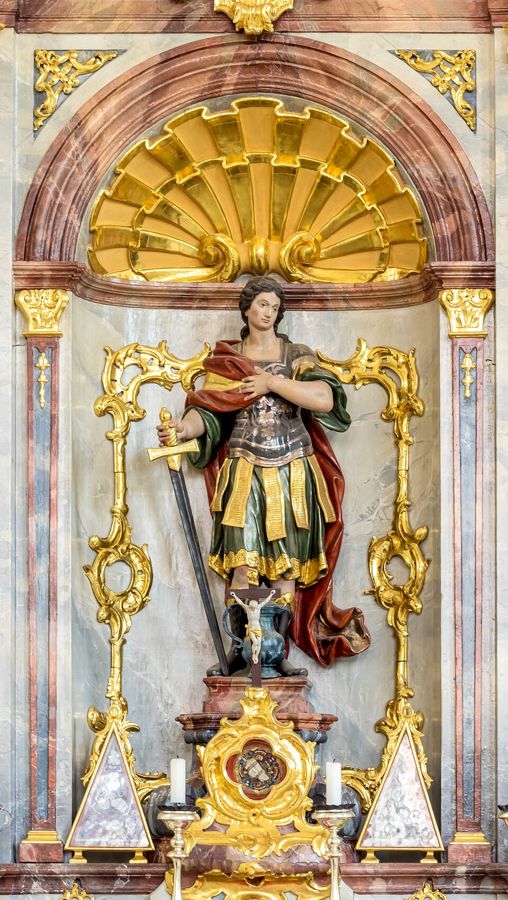
Image: St. Romanus (Schweighausen) jm37275.jpg · joergens.mi · CC BY-SA 3.0, via Wikimedia Commons
From Sabine Baring-Gould, The Lives of the Saints, new edition in 16 vols. (London: John C. Nimmo, 1897–98); text from the Internet Archive scan (OCR, lightly cleaned; errors possible). Public domain.
Image: joergens.mi, Wikimedia Commons (CC BY-SA 3.0)
From “Catholic Encyclopedia (1913)/Sts. Romanus,” The Catholic Encyclopedia (New York: Robert Appleton Company, 1907–1914), via Wikisource. Public domain. Matched by name and feast date; text unedited except for our bracketed notes in grey.
From Sabine Baring-Gould, The Lives of the Saints, new edition in 16 vols. (London: John C. Nimmo, 1897–98); text from the Internet Archive scan (OCR, lightly cleaned; errors possible). Public domain in the United States. Reproduced unedited, except for short bracketed notes in grey that we added to explain names and terms (“S.” is the old abbreviation for Saint). Some history and judgments reflect 19th-century scholarship.