Baring-Gould’s sources: Roman Martyrology, but August 30th is the day on which she is generally commemorated. She was canonized by Clement X. in i67r, and August 30th appointed for her festival. Her name occurs on both August 26th and 30th in the Martyrology. Authorities: — Her life written by Leonard Hansen, O. P., in 1664. A life in Spanish by John de Vargas, in 1657; another in Italian by Dominic Maria Marchesi, in 1665; a Latin life, “Vita admirabilis, virtus, gloria S. Rosa," &c. Aug. Vindel. 1679; J. B. Feuillot, “Vie de la brenh. epouse de Jdsns Christ, S. Rose de S. Marie," Paris, 1669. J. A. Faure, “ Vie de la brenh. M. Rose de The life of Rose of Lima, of the Third Order of S. Dominic, is suggestive and instructive.
Rose was born on April 20th, 1586, of Gaspar de Florez 1 “ Refertur in populum; consentiunt ornnes in unum... totius cleri confiuentis voce.”
ift * S. Rose of Lima. and Maria del Oliva, at Lima in Peru. Her parents were natives of Puerto Rico, in moderate circumstances and pious. At her baptism the little girl was called Isabella, after her grandmother Isabella de Herrera; but on account of her ruddy complexion was called Rose, to the no slight displeasure of her grandmother, who grumbled incessantly at the child not being commonly designated Isabella. When the little girl was confirmed, the bishop, S. Turribius, administered the sacrament to her under the name of Rosej omitting the baptismal name. When she grew older some scruples entered her mind that she had no right to this name, which was given her because of her appearance. She went, it is said, into a chapel of the B. Virgin, and besought the Holy Mother to relieve her of her difficulties in this matter. A yoice, speaking within her, replied that the name was grateful to Christ, but that she had better add to it the name of Mary; thenceforth she called herself Rosa Santa Maria.
When she was three years old a heavy chest-lid fell on her thumb and crushed it. She suffered the barbarous treatment of an ignorant surgeon with the greatest courage, and without crying.
One day when playing with her brother, who was somewhat older than herself, he, with boyish frolic, plastered her long rich brown hair with mud. Rose was very proud of her auburn hair, and withdrew, and sulked, and would not play with him any longer. “ Why, what a fuss you make about your red hair !” exclaimed the tormentor. “ You little know what a frizzling girls’ hairs get in Hell fire, if they are vain of them.” Then, imitating a preacher in action and words, the boy began a sermon against women’s vanity, and the witchery they exercise with their beautiful long hair. Rose listened with eyes and ears, and took it all in as seriously meant — she was only five years old — and, getting a razor, shaved her head. j The poor mother, who was exceedingly proud of her child’s beauty, her hair, and her complexion, was in dismay. Fortunately at that early age hair grows very fast, and poor little Rose’s scrubby pate soon assumed a presentable appearance.
Somehow or other Rose’s first religious ideas were taken from the life of S. Catharine of Siena, and from early infancy it became her passion to imitate that self-tormenting enthusiastic visionary. Her mother used to make the pretty little girl wear roses in her hair, woven into a wreath, when company were in her house. Rose took care to weave her garland with thorns on the twigs so as to scratch her skin. “ It is a great thing for the girl to have a nice white hand,” thought the mother; “ it gets as brown as a berry under the blazing sun of Peru.” So she bought her gloves, soft and scented, to wear on her hands when she went to bed.1 There were struggles over these gloves. Rose would not draw them on, the mother insisted; then came tears and groans, and Maria del Oliva only succeeded in carrying her point by the exercise of her “ferocious authority.” But Rose was not beaten yet. She was put to' bed with her gloves on, but she had inserted in them some stinging herbs, so that in the morning her hands were covered with blotches and inflamed. The mother looked at the hands, and abandoned further attempt to coerce in this matter such an obstinate and impracticable child.
Next came an altercation about dress. The mother wished to adom her daughter in the prevailing fashion, as she was now sixteen, and old enough to be in society. She must have her hair done up with pads, her gowns must be of silk, and just a little touch of colour must be added to her lips. What was to be done ? In vain did Rose protest. She had recourse at last to her confessor [in old usage, a saint who was not martyred, or who suffered for the faith without being killed], and set him to frighten her mother into letting her have her own way. 1 “ After the manner of women," says Hansen. Rose of Lima.
The parents moved to a mine at Guanca, where, as the elevation was great, they suffered from cold, and Rose caught a chill and inflammation. Her mother made her a plaster of cantharides and told her to put it on. Three days after she asked Rose about the blister, whether it had not done her good, and where she had thrown it. “ I have not taken it off,” answered die girl composedly. “ Why not?” asked her mother, in dismay. “ You did not tell me I was to,” answered Rose. The condition of her flesh after three days of blister may be imagined.
Once she was embroidering flowers in silk; some were badly done. Her mother looked over her shoulder, and said, “ What monsters of flowers those are ! — take them out,” meaning only the last she had embroidered, whilst her mind was wool-gathering. Rose unpicked every stitch in her work and reduced it to a blank. Her mother was angry. “ How could you have been such a fool?” “ You did not particularize which flowers were to be unpicked.” At the age of twenty she joined the Third Order of S. Dominic, in spite of her mother’s opposition, who wished to see her married. An old lady, whose son had cast his eyes on Rose for his wife, assaulted her with words— and ended by slapping her face, when she refused to accept her son. It had long been Rose’s intention to join the Order. She was confirmed in it by seeing a black and white butterfly hover round her one day; and black and white are the colours of S. Dominic.
She had an Indian servant girl at home, named Mariana. It was a great satisfaction to Rose to lie down on the floor and let the Indian jump and dance on her back. Mariana objected, at first, but soon acquired a relish for the pastime. Rose, says her biographer, Hansen, was ignorant of her good looks; and it was with horror that she one day heard a woman admire her taper fingers and the whiteness of her hands. She had once rubbed them with lime till the skin cockled and cracked, and for thirty days was rendered incapable of dressing herself.
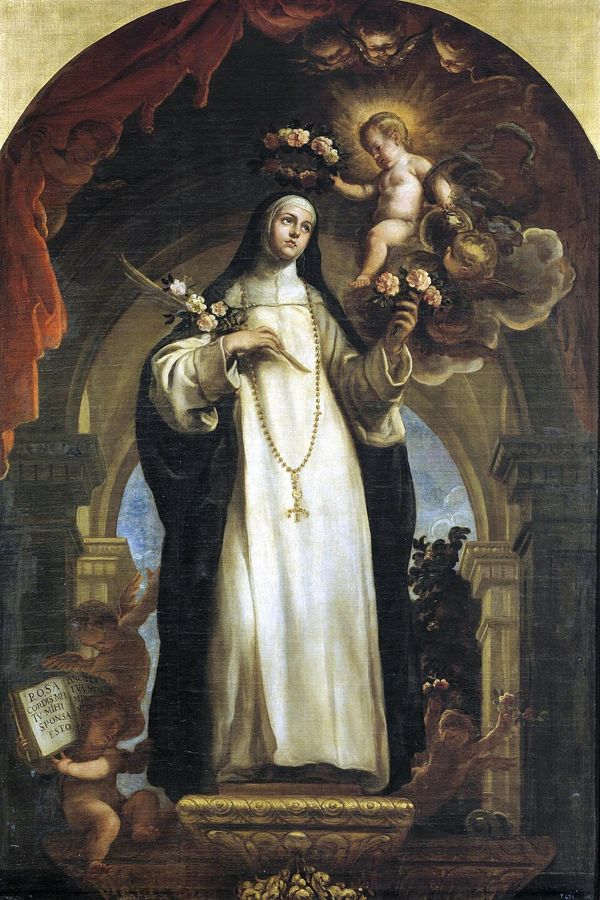
It is unnecessary to enter into particulars concerning her ingenious methods of self-torture, her fastings, chains wrapped round her body, and the like, in lively imitation of S. Catharine of Siena. She had a crown of thorns which she placed daily on her head, and had it struck so as to wound her temples. This crown was composed, we are told, of ninety-nine thorns. With this she is represented in art.
If her mother put a mattress as her bed, she flung it on one side; if she gave her a flock pillow, Rose pulled out the flocks and stuffed it with chips of wood. When visitors called, and she was told to come down to receive them, she rubbed pepper into her eyes, so that she could neither see them nor think of what they were saying. She begged hard to be allowed to live in a little shed at the end of the garden, and extorted a reluctant consent from her parents. The fancy then took her that this was to be her wedding chamber, and she fitted up her shed with the greatest delight. S. Catharine of Siena, her ideal, had been married mystically to the infant J esus j why not she also ?
The wish to be in all things like S. Catharine of Siena was father to the thought that she also was accepted as the chosen bride of Christ. Under the disappointment one Palm Sunday of having been passed over in the distribution of palms, she took refuge in the chapel of the B. Virgin, and fell into a trance before the image of S. Mary and the infant Saviour. She had had forewarnings of what was to happen.1 1 “ Post assumptam. tertii Ordinis candidam vestem, nocte quadam ostensa fuit Rosae pulcherrima ac decentissima viri species,... habitus latomum fingebat, seu marmorum caelendorum nobilem artificem. Et tunc festinus et amans venerat, tanquam virginem illic sponsam sibi quassiturus. Rosa, cui nulla unquam placuerat nuptiarum cogitatio, sentiebat intus, udo isto conjugio nihil felicius in tota sibi vita posse obtingere. Quod vero coniugium sit relinquere patrem et matrem, ut sint duo in carue una, monuit Rosam suam neonymph us.... Jamque post ejusmodi 6". Rose of Lima.
Suddenly the child said, “ Rosa cordis mei ! tu mihi sponsa esto ! ” She answered, “ I am thy handmaid ! I will be thine.” And she was unable to say more from agitation.1 She rushed home, got her brother to make her a wedding ring, persuaded the priest on Good Friday to deposit it with the Host in the Sepulchre; she got her ring back on Easter Sunday, and wore it ever after. On it she had engraved the words, “ Rosa cordis mei !. tu mihi sponsa esto.”
The vision was the product of an unwholesome condition of mind, as is evident enough to any one acquainted with psychology. It is not to be passed over as one would wish, for it shows to what dangerous dreams an ill-regulated devotion and warm temperament may lead. One cannot but be too thankful that Rose of Lima was a member of the Catholic Church, which could correct and guide such a nature as was hers, treading such a perilous path; under other influences she might have been an Antoinette Bourignon or a Joanna Southcote.
Some of her other fancies were less objectionable. Coming in one morning from mass to her little hut, she exclaimed as she looked round the garden, “ O all ye green things of the' earth, bless ye the Lord !” Then suddenly the trees began to shiver and clash their leaves together, whilst the flowers and herbs — even the vegetables in kitchen garden — lifted up murmuring voices in praise of their Creator. The stately poplars bowed their heads and touched the ground with them, as saluting God.
There was a little song-bird which had its nest in a tree one spring, near the hut of Rose. It sang so sweetly and praeambula supererat ultimum, quo demum sponsus manifesto ac palam se insinuaret vigili Rosae, exuto latomi schemate, virginem ad connubialem thalamum apertius invitaret.” — Hansen.
1 “ Certe non erravit, quicumque ille fuit, puerum qui pinxit amorem,” gravely remarks the biographer. “ Jucundissimum ipsi erat; quod eodem die ac loco* et palmam et rosam amiserat, utpote post hoc connubium non amplius sua 1 ! ' shrilly one day that she lifted up her voice, and composing Spanish verses on the spur of the moment sang them j1 then paused. The bird burst forth in song again. Once more Rose sang, and the bird followed, and so for an hour together they sang alternately. Then the bird flew away. The extraordinary fancies of Rose were not always pleasant, the visions often scared her and troubled her mind, so that she had recourse to various confessors. One said the source of all these was bile, or the spleen, another told her plainly that she was out of her mind, and that if she did not take proper nourishment and sufficient sleep she must expect to be a prey to all sorts of delusions. As she could not find a single confessor who would attribute them to any other cause, she was much put out. One advised medicine, another blood-letting. All agreed that she must eat and drink and sleep in reasonable proportions. Her mother insisted on calling in the aid of a doctor. Rose resisted, but in vain. The doctor quite agreed with the confessors, and prescribed pills, draughts, and bleeding. 2 A committee of doctors and divines sat upon her to decide if she were mad or sane. The doctors questioned her as to her food, the divines as to the books she read. She was questioned as to the works on mystical theology she had read. She stared and asked what mystical theology meant. One of the doctors present, Don Juan de Castillo, a very religious man, was the only one who could make much out of her. He pressed her very closely to describe 1 “ Laxa libras pbilomela Deum utriusque nostrum, Dulce prome canticum; Collaudabo. Pande rostrum, Pangat hymnum vox anhela, Pande guttur cantillando: Collaudemus Dominum. Alternantes concrepando Tuum lauda Creatorem; Melos demus vocibus.” Meum ego Salvatorem; numeris venustius illigabantur."
3 “ Catapotia, pharmaca, phlebotomia." August z6.) iT. Rose of Lima. her feelings; after many blushes, and much hesitation, she entered into a tolerably minute description of them.1 De Castillo decided that there was nothing to be done, the visions were of God, and the rest acquiesced or departed with a shrug of the shoulders.
She was now lent spiritual works to read, and her visions became more frequent, though scarcely more ravishing.2 She was constantly aware of the presence of angels; she was able to converse with her guardian angel, and to send him messages. One night she was fainting for food in her little cell, so she asked her guardian angel to fetch her a cup of chocolate, and then went through the garden to the house. Her mother saw by the face of Rose that she was faint, and taking out two coppers gave them to the servant, and said, “ Run to the nearest grocer’s, and bring me some sugar and chocolate.’’ “ You need not do so, mother,” said Rose; “ I have got some chocolate coming.”
“ You are telling lies, or gone crazed,” said her mother; “who at this time of night would send you hot chocolate? Go along, Mariana, and get what I told you.” At that moment there was a knock at the garden door. The maid ran to open; and lo ! there was a man, with a silver cup full of steaming, well-sweetened chocolate, outside.
It was thought to be a miracle wrought by Rose that one day she prayed before a picture of Christ till it broke out into *■ profuse sweat. Don Gundsalvo, in whose oratory this 1 “ Velut in sponsi brachiisme deprehendo,... sentis avidos liberrimi amoris impetus, ut cum rapidi amnes disruptis obicibus, non fluendo, non tuendo, sese evolvunt per cataractam.”
3 “ Jesulus digiti statura vix procerior, ssepe apparebat amanti Ross,.. stabat pusilluset nudus Amor, mox inambulabat passu levissimo, ac interim obtutu serenulo, tenero, suavi adblandiebatur virgini... nutibus taciturmsloquebaturad cordilects; arridebat; huic protendebat breves ulnas velut amplexun. offerens; hanc ardentibus oculis jugiter adurebat, omnique gestu, motu, flexu, pro test *batur amorem " marvel took place, examined the image with the greatest care, brushed off some of the moisture, smelt it, and satisfied himself that this was a miracle.1 S. Rose had an eccentric habit of preparing a set of clothes for the infant Jesus or the B. Virgin by means of prayers.
Before Christmas she would get ready a whole set of baby linen in this way. “ Fifty Litanies, nine hundred Rosaries, five days’ fasting, make up one little shirt (indusiolum). Nine stations at the B. Eucharist, nine Psalters, and nine days’ fasting supply him with a map. Five days of abstinence, five stations, and as many Rosaries furnish sheets for the crib. Thirty-three Communions, thirty-three attendances at mass, thirty-three hours of mental prayer, embroider and fringe the sheets. And for toys (crepundia) I give my tears, my sighs, my heart, and soul.”2 She provided an imaginary suit of clothes in a similar manner for the Blessed Virgin; six hundred angelic salutations and as many repetitions of the Salve Regina, and fifteen days’ fasting, made up an under-garment Six hundred angelic salutations and as many Salve Reginas, fifteen Rosaries, and fifteen days’ fasting provided the material for a gown, and so on for the buttons, lace, thread, &c., for making it up.3 But she sometimes provided more substantial garments. There was an image of S. Catharine of Siena, the care of which was confided to S. Rose. She one day poured forth an anguished prayer before the image, which was shabbily dressed: “ O sweetest mother ! if I had only fifteen or six1 '* Digito guttas aliquot delibavit, fricuit, tiaribus admovit... lustratis diligenter omnibus, edixit, supematurale sibi omnino videri, quod in imagine gerebatur." 2 “ Constat, ex devotae Rosje mystica officina, pluries hoc vestimentorum genus prodiisse; nam subinde amicissimis personis eadem liberali dono cedebat offerenda, applicanda, circumponenda Jesulo nudo, amori suo." 8 ** When a gown was finished, u Jam hoc vestimentum confectum est; benedictus sit Deus: ejusque mater sanctissima prgegrandi sua pietate suppleat defectus meos et ausuidet veniam."
teen reals I would dress you after ray fancy in a beautiful new white cloak.” Not long after, a negro woman met her and gave her sixteen reals to expend on the image. Her delight was unbounded. She bought a magnificent white cloak, and put it round the shoulders of the image, which beamed and smiled with satisfaction at receiving such an attractive gift.
S. Rose, for her livelihood, and for the support of her mother, was a milliner, which will account for the interest she took in making dresses for her heavenly patrons. There was a young man, Vincent Montessi de Venegas, who admired Rose’s good looks, and to get an opportunity of seeing her closely and having a little chat with her, went to his mother and said, “ I want a set of fine frilled linen collars, and no one makes them better than Rose de Florez; may I have a set ? ”
“ By all means," answered his mother; “ go to her house and be measured for them.” So Vincent went to the saintly milliner’s, and sat down to have a tape put round his neck, as measure for the collars. There was a pert look in his eyes which Rose did not like, so she said, “ You have not come here for collars, I see clearly enough. Do not tell lies, but mind your conduct.” Vincent sneaked away sheepishly, and never returned again.
There was a religious at Lima “possessed with a passion no less dirty than foolish and monstrous — a love of tobacco, as injurious to the welfare of his soul as of his body, so that there seemed no hope of salvation for either one or the other. The mouth of the man was all smoky within like a chimney, his snuffy nostrils were choked with black, a dark cloud compassed his brains and disorganized his chest; his clogged lungs emitted hoarse asthmatic croakings; and the miserable man never had the pernicious pipe out of his mouth. Physicians protested, friends entreated, dissuaded, finally the heads of the religious order fined him and issued the severest inhibitions, precepts, and hurled the thunderbolts of the direst censures. But all was in vain. The vicious habit of thirty-three years would not yield to entreaty, threat, or penalty. No remedy promised to be of any avail to the perishing wretch, had not Rose succeeded in shaking the obduracy of the smoker’s heart, and obtaining the cure of it by ardent prayer.”1 After five days of exhortation from the saintly milliner, he cast aside his pipe, and for ever renounced tobacco. The parents of Rose had a young cockerel, which Leonard Hansen, the biographer of the saint, describes in the glowing terms of a genuine poultry fancier. Maria del Oliva, being a prudent housekeeper, set great store by the cockerel, which she hoped would grow up and be useful for breeding purposes. But every one in the house admired this cockerel, and fed it, so that he became excessively fat and lazy. He sat down on the ground as if bent on basking in the dust all day long, and would not crow.2 The mother, at last, thinking the cock worthless, brought it into the room and set it down on the table before her husband, saying, “The cock must have its throat cut, and we will eat it to-morrow.’' But Rose, full of compassion for the young cock, said to the bird, “ Crow, my cockerel, crow that you die not.’' Scarcely had she uttered these words when the bird stood up, shook out its wings, stiffened its neck, its comb became scarlet, and it crowed lustily. Every one burst out laughing, and the more they laughed the louder crowed the cock. Then with stately strides chanticleer walked round the table, and stopping before Rose, thrust its head towards her and uttered ’ Hansen, c. xxii., who quotes as the description of the smoker the words in Job adi. 20, “ Out of his nostrils goeth smoke, as out of a seething pot or caldron." 2 “ Crevit pnllus, sed ea inerat ventricoso pigritia, ut jugiter cubavit humi, et vix unquam visus sit ultro in pedes attolli, nunquam auditus cucurire." its most vociferous and grateful crow, as though thanking her for having indicated a way by which he might redeem his life.
One day, a Dutch fleet appeared off the coast of Peru, and threatened the port of Lima. The inhabitants were panic-struck, expecting the town to be sacked. Rose entered the church, and stood on the foot-pace of the altar, ready to defend the tabernacle with her life against the insults and, profanities of the heretics. Soon after, news reached her that the fleet had weighed anchor. Her bed was a wooden chest filled with chips of wood and broken crocks, and a great stone served as her pillow. She allowed herself only two hours’ sleep. Twelve hours she devoted to prayer and meditation, the other ten to needlework for her livelihood, and the support of the household.
Want of sleep and food exposed her to the most distressing fantasies. Her imagination conjured up horrible spectres, and at night she trembled and broke into a cold sweat with fear.
She made herself a narrow silver band set with sharp nail points, which she wore round her head, to prick and wound her incessantly, so that her temples were raw and bleeding. She also scourged herself till her body was a mass of sores.
After a long and very painful sickness, S. Rose died, on August 24th, a.d. 1617, at the age of thirty-one. She was canonized by Pope Clement X. in 1671, after an apostolic commission had been issued by Pope Urban VIII. in 1630, to obtain intormation regarding her merits and miracles.