St. Salome

It has been ingeniously argued that as both the genealogies in the Gospels are of Joseph, and as Jesus was bom of Mary, and Joseph was not his father, they are wholly irrelevant, O

Read the essentials →
October 22 · —

St. Salome

St. Salome

It has been ingeniously argued that as both the genealogies in the Gospels are of Joseph, and as Jesus was bom of Mary, and Joseph was not his father, they are wholly irrelevant, O

Traditional feast

October 22
1914 / pre-1969 calendar, per Baring-Gould (1897)

Current feast

April 24 (also listed: August 3)
Secondary source · Wikipedia

Represents

Feast

Their story

Adapted in modern English from Baring-Gould (1897–98) · original text below

(The surviving account on this page begins partway through the story.)

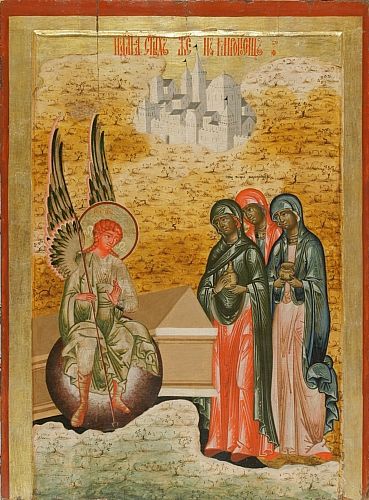
Salome was the wife of Zebedee and mother of the apostles James and John. The Gospels record three things: she asked Jesus for places of honour for her sons, she was at the Crucifixion, and she went to the tomb. Some have argued for a family tree making her a relative of Mary; others think she was also called Mary. These are theories.

Later claims are doubtful. Veroli in Italy said it found her body in 1209 with an inscription; Baring-Gould says the find was certainly a fraud. In the Camargue in Provence, legend says Mary the mother of James, Mary Salome and their servant Sarah arrived with Mary Magdalene and Martha; their bodies were "found" there in 1448, and Pope Nicolas V established a feast.

The Gospels mentioned are Matthew 20:20 and Mark 15:40 and 16:1. At Veroli, a parchment with the same inscription as the coffin was sewn into the wrappings, and Pope Innocent III was informed. The Camargue legend says the women brought heads of Holy Innocents and of St. James the Less. Pope Nicolas V set the feast on 3 December.

Early life

Selected sentences from the original account, unaltered.

It has been ingeniously argued that as both the genealogies in the Gospels are of Joseph, and as Jesus was bom of Mary, and Joseph was not his father, they are wholly irrelevant, Oct. aa.] S. Salome.

What they represent

How they teach us to live

Drawn from themes in the original account

Keep their day. Remember them on October 22 with a short prayer, and ask for their help.

Read more

The full original · 376 words

Read Baring-Gould’s full account

Baring-Gould’s sources: Roman Martyrology, Usuardus, Ado, Ac. By the Greeks on April 8. ] ALOME, the wife of Zebedee, was mother of S. James the Great and S. John the Evangelist It is the opinion of many modem critics that she was the sister of the B. Virgin Mary, to whom reference is made in John xix. 25. The words, however, admit of another and hitherto generally received explanation, according to which they refer to “ Mary, the wife of Cleophas,” immediately after mentioned. There is another theory that she was the daughter of Cleophas or Alphaeus, the brother of Joseph.

It has been ingeniously argued that as both the genealogies in the Gospels are of Joseph, and as Jesus was bom of Mary, and Joseph was not his father, they are wholly irrelevant, Oct. aa.] S. Salome.

unless it be supposed that the same genealogy does for both. And the following table has been constructed — Joses. Mary =f=. Cleophas or I Alpnaeus.

James. Anna == Heli (Joachim). Josephs Jesus Christ Zebedee == Salome. Mary. S. James Joses. Judas or Simeon or I (Matt xviii. x.) the Less. Thaddaeus. Simon. S. James S. John, the Great Evangelist Another theory is that Salome was also called Mary. The only events recorded of Salome are that she preferred a request on behalf of her two sons for seats of honour in the kingdom of heaven (Matt. xx. 20), that she was present at the crucifixion of Jesus (Mark xv. 40), and that she visited the sepulchre (Mark xvi. 1).

It is pretended that Salome came to Italy and settled at Veroli. Her body was found there in 1209, together with that of Mary, the mother of James and John. The two bodies were found in a stone cist, on which was inscribed, “ Maria Mater Joannis Apostoli et Jacobi in ista,” and with the bodies a piece of parchment sewn to the linen which wrapped them round, with the same inscription. That the discovery was a fraud admits of no manner of doubt Information was sent to Pope Innocent III. In the Camargue at the mouth of the Rhone, are venerated the “Three Maries,” /.<?. Mary, the mother of James, and Mary Salome, and Sarah, their servant. These three came to Provence with S. Mary Magdalene and S. 'Martha. They brought away with them from Jerusalem three heads of Holy Innocents who had perished in the massacre of Bethlehem, and also the head of S. James the [Oct. as.

Less. The “ invention ” of the bodies of S. Mary, the mother of James, and S. Salome in the Camargue, took place in 1448, and Pope Nicolas V. instituted a festival of the “ Revelation ” of these precious relics [the bodily remains of a saint, or objects they used, kept with honor] on December 3rd. The story of the arrival of the female saints in Provence has been already told.1
Feast days

Feast: April 24
Traditional: October 22

Nine days · Free

Pray the novena
with us.

One short email a day for nine days. The day's prayer, a line from St. Salome's story, and a nudge to keep going.

Also on October 22
M

St. Mark of Jerusalem

October 22 · Bishop
A

Sts. Alexander and…

October 22 · Bishop, Martyr, Martyrs
P

St. Philip of Heraclea

October 22 · Bishop
← All 1726 saints in the library
Sources & notes

Feast-day sources

Story sources

Sources

Credits

Image: Wifes grave kizhi.jpg · AnonymousUnknown author · Public domain, via Wikimedia Commons

From Sabine Baring-Gould, The Lives of the Saints, new edition in 16 vols. (London: John C. Nimmo, 1897–98); text from the Internet Archive scan (OCR, lightly cleaned; errors possible). Public domain.

Image: AnonymousUnknown author, Wikimedia Commons (Public domain)

From Sabine Baring-Gould, The Lives of the Saints, new edition in 16 vols. (London: John C. Nimmo, 1897–98); text from the Internet Archive scan (OCR, lightly cleaned; errors possible). Public domain in the United States. Reproduced unedited, except for short bracketed notes in grey that we added to explain names and terms (“S.” is the old abbreviation for Saint). Some history and judgments reflect 19th-century scholarship.