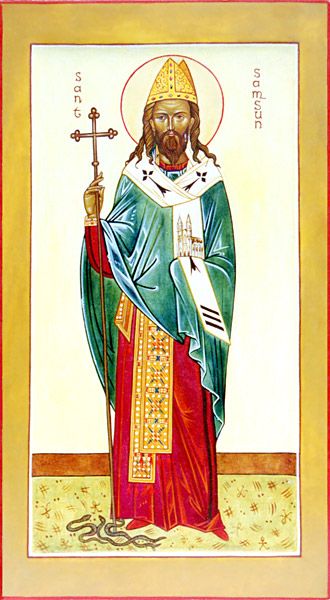
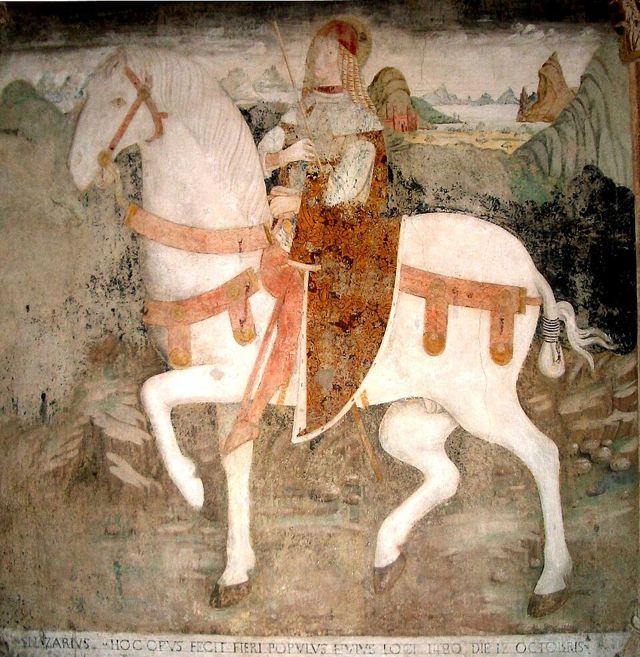
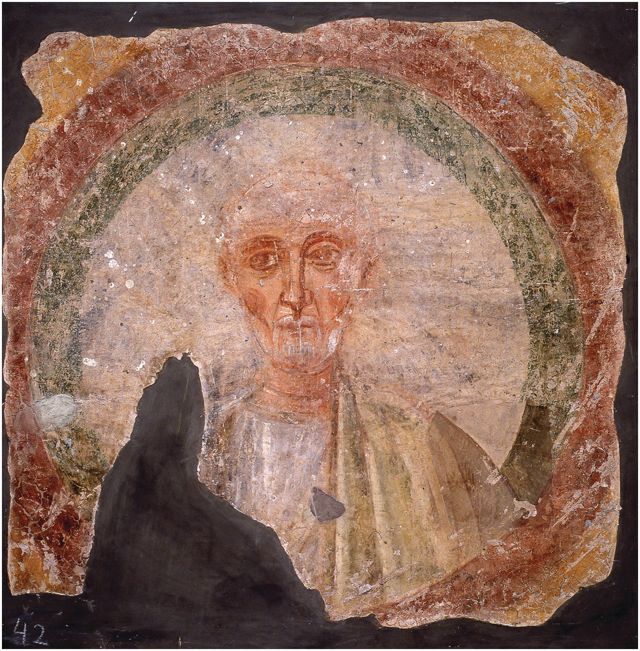
Baring-Gould’s sources: Usuardns, &c. Gallican and Roman Martyrologies. Authority: — An ancient Life, attributed to a certain Bishop Tigernomail, of S. Pol de Leon, 1 who lived at the same time or shortly after. 2 It is for the most part trustworthy, and is very curious. Another Life, mainly agreeing with this, in the Liber Landavensis, 1. 8, c.25; a third is Du Bose, Biblioth. Floriac., 464 — 484; a fourth, apparently never printed, attributed to Balderic, bishop of Dol {d. 1130.).] S. Samson was born in Glamorganshire, and- was the son of Amwn Dhu, son of Emyr Llydaw, by Anna, daughter of Meurig ap Tewdrig, and was a cousin of S. Padarn.
Amwn Dhu was a petty prince in Armorica [Brittany in north-west France], perhaps only the son of one; he crossed over into Wales, where he married Anna, daughter of Meurig, prince of Glamorgan, and enjoyed the friendship of S. Dubricius 1 He had been a pupil in the monastery of S. Iltut. He says, ** in cujns magnifico monasterio ego fui,” The later lives are all based on this one, but amplified with marvels.
2 “Credia me vos volo, quo non juxta adinventionis meae temeritatem, nec jnxta inordinata et incomposita audita, haec verba collecta suntj sed juxta hoc quod a quodam religioso ac venerabili sene, in cujus domo, quam ultra mare ipse solus Samson fundaverat, ille per octogenarios fere an nos catholicam vitam ducens, propissimisque temporibus ejusdem supradicti sancti Samsonis mater tradidisse avunculo suo sanctissimo diacono (qui ct ipse diaconus consobrinus esset sanct'o Samsoni), mihi veraciter affirmavit; multaque de ejns gestis ad me Teferens, et non solum hoc, sed etiam quamplnra dc ejns actibns, quae citra mare in Britannia ac Romana (i.e., Gallia) fecit, verba supradictns sanctns diaconus, Henocus nomine, congruis stills polita ultra mare adportavit, et ille de quo nuper praefati snmns venerabilis senex, semper ante me in illo monasterio commanens, pie legere et diligenter faciebat." — Tigernomail. l ul y a8 and S. Iltut. He afterwards retired to an islet, near Llantwit Major, where he lived an austere life, and then moved to a solitary place on the shores of the Severn, where he died. Anna settled near his cell, and in after time her son Samson consecrated a church there for her.
Amwn and Anna were some time without a child, but on Amwn presenting three bars of silver to the church, Anna conceived, and believed she heard it announced to her in a dream that the child that was to be born would be to her seven times as precious as the bars of silver given for him.
Samson was taught in the school of Iltut “all the Old and New Testament, and all sorts of philosophy, to wit, geometry and rhetoric, grammar and arithmetic,. and all the arts known in Britain.”
At the age of fifteen, Samson began to practise himself in fasting, but was reprimanded by the master, who said, “My little son, it is not proper that you should injure the health of your small body in its early bloom by severe abstinence.”
One day when the boys were out winnowing corn with the steward, an adder (hilider) darted out of a bramble bush suddenly and struck one of the monks, who fainted with fright. “ Run, one of you boys, and tell the abbot!” said the steward. Samson ran to Iltut with tears in his eyes, to tell him the news, and full of faith and enthusiasm, asked the abbot to allow him to attempt the cure of the monk. Iltut gave the desired.permission, and Samson ran back, and rubbed the bite with oil. By degrees the monk got over his fright and the adder's bite; and Samson was thought much of after this.
At last the day of his ordination as deacon arrived. Lives oj the Saints. £July a8. S. Dubricius 1 came to the monastery. There were three of the brethren to be ordained, two as priests, Samson as deacon. As they knelt before the altar, the bishop 2 saw a white pigeon fly in at the church window — it was no doubt one that Samson was wont to fondle and feed, — and flutter about his head, then gently perch on his shoulder; and there the bird sat whilst the young deacon was ordained, and till he arose, after having received the Holy Communion.
Samson did not escape envy. There were two nephews of the abbot in the monastery, one a priest, and they were very jealous of Samson, fearing lest he should be appointed abbot on the death of their uncle, and so their own right to succeed to the rule of the monastery be invaded. They therefore determined to make away with Samson. The priest's brother was butler in the monastery, and it was the c^m for the monks to drink a cooling beverage of crushed herbs, to purify their blood when heated. The butler put some poisonous herb 3 into Samson's cup, but he let the cat 4 lap some of it, and the animal died.
Samson was ordained priest, and then began to lead a more austere life than before. There were so many monks now in the monastery, that he craved for quiet, and he asked the abbot Iltut to allow him to spend his days on a little island, 6 near the monastery, where lodged Piro, “a holy priest and excellent man." 6 Iltut gave him leave, and Samson took up his abode in the island. He worked hard all day with his hands, and in the evening, lit his lantern and 1 “Dubricius papa.” 2 “ Vidit sanctus papa.” 8 “Till! urn”— what herb it is 1 do not know. Not Tilia the Lime tree, the leaves and flowers of which are wholesome. Lime flowers are used to make a cooling drink in Belgium. Was the butler a foreigner, and Samson suspicious of a novelty ? 4 “ Pilax.” B In qua insula et ego fui.” 6 “A quodam egregio viro dc sancto presbytero, Piro nomine.” S. Samson.
retired to his cell, where he remained reading till late at night. Now Amwn, the father of Samson, fell ill, and desired to see his son before he died. So he sent messsengers to fetch him. But Samson said coldly, “I have left Egypt, why should I return thither ?” and he refused to go. Then Piro rebuked him, and bade him remember that it was his father who sent for him, and insisted on his going to see him. So Samson and a young deacon, as his companion, set out on a couple of horses for his father's palace. They passed through a vast wood, and the hooting of the owls, the various strange sounds of an unpeopled land, filled both with alarm, but especially the young deacon; and when they saw an old woman emerge from the forest with wildly flowing grey hair, with a huge boar spear in her hand; the deacon screamed to Samson not to be afraid, beat his own horse, and sped along the rough road at a tearing gallop, till his horse stumbled; he was thrown, and fell stunned on the road. Samson crossed himself, caught the woman, — she was a witch, asked her who she was, ordered her to restore his friend to consciousness, and because she was unable to do so, killed her; thinking he did God a service in ridding the world of a witch. The young deacon was restored to consciousness, and both pursued their journey. “You were lucky not to.be transfixed with her great spear, ”'said Samson. In his flight the deacon h^d lost his cloak. Samson picked it up, and restored it to him.
On reaching his father's house, Amwn ordered all out of the room except his wife, his son and the deacon, and before them he made confession of all the errors and offences of his past life. And then he vowed to dedicate himself, his wife, the six brothers of Samson, and his baby daughter to the Lord. Samson blessed them, and accepted the oblation in the Lord’s name, except only that of the infant daughter, “ She is given up to this world’s pomps and pleasures,” he said coldly, “ nevertheless, let her be suckled, for she is a human being.”
Amwn, who was recovering from his sickness, was forthwith shaven, together with his brother, his wife, and his sister-in-law. On the complete restoration of Amwn to health, Samson placed hitn and the rest in suitable cells, where they might learn monastic discipline.
Samson returned to Iltut, and the deacon told the abbot all that had befallen them in the way, 11 not concealing his own cowardice.” Iltut was so pleased with his favourite disciple, that he constituted him cellarer. This did not give universal satisfaction; some of the monks grumbled that Samson had a sweet tooth, and ate the honey out of the jars in the store room. Iltut heard this, and went to examine the jars; they were full. Unfortunately, a sad affair happened about this time. Piro, that “ excellent man and holy priest,” was returning one night, it was said, very drunk, to his cell, when he tumbled into the well. A monk heard his howl of terror, rushed to the spot, and hauled him out. But Piro died of the bruises and broken bones he had received. When S. Iltut heard of this, he made all the monks in Piro’s island come to his monastery and elect Samson to be their abbot. Then they returned to the island, and Samson did his best to instil into them a love of temperance in drink and moderation in diet, by his own example. 1 But the opposition of his monks 1 “Studcbat inter dapes abundantes et pocula inundantia jejunus semper ac sitiens esse/' 6 s. Samson.
made him abandon the rule over them, after a year and a half, and he went to Ireland, visited some of the monasteries there, and then, returning to Wales, settled in a cave on the shore of the Severn Sea. One night in this lone cave, Samson had a dream. He saw three bishops in glittering vestments, with gold mitres on their heads, come to him. He asked their names. They were the apostles Peter, James and John. They recited the office of ordaining bishops over the sleeping Samson, and when he woke, he felt in himself that he was indeed a bishop. He forthwith went to S. Dubricius and informed him of his vision. Dubricius believed him, declared it unnecessary to re-ordain one who had received the grace of episcopal orders from the hands of the Apostles themselves, and gave him a see, in Wales, with wise discretion he joined with him two assistant bishops who had received consecration in the ordinary way. 1 One Easter night whilst Samson was saying mass, he fell into a trance, and saw a tall man appear at his side, who bade him leave Wales and go to Armorica. 2 3 He accordingly took ship to Brittany, and on reaching the coast, filled a cart with his books and vestments, harnessed to it “ two horses "which he had brought from 1 In the 12th century, the concurring interests of the clergy of Dol wishing to establish the independence of their see against the Archbishopric of Tours, and of Giraldus Cambrensis wishing to prove the metropolitanship of S. David’s against the see of Canterbury [a bishop’s “see” is his diocese, named from his seat (Latin sedes)], led to the assertion that Samson had been an archbishop, Geoffry of Monmouth says, of York, Giraldus says, of S. David’s, This arises from mistaking this Samson, son of Amwn, for Samson, son of Caw, who had a church at York, bnt was no bishop of York. The story goes that the Saxons destroyed his chnrch of York, and then Samson fled to Brittany, where he became bisbop of Dol. Of all this the Welsh authorities say nothing. Samson, son of Caw, lived a generation earlier than Samson, son of Amwn3 Tigernomail was told this by Samson’s lather, '* nt narrare postea suum patrem audivimus.” But perhaps he means that Enoch, his great authority, heard this Horn Amwn.
VOL. VIII. Ireland,” and started — he knew not whither. One day he passed a hill where a crowd of Bretons were making merry and dancing round an upright granite stone. Samson jumped out of the cart, ran among them, and denounced their idolatry. Gwedian, the chief of that district, was present. He told the man of God that the people were not guilty of practising “ mathematics ” (meaning magic) with the stone, they were only playing and making merry. But it was a relic of paganism, which Samson could not endure, and he uttered threats of divine vengeance.. The revellers laughed and mocked; but just then, a boy who was galloping about the field on the back of a horse, fell off, and was taken up insensible, and their scoffing at his warnings were exchanged into wails of sorrow. Samson knelt down by the stunned child, and shortly after it returned to consciousness. The saint chiselled a cross on a standing granite block, on the hill, as a memorial of the miracle. His biographer tells us that he had seen the cross and felt Samson settled at Dol, and there erected a monastery. He found that Jonas, prince of that part of Brittany, had been killed by an usurper named Commor, who had sent the son of Jonas, named Judael, to king Childebert, at Paris. Samson went to Paris to implore the. king to release the young prince, and re-instate him in his ancestral possessions; but met with strong opposition from Queen Ultrogotha. 1 Nevertheless he carried his point, and restored Judael to his people and principality. The Welsh accounts proceed to say that Samson returned from Armorica to the college of II tut, where he died; and in the churchyard of Lantwit 1 All this latter part of the narrative appears to have been tampered with by copyists, who have inserted stories of his conquering lions and dragons. S, Botvid.
Major, two large stone crosses still remain, one of them having three inscriptions, purporting that it was the cross of Iltut and Samson, the second that Samson erected the cross for his soul, and the third that one Samuel was the carver; the other cross has but one inscription, which states that it was prepared by Samson for his soul, and for those of Jndael, the king, and Arthmael. The life of S. Samson by Tigernomael does not say anything about his return to Wales, but rather leaves one to infer that he died at Dol. He assisted at a council at Paris in a.d. 555 or 557.