Faithfulness to Christ when it cost everything.
Read the essentials →Faithfulness to Christ when it cost everything.
November 29
October 30
Bishop
Martyr
They, however, were so frightened that they ran away, and Saturninus thereupon cursed Toulouse, that no priest, a native of that city, should ever mount its S. Radbod.
Stay faithful when it costs you. This account is about holding firm under pressure.
Pray a little every day. Prayer runs all through this account.
Learn from the kind of life it was. Faithfulness to Christ when it cost everything.
St. Saturninus was, says Tillemont, one of the most illustrious martyrs France has given to the Church. We possess only his Acts, which are very old, since they were utilized by St. Gregory of Tours [bishop and historian of the Franks (d. 594)]. He was the first bishop of Toulouse, whither he went during the consulate of Decius [Roman emperor 249–251, who ordered everyone to sacrifice to the gods] and Gratus (250). Whether there were already Christians in the town or his preaching made numerous conversions, he soon had a little church. To reach it he had to pass before the capitol where there was a a temple, and according to the Acts, the pagan priests ascribed to his frequent passings the silence of their oracles. One day they seized him and on his unshakeable refusal to sacrifice to the idols they condemned him be tied by the feet to a bull which dragged him about the town until the rope broke. Two Christian women piously gathered up the remains and buried them in a deep ditch, that they might not be profaned by the pagans. His successors, Sts. Hilary and Exuperius, gave him more honourable burial. A church was erected where the bull stopped. It still exists, and is called the church of the Taur (the bull). The body of the saint was transferred at an early date and is still preserved in the Church of St. Sernin (or Saturninus), one of the most ancient and beautiful of Southern France. His feast was entered on the Hieronymian Martyrology for 29 November; his cult spread abroad. The account of his Acts was embellished with several details, and legends linked his name with the beginning of the churches of Eauze, Auch, Pamplona, and Amiens, but these are without historic foundations.
Ruinart, Acta Martyrum (Ratisbon [Regensburg in Bavaria], 18569), 177-80; Gregorii Turonensis opera Hist. Francorum, ed. ARNDT AND KRUSCH, I (Hanover, 1884), xxxix; TILLEMONT, Hist. ecclesiastique, III (Paris, 1701), 297; LABAN, Vie de Saint Saturnin (Toulouse, 1864); DUCHESNE, Fastes épiscopaux de l ancienne Gaule (Paris, 1894), 25, 295.
As he was about to be tied to the tail of the bull, Saturninus besought two priests who attended him to remain with him to the last. They, however, were so frightened that they ran away, and Saturninus thereupon cursed Toulouse, that no priest, a native of that city, should ever mount its S. Radbod.
episcopal throne: an imprecation which, we are assured, has been ratified.1 An angel appeared to the martyr, to console him for this base desertion, and prepare him for a succession of hideous tortures, of which the early writer of the Acts knew nothing. At the prayer of the saint all the idols fell and were broken to fragments, and the idolaters pelted the martyr with the bits. As the bull dragged him down the stairs of the Capitol, his brains were dashed out. The two princesses of Huesca diligently collected them into a vessel, and then ran after the bull to mop up the scattered blood of the martyr, and finally bury his body. These maidens— whom Fortunatus merely calls a woman and her servant— receive veneration in the church of Toulouse as “ Les deux Pucelles,” two holy virgins. For their attention to the remains of the saint they were soundly scourged, and they then fled Toulouse, and took refuge in a village near Castelnaudary, now called after them Mas des SaintesPucelles, where they died and were buried. Their relics [the bodily remains of a saint, or objects they used, kept with honor] were afterwards translated to Toulouse. The relics of S. Saturninus are shown at Toulouse in the cathedral. In art he is represented with a bull.
Feast: October 30
Traditional: November 29
One short email a day for nine days. The day's prayer, a line from St. Saturninus's story, and a nudge to keep going.
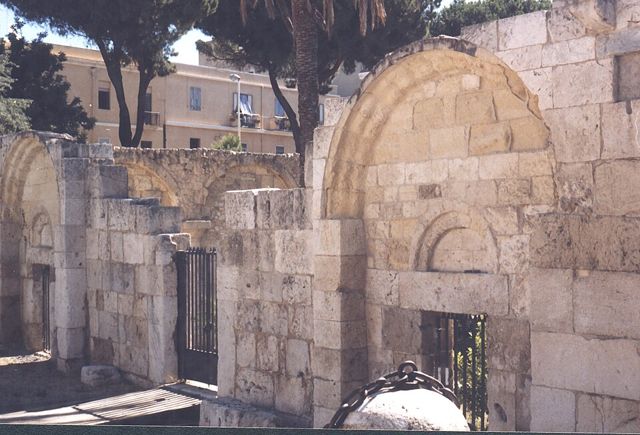
Image: Ssaturnino2.jpg · Giova81 · CC BY-SA 3.0, via Wikimedia Commons
From Sabine Baring-Gould, The Lives of the Saints, new edition in 16 vols. (London: John C. Nimmo, 1897–98); text from the Internet Archive scan (OCR, lightly cleaned; errors possible). Public domain.
Image: Giova81, Wikimedia Commons (CC BY-SA 3.0)
From “Catholic Encyclopedia (1913)/St. Saturninus,” The Catholic Encyclopedia (New York: Robert Appleton Company, 1907–1914), via Wikisource. Public domain. Matched by name and feast date; text unedited except for our bracketed notes in grey.
From Sabine Baring-Gould, The Lives of the Saints, new edition in 16 vols. (London: John C. Nimmo, 1897–98); text from the Internet Archive scan (OCR, lightly cleaned; errors possible). Public domain in the United States. Reproduced unedited, except for short bracketed notes in grey that we added to explain names and terms (“S.” is the old abbreviation for Saint). Some history and judgments reflect 19th-century scholarship.
