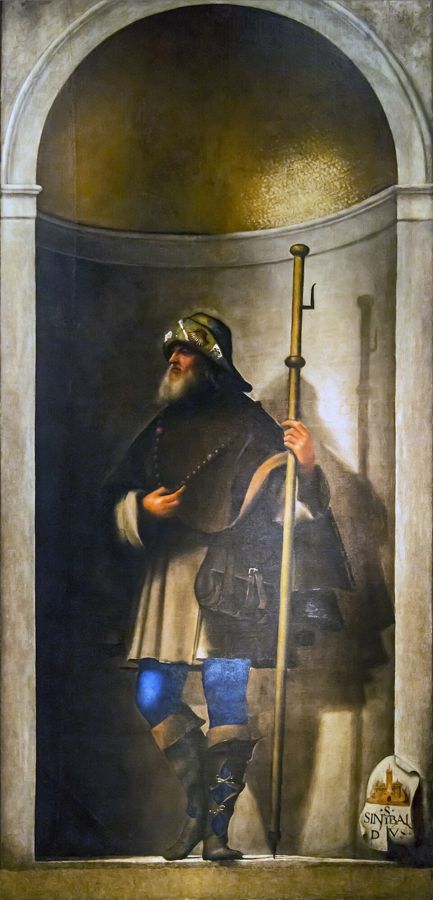
Leaving everything to pray, yet still drawing people who needed wisdom.
Read the essentials →Leaving everything to pray, yet still drawing people who needed wisdom.
Read the essentials →Leaving everything to pray, yet still drawing people who needed wisdom.
August 19
August 19
Hermit
Sebald arrived in Rome during the pontificate of Gregory II. (a.d. 715 — 731); Willibald did not start for Germany till 739. But the biographer tells us of a long period of eremitical life spent in Lombardy near Vicenza, and this may have occurred during the time that Willibald was in the East. When Gregory III. sought for missionaries to send into Germany in answer to the appeal of S. Boniface, he probably summoned Sebald from his retreat to join Willibald.
Make time for silence. Solitude and withdrawal to pray shape this life.
Share your faith, in words and by example. Preaching and conversion are central here.
Learn from the kind of life it was. Leaving everything to pray, yet still drawing people who needed wisdom.
Sebald arrived in Rome during the pontificate of Gregory II. (a.d. 715 — 731); Willibald did not start for Germany till 739. But the biographer tells us of a long period of eremitical life spent in Lombardy near Vicenza, and this may have occurred during the time that Willibald was in the East. When Gregory III. sought for missionaries to send into Germany in answer to the appeal of S. Boniface [English missionary to Germany, martyred 754], he probably summoned Sebald from his retreat to join Willibald.
1 The biographer says Pepin and Charlemagne [king of the Franks, crowned emperor in 800], but this is a gross anachronism, One day Sebald asked shelter of a labourer in bitter frosty weather. The snow was over the ground, the wind howled over the frozen marshes of the Pegnitz. He was received with great churlishness. In vain he crouched over the low embers of the fire, seeking to restore warmth to his chilled hands and feet. At last he ventured to ask if more fuel might be cast on the hearth. “ I cannot afford it,” said the surly rustic, “ it takes time to cut wood and cart it.” “ Then, good woman,” said Sebald, addressing the wife of the churl, who looked on him with pitying eyes, “ go fetch in a sheaf of icicles I saw hanging from the roof.” The woman — so runs the tale — obeyed, and, at Sebald’s command, cast them on the fire. A flame shot up and crackled among the icicles, and speedily the whole bundle was in roaring flames.
It is a pretty story, perhaps only an allegory of how Sebald quickened and made to flame with divine love the icy Franconian natures, which seemed as impossible to warm with grace as the winter’s ice.
At length he died, and those who ministered to him swung incense over the dead body of the old hermit, and lit candles about it. Now, there was a woman, a sinner, whom Sebald had turned to the love of the living God. And in memory of her sin, and in expiation thereof, she wore about her arm a hoop of iron. And she came to see the dead hermit. And one of the candles about his head was crooked, and swaled; then she stretched forth her arm and set it upright, and the iron band burst at the same moment. So she thought that the old man, as he entered into the presence of God, had not forgotten the poor woman whom he had converted on earth, and that God had heard his petition, and the snapped ring was a token sent her that her sins, which were many, were pardoned.
The body of the hermit rests in an exquisite shrine in the S. SEBALD MAKING A FIRE FROM ICICLES. A relief from the tomb of S. Sebald, by Peter Vischer and his sons in the cburch or S. Sebald, Nuremburg.
August ig.] kS". Louis. choir of S. Sebaldus’ church in Niimberg, undisturbed. The sides of the shrine are chased with scenes from his life by Adam Kraft
Feast: August 19
One short email a day for nine days. The day's prayer, a line from St. Sebaldus's story, and a nudge to keep going.
Image: Accademia - San Sinibaldo di Sebastiano del Piombo.jpg · Didier Descouens · Public domain, via Wikimedia Commons
From Sabine Baring-Gould, The Lives of the Saints, new edition in 16 vols. (London: John C. Nimmo, 1897–98); text from the Internet Archive scan (OCR, lightly cleaned; errors possible). Public domain.
Image: Didier Descouens, Wikimedia Commons (Public domain)
From Sabine Baring-Gould, The Lives of the Saints, new edition in 16 vols. (London: John C. Nimmo, 1897–98); text from the Internet Archive scan (OCR, lightly cleaned; errors possible). Public domain in the United States. Reproduced unedited, except for short bracketed notes in grey that we added to explain names and terms (“S.” is the old abbreviation for Saint). Some history and judgments reflect 19th-century scholarship.

