St. Sergius I., Pope

Sergius, son of Tiberius, was a native of Antioch, educated in Sicily.

Read the essentials →
September 9 · —

St. Sergius I.

St. Sergius I., Pope

Sergius, son of Tiberius, was a native of Antioch, educated in Sicily.

Traditional feast

September 9
1914 / pre-1969 calendar, per Baring-Gould (1897)

Current feast

Not verified yet

Represents

Feast

Their story

Adapted in modern English from the Catholic Encyclopedia (1913) · original text below

Sergius, son of Tiberius, was a native of Antioch, educated in Sicily. While Pope Conon lay dying, rival factions elected the archdeacon Paschal, who had bribed the exarch (the Byzantine emperor's governor in Italy), and the archpriest Theodore. The clergy and people set both aside and chose Sergius, consecrated probably on 15 December 687.

He had many ties with England. He baptized King Caedwalla of the West Saxons, ordered St Wilfrid restored to his see, favoured St Aldhelm, and consecrated St Willibrord bishop for the Frisians. When he refused to accept the Trullan Council of 692, the Emperor Justinian II sent an officer to seize him, but the people of Rome protected him. He added the Agnus Dei to the Mass and died on 8 September 701.

Early life

The book says little or nothing about early life. This is how the account begins.

On the death of Pope Conon in 687, three candidates were proposed for the Apostolic chair, by their conflicting partisans. The Archdeacon Paschal, the Archpriest Theodore, were supported by two rival factions; a third proposed Sergius, and carried him in triumph to the Lateran palace. Each of the other candidates occupied a strong position in the city.

What they represent

How they teach us to live

Drawn from themes in the original account

Keep their day. Remember them on September 9 with a short prayer, and ask for their help.

From the Catholic Encyclopedia

1913 · 358 words

(Reigned 687-701), date of birth unknown; consecrated probably on 15 Dec., 687; d. 8 Sept., 701. While Pope Conon lay dying, the archdeacon Pascal offered the exarch a large sum to bring about his election as his successor. Through the exarch's influence the archdeacon was accordingly elected by a number of people; about the same time another faction elected the archpriest Theodore. The mass of clergy and people, however, set them both aside and chose Sergius, who was duly consecrated. Sergius, the son of Tiberius, was a native of Antioch; he was educated in Sicily, and ordained by [St.] Leo II. The new pope had numerous relations with England and the English. He received [St.] Caedwalla, King of the West Saxons, and baptized him (689); and, as he died in Rome, caused him to be buried in St. Peter's. He ordered St. Wilfrid to be restored to his see, greatly favoured St. Aldhelm, Abbot of Malmesbury, and is credited with endeavouring to secure the Venerable Bede [English monk and historian (d. 735)] as his adviser. Finally he consecrated the Englishman [St.] Willibrord bishop, and sent him to preach Christianity to the Frisians. The cruel Emperor Justinian [Byzantine emperor 527–565] wanted him to sign the decrees of the so- called Quinisext or Trullan Council of 692, in which the Greeks allowed priests and deacons to keep the wives they had married before their ordination, and which aimed at placing the Patriarch of Constantinople on a level with the Pope of Rome. When Sergius refused to acknowledge this synod, the emperor sent an officer to bring him to Constantinople. But the people protected the pope, and Justinian himself was soon afterwards deposed (695). Sergius succeeded in extinguishing the last remnants of the Schism of the Three Chapters in Aquileia. He repaired and adorned many basilicas, added the Agnus Dei to the Mass, and instituted processions to various churches.

Liber Pontificalis, ed. DUCHESNE, I (Paris, 1886), 371 sqq.; HEFELE, Hist. of the Councils, V (tr., Edinburgh, 1894), 221 sqq.; BEDE, Hist. eccles., V; PAULUS DIACONUS, De gest. Langob., VI; HODGKIN, Italy and Her Invaders, VI (Oxford, 1895), 352 sqq.; MANN, Lives of the Popes, I (London, 1902), ii, 77 sqq.

Read more

The full original · 486 words

Read Baring-Gould’s full account

Baring-Gould’s sources: Roman Martyrology. In some copies of Ado, in Notker. Authorities: — Anastasius Bibliothecarius.] Sergius, a native of Palermo, son of Tiberius, said to have been a merchant of Antioch, settled there, arrived at Rome in the reign of Pope Adeodatus, and was ordained priest between the years 682 and 684.

On the death of Pope Conon in 687, three candidates were proposed for the Apostolic chair, by their conflicting partisans. The Archdeacon Paschal, the Archpriest Theodore, were supported by two rival factions; a third proposed Sergius, and carried him in triumph to the Lateran [St. John Lateran, the pope’s cathedral in Rome] palace. Each of the other candidates occupied a strong position in the city. To quell the disturbance and arrest bloodshed, the Exarch of Ravenna came to Rome, disbanded the armed partisans of the rival popes, and pronounced in favour of Sergius. Paschal had sent a large bribe to Ravenna to influence the choice of the Exarch. When the Exarch gave his preference to Sergius, he demanded of him the sum which Paschal had offered, and the churches had to be despoiled to satisfy his rapacity, and secure his ratification of the election of Sergius.

A Council had been summoned by Justinian [Byzantine emperor 527–565] II. which met in a chamber of the Imperial Palace, and from the shape of the room has acquired the title of the Council “ in Trullo.” This Council is the great authority for the discipline of the Oriental Church. Rigid in its enactments against marriage after entering into holy orders [ordination; “orders” means the sacrament by which deacons, priests and bishops are ordained], and severe against those who had married two wives, or wives under any taint, as of widowhood, actresses, or any unlawful occupation, it rejected the Roman canon which forced priests Lives of ihe Saints.

to repudiate their wives 3 it asserted the permission of Scripture and of the Apostolic Constitutions in favour of a married clergy — married, that is, to virgins and reputable wives, previous to taking orders.

Justinian signed the canons in vermilion ink, a gap was then left for the signature of the Pope, though his legates signed them;l then the patriarchs of Alexandria, Antioch, and Constantinople attached their signatures. Spaces were left for the subscription of the Bishops of Thessalonica, Sardinia, Ravenna, and Corinth, who were not present. The acts of the Council were sent to Sergius, that he might put his name in the blank space reserved for it. But Sergius refused, and protested that he would die rather than attach his name to these canons.

The Emperor sent an officer of the Imperial Guard to Rome to force him to sign. But Sergius appealed to the Exarch, and troops were sent to Rome to protect the Pope \ and the Lateran was surrounded by guards. The officer of Justinian, frightened at the weapons and ferocious looks of the barbarians, hid himself in the Pope's bed, and would not leave it till Sergius had pacified his Arian [followers of Arius, who taught that the Son is a created being, not fully God] defenders, and dismissed them with a largess.

Ere the Emperor could revenge his insulted dignity, he was deposed, and his nose cut off. Before his restoration, Sergius had been dead several years.

1 Hefele says that these were the pontifical apocrisiarii, and not legates a latere, and therefore not properly qualified so to sign. Sept, g.] S. Bertellin.
Feast days

Feast: September 9

Nine days · Free

Pray the novena
with us.

One short email a day for nine days. The day's prayer, a line from St. Sergius I.'s story, and a nudge to keep going.

Also on September 9
St. Theophanes

St. Theophanes

September 9 · Hermit, Confessor
D

Sts. Dorotheus and…

September 9 · Martyrs
S

St. Severian

September 9 · Martyr
← All 1726 saints in the library
Sources & notes

Feast-day sources

Story sources

Sources

Credits

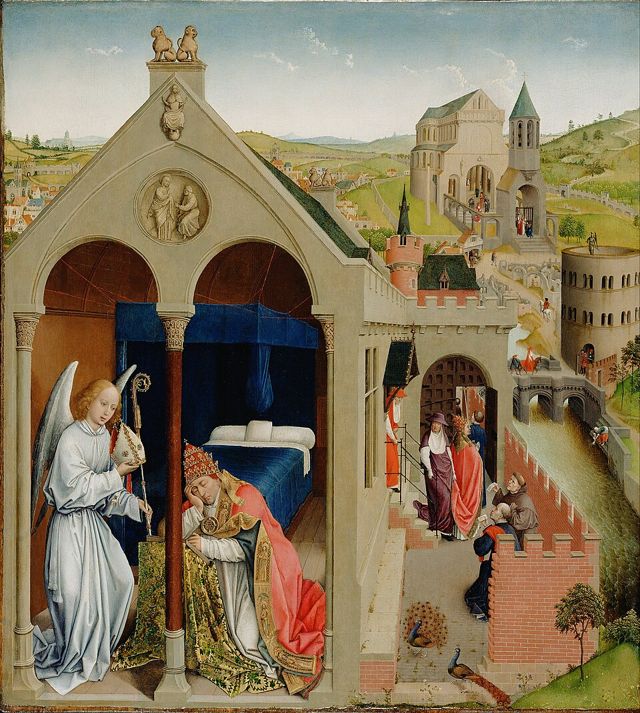
Image: Workshop of Rogier van der Weyden (Netherlandish - The Dream of Pope Sergius - Google Art Project.jpg · Workshop of Rogier van der Weyden (Netherlandish, 1399/1400 - 1464) (1399 - 1464) – artist (Netherlandish) Details on Go · Public domain, via Wikimedia Commons

From Sabine Baring-Gould, The Lives of the Saints, new edition in 16 vols. (London: John C. Nimmo, 1897–98); text from the Internet Archive scan (OCR, lightly cleaned; errors possible). Public domain.

Image: Workshop of Rogier van der Weyden (Netherlandish, 1399/1400 - 1464) (1399 - 1464) – artist (Netherlandish) Details on Go, Wikimedia Commons (Public domain)

From “Catholic Encyclopedia (1913)/Pope St. Sergius I,” The Catholic Encyclopedia (New York: Robert Appleton Company, 1907–1914), via Wikisource. Public domain. Matched by name and feast date; text unedited except for our bracketed notes in grey.

From Sabine Baring-Gould, The Lives of the Saints, new edition in 16 vols. (London: John C. Nimmo, 1897–98); text from the Internet Archive scan (OCR, lightly cleaned; errors possible). Public domain in the United States. Reproduced unedited, except for short bracketed notes in grey that we added to explain names and terms (“S.” is the old abbreviation for Saint). Some history and judgments reflect 19th-century scholarship.