Building a community where people could actually live the Gospel.
Read the essentials →Building a community where people could actually live the Gospel.
September 25
September 25 (also listed: October 8, July 5, July 18)
Abbot
Princes and prelates applied to Sergius not only for advice, but also for teachers trained in his school, who might become in their realms and dioceses the heads of similar institutions, centres whence light and wisdom might shine. Tartar invasion had quenched the religious fervour of the Russians, a new era of zeal opened with the foundations of the Troitzka monastery and the labours of Sergius. At the request of Vladimir, Athanasius, a disciple of Sergius, founded the Visotsky monastery at Serpouchoff; and another of his pupils, Sabbas, laid the foundation of the convent of Svenigorod, whilst his nephew Theodore laid that of Simonoff in Moscow.
Build up the community you belong to. This life was lived with and for a community.
Make time for silence. Solitude and withdrawal to pray shape this life.
Learn from the kind of life it was. Building a community where people could actually live the Gospel.
Princes and prelates applied to Sergius not only for advice, but also for teachers trained in his school, who might become in their realms and dioceses the heads of similar institutions, centres whence light and wisdom might shine. Tartar invasion had quenched the religious fervour of the Russians, a new era of zeal opened with the foundations of the Troitzka monastery and the labours of Sergius. At the request of Vladimir, Athanasius, a disciple of Sergius, founded the Visotsky monastery at Serpouchoff; and another of his pupils, Sabbas, laid the foundation of the convent of Svenigorod, whilst his nephew Theodore laid that of Simonoff in Moscow.
In the terrible struggle against the Tartars, the heart of the Grand-Prince Demetrius failed him; how could he break the power of this inexhaustible horde which, like the locusts of the prophet (Joel ii.), had the garden of Eden before them, and left behind them a desolate wilderness. It was the remonstrance, the blessing, the prayers of Sergius, that encouraged the Prince to engage in battle with the horde on the fields of the Don. No historical picture or sculpture S. Sergius.
in Russia is more frequent than that which represents the youthful warrior receiving the benediction of the aged hermit. Two of his monks, Peresvet and Osliab, accompanied the Prince to the field, and fought in coats of mail drawn over their monastic habit; and the battle was begun by the single combat of Peresvet with a gigantic Tartar, champion of the Horde.
The two chief convents in the suburbs of Moscow still preserve the recollection of that day. One is the vast fortress of the Donskoi monastery, under the Sparrow Hills. The other is the Simonoff monastery already mentioned, founded on the banks or tne Mosqua, on a beautiful spot chosen by the saint himself, and its earliest site was consecrated by the tomb which covers the bodies of his two warlike monks. From that day forth he stood out in the national recollection as the champion of Russia. It was from his convent that the noblest patriotic inspirations were drawn, and, as he had led the way in giving the first great repulse to the Tartar power, so the final blow in like manner came from a successor in his place. When Ivan III. wavered, as Demetrius had wavered before him, it was by the remonstrance of Archbishop Bassian, formerly prior of the Troitzka monastery, that Ivan too was driven, almost against his will, to the field. “ Dost thou fear death so he was addressed by the aged prelate. “ Thou too must die as well as others; death is the lot of all, man, beast, and bird alike; none avoid it. Give these warriors into my hands, and, old as I am, I will not spare myself, nor turn my back upon the Tartars.7' The Metropolitan, we are told, added his exhortations to those of Bassian. Ivan returned to the camp, the Khan of the Golden Plorde fled without a blow, and Russia was set free for ever. The Metropolitan, Alexis, being eighty-four years old, perceived that his end was approaching, and he wished to tSepi. 2«.
give Sergius his blessing and appoint him as his successor. But the humble monk, in great alarm, declared that he could not accept and wear the sacred picture of the B. Virgin suspended by gold chains, which the primate [the leading bishop of a country] had sent him from his own breast on which it had hung. “ From my youth up,” said he, “ I have never possessed or worn gold, and how now can I adorn myself in my old age ?” S. Sergius died at an extremely advanced age in 1392, amidst the lamentations of his contemporaries. He was canonized in 1428, when his body was found un corrupt. a. James the Less. See May L S-S". Callistratus and Comp.
Feast: September 25
One short email a day for nine days. The day's prayer, a line from St. Sergius's story, and a nudge to keep going.
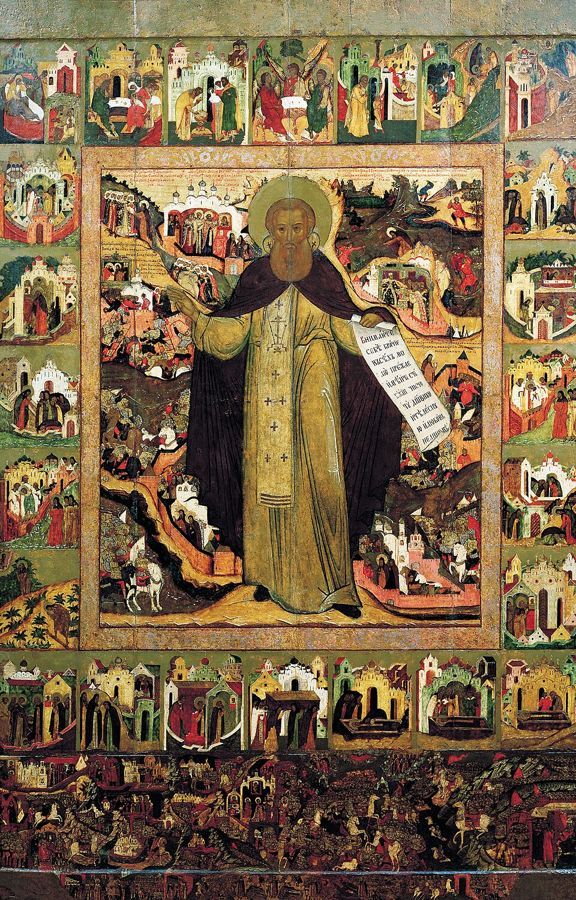
Image: Sergius of Radonezh vita icon (17 c., Yaroslavl museum) 2.jpg · AnonymousUnknown author · Public domain, via Wikimedia Commons
From Sabine Baring-Gould, The Lives of the Saints, new edition in 16 vols. (London: John C. Nimmo, 1897–98); text from the Internet Archive scan (OCR, lightly cleaned; errors possible). Public domain.
Image: AnonymousUnknown author, Wikimedia Commons (Public domain)
From Sabine Baring-Gould, The Lives of the Saints, new edition in 16 vols. (London: John C. Nimmo, 1897–98); text from the Internet Archive scan (OCR, lightly cleaned; errors possible). Public domain in the United States. Reproduced unedited, except for short bracketed notes in grey that we added to explain names and terms (“S.” is the old abbreviation for Saint). Some history and judgments reflect 19th-century scholarship.