S. Demetrius. was of the family of David, and his son was Gamaliel the Pharisee, at whose feet S. Paul was brought up. 1 S. Adamnan, and S. Gregory of Tours, say that he was buried
Read the essentials →S. Demetrius. was of the family of David, and his son was Gamaliel the Pharisee, at whose feet S. Paul was brought up. 1 S. Adamnan, and S. Gregory of Tours, say that he was buried
Read the essentials →S. Demetrius. was of the family of David, and his son was Gamaliel the Pharisee, at whose feet S. Paul was brought up. 1 S. Adamnan, and S. Gregory of Tours, say that he was buried
October 8
September 1 (also listed: January 5, July 27)
Feast
Thin entry · the 1897 book gives only 130 words. We have not filled the gap with invented detail.
S. Demetrius. was of the family of David, and his son was Gamaliel the Pharisee, at whose feet S. Paul was brought up. 1 S. Adamnan, and S. Gregory of Tours, say that he was buried on Mount Olivet.
Keep their day. Remember them on October 8 with a short prayer, and ask for their help.
S. Demetrius. was of the family of David, and his son was Gamaliel the Pharisee, at whose feet S. Paul was brought up. 1 S. Adamnan, and S. Gregory of Tours [bishop and historian of the Franks (d. 594)], say that he was buried on Mount Olivet. In the 6th century his relics [the bodily remains of a saint, or objects they used, kept with honor] were translated to Constantinople, by Justin the Younger. Portions were given to Charlemagne [king of the Franks, crowned emperor in 800], and were by him placed at Aix, where the arm on which the infant Saviour rested when the “ Nunc Dimitris” was first is said, is shown. Other relics at Hartzburg, but the entire body at Zara, in Dalmatia; and another entire body at Andechs, in Bavaria. Part of an arm at Perigueux, another part at Palermo. The head in the Jesuit college at Brussels. Numerous other relics, mostly of arms, elsewhere.
Feast: September 1
Traditional: October 8
One short email a day for nine days. The day's prayer, a line from St. Simeon's story, and a nudge to keep going.
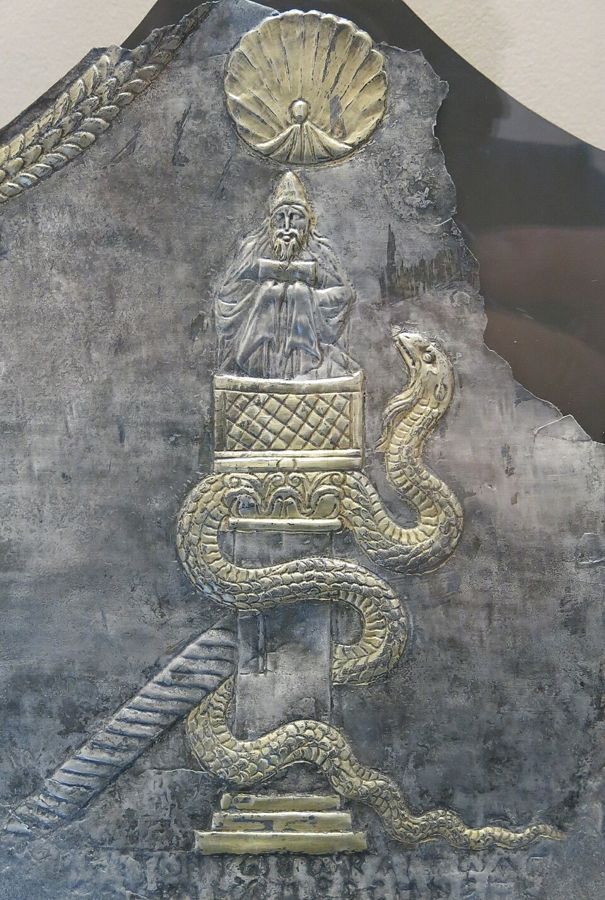
Image: Plaque de Saint-Simeon (Louvre, Bj 2180) (cropped).jpg · Tangopaso · Public domain, via Wikimedia Commons
From Sabine Baring-Gould, The Lives of the Saints, new edition in 16 vols. (London: John C. Nimmo, 1897–98); text from the Internet Archive scan (OCR, lightly cleaned; errors possible). Public domain.
Image: Tangopaso, Wikimedia Commons (Public domain)
From Sabine Baring-Gould, The Lives of the Saints, new edition in 16 vols. (London: John C. Nimmo, 1897–98); text from the Internet Archive scan (OCR, lightly cleaned; errors possible). Public domain in the United States. Reproduced unedited, except for short bracketed notes in grey that we added to explain names and terms (“S.” is the old abbreviation for Saint). Some history and judgments reflect 19th-century scholarship.