Baring-Gould’s sources: Roman Martyrology. SS. Simon and Jude together always in later Martyrologies. In that of Jerome (the edition of Florentinus), on June 29, ** In Persia the nativity of the Apostles Simon and Jude,” and on July 1, “ In Persia the passion of the Holy Apostles Simon the Canaanite and Jude Zelotes.” But by the Greeks S. Simon on May io, S. Jude on June 19. The Constantinopolitan Kalendar has on Aug. 20, “The contest of the Holy Apostle Thaddaeus,” and no mention of S. Simon. On the marble Neapolitan Kalendar on May 26, S. Jude alone, and on July 1, both Simon and Jude; and on Sept 10, S. Simon alone. Some of the Latin Martyrologies have “ The Nativity of the R Apostle Simon, who is also called Jude,” on Oct 28. The Anglican Reformed Kalendar, Sarum, York, Hereford Kalendars.] TMON the Canaanite, one of the Twelve Apostles,1 is also called Simon Zelotes.2 This latter term, which is peculiar to S. Luke, is the Greek equivalent for the Chaldee term Canaanite (Kanne&n). This does not signify a descendant of Canaan, but one of the Jewish sect or faction of “ the Zealots,” who were conspicuous for their fierce advocacy of the Mosaic ritual. Some writers have identified Simon Zelotes with Simon the “brother” of Jesus,3 but this opinion rests on no evidence whatever.
The pseudo-Hippolytus says, “ Simon the Canaanite, the son of Cleophas, also called Jude, was created bishop ot Jerusalem after James the Just fell asleep and was buried there, at the age of 120;” but this testimony is worth nothing. The ignorance of the writer is shown by his confounding Simon with Jude. In like manner the Menology and Menaea confound Simon with Nathaniel. On April 22, they have “ the memorial of the holy Apostle Nathaniel, who is also called Simon Zelotes;” and the Synaxarium, on May 10, says, “This is Simon, who is called also NathanieL” The Menology of Basil does not make this mistake: it commemorates S. Simon on May 10, and Nathaniel on April 22, whom it also distinguishes from S. Bartholomew on June n. A misunderstanding of the title “Canaanite” has led the Greeks to suppose that Simon was of Cana of Galilee, and the Synaxarium for May 10 says of him: “He was the bridegroom at the marriage to which Christ and His disciples were called, in Cana, where He changed water into S. Simon.
wine.” And it adds that Simon left the marriage table and wine, to follow Christ, and become His Apostle. But Bede [English monk and historian (d. 735)] and others think that the bridegroom was S. John the Divine, and that he left his bride to follow Christ. S. Augustine believed the same.1 It is very uncertain where Simon preached. Moses of Chorene, an Armenian writer of the 5th century, says that he preached in Persia. But he adds that “ some relate that a certain Simon the Apostle perished at.Bosphorus in Iberia. But whether it be true I know not, nor why he should have gone there.” Ado and S. Isidore of Seville, late writers and of no authority, take him to Egypt, but neither Copts nor Abyssinians have any commemoration of him. The Pseudo-Dorotheus says he preached in Africa and Britain, but this testimony is also worthless. As no certainty exists as to where he preached, so also is it doubtful whether he died a martyr’s death or not, and where he died. The Menology of Basil says he preached at Edessa and there died peacefully. The Latin Martyrologies generally say that he was martyred in Persia, but it is improbable that he died a cruel death, as Easterns say he died in peace, and the Latins had no authority whatever for their statement In the year 1204 an Armenian bishop or some wandering Oriental who gave himself out to be such, came to Cologne, pretending that he had made the journey from his native land for the purpose of venerating the Three Kings. He brought with him an arm of S. Simon Zelotes and gave it to Bruno, provost of Bonn, who made the precious relic over to the Pr&nontr£ convent of Seyn in the diocese of Trfeves, where it has performed many notable miracles. In art S. Simon is represented with a long saw, as he is supposed to have been sawn asunder; but sometimes he 1 In Prsefat. ad Tract. *eu Sermones in Joannem. [Oct. it.
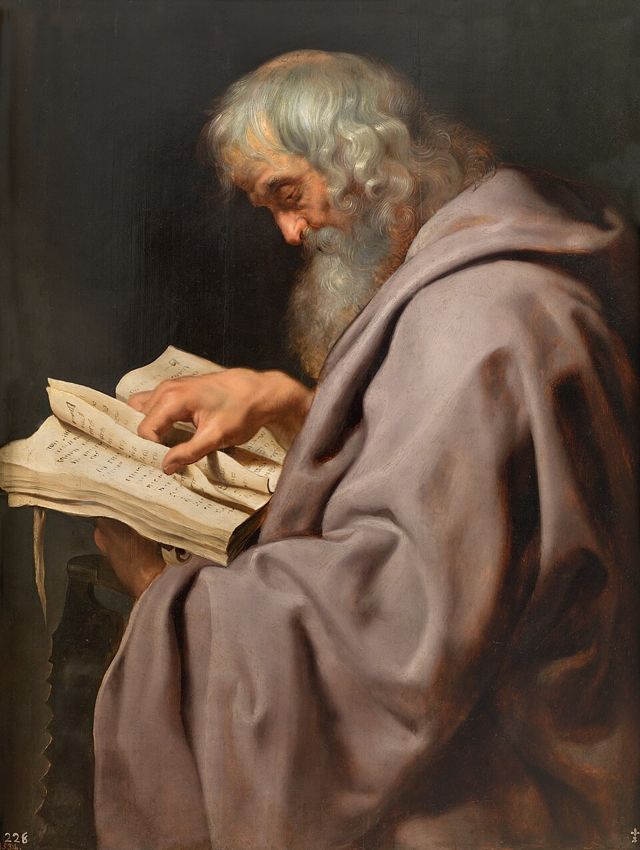
holds one or two fish. The Greek paintings represent him as an old man, bald, and with a rounded beard.