Faithfulness to Christ when it cost everything.
Read the essentials →Faithfulness to Christ when it cost everything.
September 7
September 7
Martyr
Maximian. “ Whence come you ?” Sozon. “ From the village of Midarze.” Maximian.
Learn from the kind of life it was. Faithfulness to Christ when it cost everything.
Keep their day. Remember them on September 7 with a short prayer, and ask for their help.
Maximian [Diocletian’s co-emperor in the West, 286–305]. “ Whence come you ?” Sozon. “ From the village of Midarze.” Maximian. “ What brought you hither ?” Sozon. “I am a shepherd boy, I wander from place to place with my flock.”
Maximian. “ And what induced you to commit this act of audacity ?” Sozon. “ I wished to show that I was a Christian, and that I thought you impious. That is why I struck off the hand of the idol/' Maximian. “ Come now, adore the gods, and we will look over this first audacity.”
Sozon. “What god, that one-handed fellow? I should be ashamed to venerate such a god as that, who cannot help himself against my crook.”
Maximian, turning to the executioners, said, “ Rack his limbs.” Then Sozon said, “Lord Jesus I help thy servant.” Maximian. “ There is yet time. Do what I bid you, and you shall be spared torture.”
Sozon. “ Fool ! do you not see that I did this deed to prove myself a Christian ? I fear not your torments, and I despise that filthy idol.”
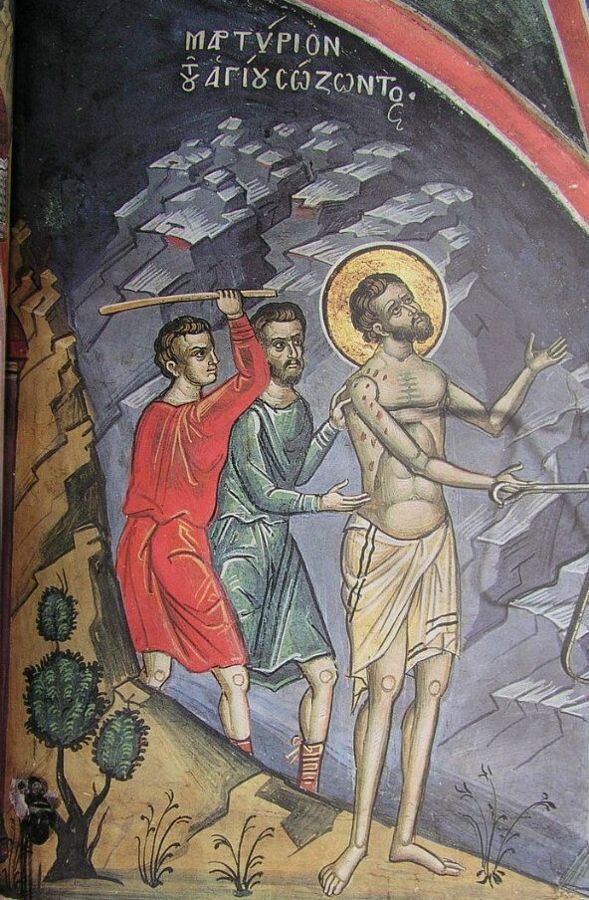
Maximian ordered nails to be driven into his shoes, and that the boy should be made to walk round the arena. Sozon did so, and the blood spirted from his torn feet, so that his skin was reddened above his ankles. As he passed the tribunal of Maximian, he pointed to his feet and said, “ By my hope ! you are not as gaily booted as I am in crimson.” “ Why, fellow/' said Maximian, “ you bear it bravely.” “ I feel nothing/' answered the shepherd lad. “ Then tune your pipe,” said the magistrate, “ and by the gods I will spare you.”
“ Of old I have piped many a pretty song to my sheep/’ said the boy, “ now I will not pipe to you, but sing to God.” “ Burn him to death/' said Maximian, “ and silence his accursed tongue.”
Then the martyr walked gladly to the pile of wood smeared with tar, a fire was set to it, and the flame rushed up around him, and consumed him. Now as evening came on, a heavy thunderstorm arose, and roared over the city, and the hail and rain drove the keepers from the court under cover, and taking advantage of the storm and darkness the Christians came by night and carried off the scorched bones of the martyr.
Feast: September 7
One short email a day for nine days. The day's prayer, a line from St. Sozon's story, and a nudge to keep going.
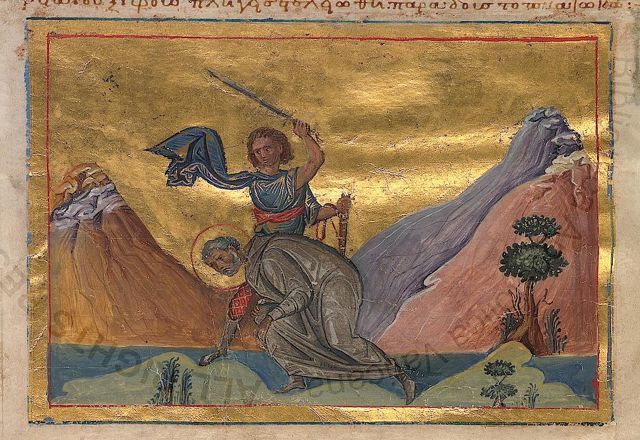
Image: Martyrion Agiou Sozontos Dionysiou.jpg · Theophanes the Cretan · Public domain, via Wikimedia Commons
From Sabine Baring-Gould, The Lives of the Saints, new edition in 16 vols. (London: John C. Nimmo, 1897–98); text from the Internet Archive scan (OCR, lightly cleaned; errors possible). Public domain.
Image: Theophanes the Cretan, Wikimedia Commons (Public domain)
From Sabine Baring-Gould, The Lives of the Saints, new edition in 16 vols. (London: John C. Nimmo, 1897–98); text from the Internet Archive scan (OCR, lightly cleaned; errors possible). Public domain in the United States. Reproduced unedited, except for short bracketed notes in grey that we added to explain names and terms (“S.” is the old abbreviation for Saint). Some history and judgments reflect 19th-century scholarship.