Building a community where women could live the Gospel together.
Read the essentials →Building a community where women could live the Gospel together.
September 11
September 11
Virgin
Abbess
Among other stories told of her is one that Christ Himself appeared to her with a pig’s-skin in His hand and clothed her with it, the bristles inside. Round this she wore an iron girdle, and absolutely refused to put on any other clothes. This incident is related in the sequence at Mass for her festival at Cingoli.
Learn from the kind of life it was. Building a community where women could live the Gospel together.
Keep their day. Remember them on September 11 with a short prayer, and ask for their help.
Among other stories told of her is one that Christ Himself appeared to her with a pig’s-skin in His hand and clothed her with it, the bristles inside. Round this she wore an iron girdle, and absolutely refused to put on any other clothes.
This incident is related in the sequence at Mass for her festival at Cingoli. “ Dedit tibi vestimentum Pellis suis indumentum, Zon& strinxit ferret.
Another of her visions was less fantastic and objectionable. She saw in dream a narrow road strewn with thorns and razors, and a voice called her to walk in it. When she did so, and her feet were cut and bleeding, the Lord shone before her, encouraging her to advance, and looking at Him, she forgot the pain in her feet, and advanced hastily, and found herself in a meadow of roses and violets.1 On another occasion she saw in vision a red cross, where1 “ltemdum manebat in contemplatione, vidit tres juvenes, aetate fere viginti quinque annorum, et quilibet in fionte crucem habebat, et statim in unum redact! fcuiit; ac Trinitatem esse, sibi dictum fuit." Sept n.) S. Sperandea.
upon on waking she made one like it, and marched bearing it, apparelled only in the miraculous pig’s-skin, through the town, singing at the top of her voice. No wonder that the biographer adds, “A swarm of boys followed her.” These were some of her less objectionable visions and exploits, the Bollandist father declines to print the rest.1 Various miracles are said to have been wrought by her. Some images of the Saint at Gubbio and Caorle have been indulgenced; and devotion to her was sanctioned by a decree of the Congregation of Sacred Rites in 1633. » “ Ex recitatis/* he says, “ non mirabitnr eruditus lector, alias a noe prseter[Sept. ia.
Feast: September 11
One short email a day for nine days. The day's prayer, a line from St. Sperandea's story, and a nudge to keep going.
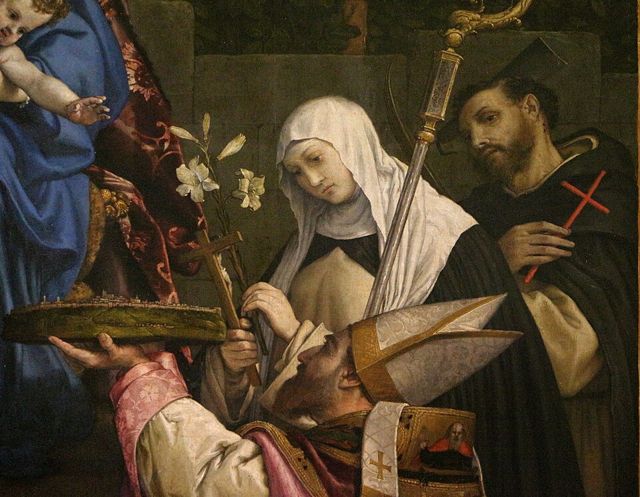
Image: Lorenzo lotto, madonna del rosario, 1539, 14.jpg · Lorenzo Lotto · CC BY 3.0, via Wikimedia Commons
From Sabine Baring-Gould, The Lives of the Saints, new edition in 16 vols. (London: John C. Nimmo, 1897–98); text from the Internet Archive scan (OCR, lightly cleaned; errors possible). Public domain.
Image: Lorenzo Lotto, Wikimedia Commons (CC BY 3.0)
From Sabine Baring-Gould, The Lives of the Saints, new edition in 16 vols. (London: John C. Nimmo, 1897–98); text from the Internet Archive scan (OCR, lightly cleaned; errors possible). Public domain in the United States. Reproduced unedited, except for short bracketed notes in grey that we added to explain names and terms (“S.” is the old abbreviation for Saint). Some history and judgments reflect 19th-century scholarship.