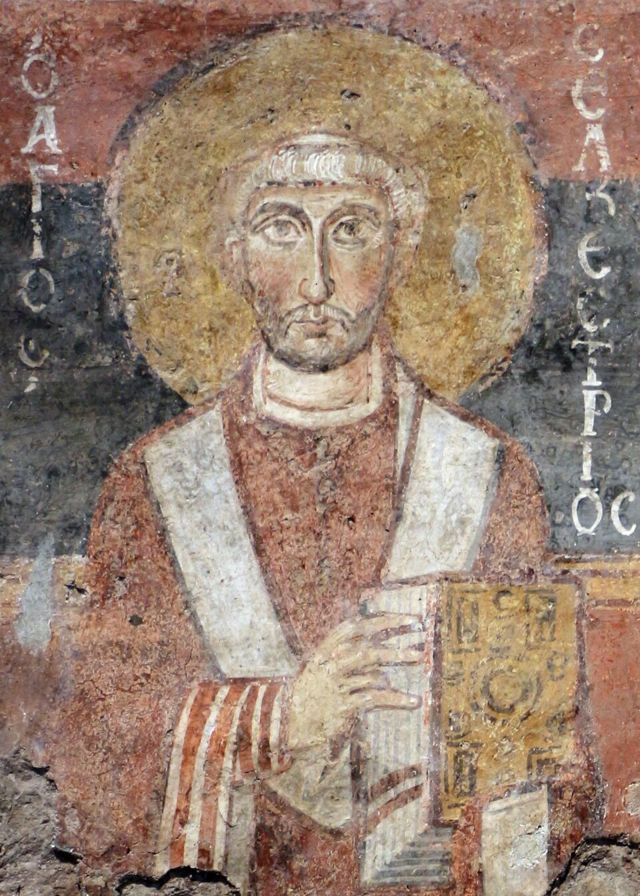
Baring-Gould’s sources: Roman Martyrology and all Latin Martyrologies and Kalendars. Authority: — Anastasius Bibliothecarius.] Sylvester was the son of a certain Rufinus, a Roman. He succeeded Melchiades in the chair of S. Peter, 314. 8. 8YLV23TSR. After Cahier.
S. Sylvester. His election took place on the 31st of January. When Maxentius [rival emperor at Rome 306–312, defeated by Constantine] held Rome, Sylvester, not then Pope, had retired for safety, or was driven, to Mount Soracte, and remained there in concealment till Constantine defeated the tyrant at Saxa Rubra, and Maxentius was drowned in attempting to escape into Rome across the Milvian bridge (a.d. 312). After the battle Sylvester returned to Rome, and two years later succeeded Melchiades. Constantine is said to have offered him a golden diadem set with jewels, but Sylvester refused it, and wore instead a white Phrygian cap or mitre. At the exhortation of Sylvester, Constantine built a church near the Baths of Diocletian [Roman emperor 284–305, who began the ‘Great Persecution’ of Christians in 303], and endowed it with a farm. Sylvester issued several constitutions for the Church of Rome. He ordered that chrism should be consecrated by bishops only, but that priests might administer confirmation with it in emergency, as in that of approaching death. A deacon was to wear a dalmatic when serving at the altar, and his left shoulder should be covered with a linen napkin.1 A priest in celebrating was not to use silk or coloured cloth, but linen, and that white, because the Lord's body was laid in white linen.2 Constantine built the Lateran [St. John Lateran, the pope’s cathedral in Rome] chinch and adorned the pediment with a silver figure of Christ enthroned, with the twelve apostles bearing silver crowns. He also placed in the apse a figure of the Saviour, of silver, five feet high, and four silver angels with u golden crowns and dolphins.” He set up a fountain of porphyry and silver near this basilica, on a porphyry pillar stood a golden lamb, from which spouted the water, and in the middle of the fountain was a phial containing balsam to be used for the lamps at night on the 1 “Constituit ut Diaconi dalmatica uterentur in Ecclesia, et pallio linostimo leva sorum tegerentur." — Anast. in S. Silvest. 1 Not apparently the vestments of the priest, but the napkins and corporals for the Eucharist Paschal festival. On one side of the lamb stood a statue of the Saviour, of silver; on the other, one of the Baptist, bearing a scroll on which was engraved, “ Behold the Lamb of God, that taketh away the sins of the world.” There were also four silver stags which spouted water. Sylvester and Constantine are the subjects of a forgery which was productive of important results. In 728 Pope Gregory II. made an attempt to form a confederation of States in Italy which was to maintain itself against the Greek empire and the Lombard kingdom. And, according to his scheme, the papal chair was to be the head and centre of this confederation. The plan came to nothing. In Rome, however, the idea ripened more and more, that the power of the Pope might come forward in Italy and take the place of the decaying power of the Greeks and the reluctantly tolerated power of the Lombards [a Germanic people who ruled much of Italy from 568 to 774]. Accordingly between 752 and 777 a document was foiged purporting to be a donation made by Constantine, containing the following grants: — 1. Constantine desires to promote the chair of Peter over the empire and its seat on earth, by bestowing on it imperial power and honour.
2. The chair of Peter shall have supreme authority over the patriarchal chairs of Alexandria, Antioch, Jerusalem, and Constantinople, and over all Churches in the world. 3. It shall be judge in all that concerns the service of God and the Christian faith.
4. Instead of the diadem which the emperor wished to place on the Pope's head, but which the Pope refused, Constantine gives him and his successors the phrygium (*>. the tiara) and the lorum which adorned the emperors1 neck, as well as the other gorgeous robes and insignia of the imperial dignity.
5. The Roman clergy shall enjoy the high privileges of the imperial senate, be eligible to the dignity of patrician or S. Sylvester.
consul, and have right to wear the decoration worn by the optimates or nobles in office under the empire. 6. The offices of cubicularii, ostiarii, and excubitores shall belong to the Roman Church.
7. The Roman clergy shall ride on horses decked with white coverings, and, like the senate, wear white sandals. 8. If a member of the senate shall wish to take orders, and the Pope consents, no one shall hinder him. 9. Constantine gives up the remaining sovereignty over Rome, the provinces, cities, and towns of the whole of Italy or 1 of the Western regions, to Pope Sylvester and his successors.
Pope Leo IX. recounted nearly the whole text of the donation to the patriarch [the title of the bishops of the great ancient sees: Rome, Constantinople, Alexandria, Antioch, Jerusalem] Michael Cerularius in 1054, openly and confidently, without, apparently, the shadow of a suspicion that the document was forged.
He wished the patriarch to convince himself “of the earthly and heavenly imperial power, the royal priesthood, of the Roman chair,” and to retain no suspicion “ that this chair 1 wished to usurp power by the help of foolish and old wives’ fables. ’ ” On the strength of this document Urban II. claimed Corsica in 1091. On it also Hadrian IV. rested his claim to give Ireland to Henry II. in 1155.2 A story was fabricated, or grew up, to account for the donation. According to this tale, Constantine was afflicted with leprosy, and Sylvester baptized him in a porphyry basin. In gratitude for the cure which was the result of the baptism, Constantine made the donation. In a mosaic on the frieze ot the Lateran basilica the scene of the baptism of Constantine by the Pope is represented. In reality, the emperor was baptized on his deathbed at Nicomedia, by 1 Later the “aut,” or, was changed into “et,” and; for purposes which may be guessed.
3 For a full account of the forged donation, see Dr. Dellinger's “ Fables of the Popes in the Middle Ages.” the Arian [followers of Arius, who taught that the Son is a created being, not fully God] Eusebius [Eusebius of Caesarea (d. c. 339), the first historian of the Church], bishop of that city. The Roman Martyrology and Breviary, however, still assert that “ S. Sylvester baptized Constantine.”
When the council of Nicaea met, Sylvester was very old, and unable to attend, and he sent in his place the two priests, who, according to the arrangement laid down by the emperor, would have accompanied him had he been able to make the journey. In this simple deputation later writers have seen the first germ of “ legati a latere.” In order to supplement history and give Sylvester a more prominent place in the decision of the Arian controversy, a fable was invented, according to which, on the return of Victor and Vincent, the two priests who represented Sylvester at Nicaea, the aged pontiff summoned a council of 277 bishops, in which Sylvester reviewed the decrees of Nicaea, and formally ratified them. There was probably a synod in his reign in which the regulations were passed already mentioned, relative to the dress of deacons and the altar linen. But the story of a council of Western bishops held after Nicaea is a fable.1 Constantine is credited with the murder of his son Crispus, his wife Fausta, and his nephew Iicinius. He, no doubt, felt great agony of remorse for his crimes, and his last visit to Rome, and the foundation of the churches there, already recorded, with their costly adornments, were probably the fruits of his penitence. According to one legend, Hosius of Cordova comforted the conscience-tortured monarch with promises of forgiveness in the Church. According to a story told by Sozomen, Constantine applied to a philosopher named Sosipater, who told him that there was no place of repentance for those guilty of such crimes. He 1 Guerin and Giry assert it as history ! but then they also give at length the story of Constantine’s leprosy and baptism by Sylvester, with only a faint qualification, and an attack on Eusebius, to discredit the statement of the historian, so as to substantiate the fable.
S. Melania the Younger. then applied to “ some bishops, who told him that he would be cleansed from sin on repentance and the reception of baptism.” But Sozomen rejects this story as u the invention of persons who desired to vilify the Christian religion.” But it is easy to see how from this germ grew the legend of Constantine covered with leprosy (sin), seeking first cleansing in heathen rites and a bath of infants’ blood, and then turning to Christianity and finding cleansing in baptism. When the forgery of the Donation was well established, this fable naturally attached itself to it, and the baptizer became Sylvester.1 S. Sylvester is represented trampling on a dragon,4 the symbol of the paganism which received its death-stroke from Constantine in his reign.