Baring-Gould’s sources: Modem Roman Martyrology, Benedictine Martyrologies. Authority: — A life written not long after his death by a monk of Padolira. The early part of his life was learned from letters of Arsenius, Patriarch of Jerusalem. He was canonized by Benedict VIII.; and at the elevation of his body, Leo IX. sent a brief to the bishop of Mantua, approving veneration to the saint.] Symeon, a native of Armenia, ran away from his home, when his parents had married him to a suitable wife, and took refuge with some other like-minded men in a cave, where they lived as hermits. One winter night the snow bed on the mountain slope above their cave slipped, and blocked up their cave. They remained for six or seven days buried under the snow, and broke a way out with the greatest difficulty. They were starving; but God sent them food. A stag took refuge from the cold and storm in their cave, and the ravenous hermits fell on her, cut her throat and devoured her. Only one of them refrained, saying it was wrong to eat meat, and he fainted from exhaustion. 1 When he came to himself, he changed his mind.
After a while, Symeon got tired of his cave, and the solitude of the Armenian mountains, and started on his rambles. He visited Jerusalem, where he made acquaintance with the patriarch [the title of the bishops of the great ancient sees: Rome, Constantinople, Alexandria, Antioch, Jerusalem], and then taking ship, came to Rome in 983. There he very nearly lost his life.. His unusual 'appearance, perhaps the fact of his making the sign of the cross differently from the Romans, caused a priest to denounce him as a heretic, and demand that he should be consigned to the flames. A howling rabble surrounded him, delighted with the prospect of burning a Manichgean, and the unfortunate Armenian would infallibly have been put to death, had riot Pope Benedict VII. heard of the proceedings, and ordered an Oriental bishop, then present in the city, to examine the unfortunate man in his faith, and ascertain whether he really deserved to be burnt. The bishop reported that the stranger was sound in his creed, and he was dismissed. Symeon at once escaped out of Rome, and we next hear of him obtaining shelter in a monastery at no great distance from Pisa. There he was so unmercifully beaten by the monks, who also probably took him for a heretic, that the bishop had to interfere and rescue him from their hands. He then went to Lucca, and a poor man who had heard of the cruel treatment to which he had been subjected, let him S. Symeon.
ride thither on his ass. At Pisa he lodged with some Jews, with whom he began to argue on the truths of Christianity; when one of them, in the heat of controversy, fell down in a fit and died. This so alarmed those present that they professed their eagerness to become Christians, and next day Symeon led them before the bishop, to announce their conversion.
He rambled through Lombardy, accompanied by other pilgrims. As he crossed the bridge over the Po, on his way to Vercelli, he found an old man crying over his horse which had fallen down, and had, as he thought, so severely injured itself, that it would never rise up and be of service to him any more. Symeon blessed the old horse and it started up, and jogged along its way as hale as if it had not fallen. One cold winter’s day he had compassion on a nearly naked beggar, so he sat down by the road-side, pulled off his trowsers, and gave them to the poor man. He wandered through Gascony, visited the tomb of S. James at Compostella, then rambled through France, paid his devotions at the tomb of S. Martin [St. Martin of Tours (d. 397), soldier turned bishop] at Tours, and returned to Italy, to settle in the Benedictine [monks following the Rule of St. Benedict] Monastery of Padolira, near Mantua, for the rest of his days. He filled the people of Mantua with the most intense amazement and veneration, by patting the head of a lion and putting his hand into its mouth. The lion was tied to a stake in the market-place, and was being exhibited, probably by some travelling showmen. When the Mantuese saw how coolly Symeon handled the lion, they shouted, “ Truly this is a servant of God.”
One day he was called into a cottage to see a girl nearly choked with quinsy. He blessed her, and the quinsy burst. One of the monks of Padolira got a Lives of the Saz?Us.
(July a6. fish bone down his throat, and was in dreadful pain, and nearly suffocated. Symeon crossed his throat, and he coughed up the bone and some blood with it. Symeon died on July 26th, 1016.
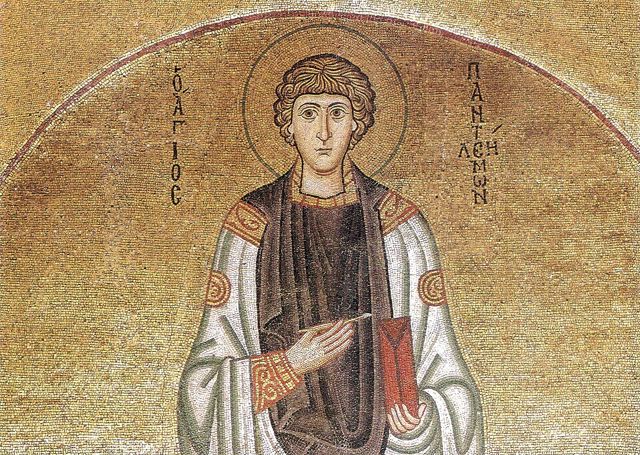
.Romanesque Altar-lights. The Seven Sleepers. SS. Maurus, B.M., Pantaleemon and Sergius, MM. at BiscegliOt 2nd cent. The Seven Sleepers, at Ephesus, a.p. 250. S. Pantale on, M. at Nicomedia, about a.d. 3d$. S. Deside rat us, B. of Besancon, 4 th cent. ^ S« Galactorius, B»M. of Lescar in Bearn, a. 0. 507. S. Laurence, Abp of Milan, a.o. 512. S. Ant h USA, at Constantinople, S th cent. SS. Aurelius, Sabagotha or Natalia, and Others, MM. at Cordova, S. Berthold, Ab. of Gastein in 'Styiia, a.d. 1142. S. Hugh of Lincoln, M., a.o. 1255.