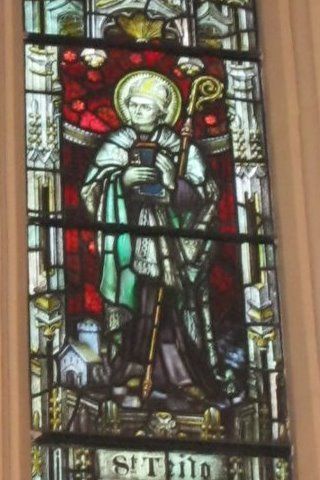
Baring-Gould’s sources: Patron of Llandaff. His name occurs in the Salisbury Martyrology of Wytford, and in the Anglican Mart. of John Wilson, who placed him on Dec. 26th, and was followed by Ferrarius. The correct day is, however, certainly Feb. 9th. He is recorded in the Welsh triads as one of the three canonized Saints of Britain; the two others are S. David and S. Cadoc. Authorities:—The Life, by Galfredus, of Llandaff (circ. 1120); another anonymous life in Capgrave; the Regestum Landavense; and the Liber Landavensis.
S. Teilo or Theliav was descended from a noble British stock. His father's name was Enlleu, son of Hydwn Dwn, and the place of his birth was Eccluis Cunnian, near Tenby. From his infancy he bent his neck beneath the gentle yoke of Christ, and, despising worldly vanities, was given to prayer and alms-deeds. He studied first under S. Dubricius, by whose assistance he attained great proficiency in the knowledge of the Scriptures; his next instructor was Paulinus, under whom he pursued the same study, and in whose school he was the associate of S. David. Under the patronage of Dubricius he opened a college, at Llandaff, which was called Bangor Deilo, or the great choir of Teilo; and his settlement at that place may serve to account for his appointment to fill the See of Llandaff upon the retirement of his patron to the Isle of Bardsey. The idea that he was made bishop of Llandaff at the time S. Dubricius was raised to the Archbishopric of Caerleon, is irreconcilable with chronology. The original diocese governed by S. Teilo, as ascertained by the absence of churches founded by S. David, was co-extensive with the ancient lordships of Glamorgan, containing the present rural deaneries of Croneath, Llandaff, and Newport. How long he continued to preside over this limited district is uncertain; but, in the reign of Maelgwn Cwynedd, the Yellow Plague desolated the Principality. Upon this occasion S. Teilo, with several others, retired to Cornwall, and thence into Brittany, where he was honourably received by S. Samson, Bishop of Dol. After he had remained seven years and as many months in Brittany, he returned, with several of his disciples, to his native country, and on his arrival was elected to the Archbishopric of Menevia, vacant by the death of Cynog. Like S. David, he, however, retained a predilection for the seat of his original bishopric, and, appointing Ismael to the situation of Bishop of Menevia, he removed the archbishopric to Llandaff. In order to maintain his title to the primacy undisturbed, he appears to have kept under his immediate government the whole of the diocese held before by S. David, with the exception of the part north of the river Tivy, which was henceforth attached to the diocese of Llanbadarn.
There is a story told of his having made a pilgrimage, before all this, to the Holy Land, in company with S. David and S. Padarn, and of their having received episcopal consecration from the Patriarch of Jerusalem; but it is probable that this was a story, borrowed by Giraldus from one of the lost Triads, and was invented to establish the independence of the Welsh bishops of the See of Rome.
In the Triads, S. Teilo is called one of the Three Blessed Visitors to the Isle of Britain, and he is associated with SS. David and Padarn. "They were so called," says the Triad, "because they went as guests to the houses of the noble, the plebeian, the native, and the stranger, without accepting either fee or reward, or victuals, or drink; but what they did was to teach the faith in Christ to every one without payment or thanks. Besides which, they gave to the poor and needy, gifts of their gold and silver, their raiment and provisions." His companions, or pupils, playing on his name, compared it to Helios , which, in Greek, means the sun; because, by his heavenly doctrine and example, he illumined the Church in South Wales, and warmed the hearts of the faithful. Twelve churches in the diocese of S. David's, and six in that of Llandaff, claim to have been founded by S. Teilo. [29]
A curious, late, and utterly worthless story, save as an example of the manner in which the popular tongue forges marvels, is related of his relics [the bodily remains of a saint, or objects they used, kept with honor]. At his death, three priests of different parishes were present, one from Llandaff, where he had been bishop; one of Llandeilo Fawr, where he died; and one of Penaly, near Tenby, where his ancestors had been buried. Each wished to claim the body for his church. The contention grew sharp between them, and was only terminated by the oldest of the three exhorting his brethren to leave the decision to God. Then they retired to rest, and, next morning, when they entered the room where the dead saint lay, lo! his one body had become three, perfectly identical in every particular, and each priest was able to carry off a S. Teilo to his own church. The origin of this foolish story is self-evident. It is an attempt to account, by a miracle, for the existence, in three places, of bodies of S. Teilo; a portion of his relics being probably preserved in each of these churches, and the popular tongue having magnified each portion into an entire body.