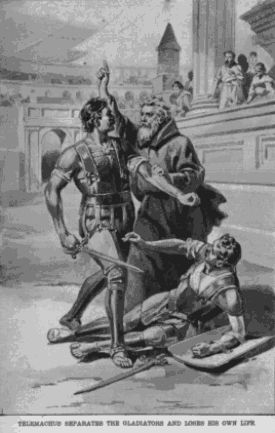
The following account of the martrydom of S. Telemachus is given by Theodoret, in his Ecclesiastical History, book v., chap. 26:—"Honorius, who had received the empire of Europe, abolished the ancient exhibitions of gladiators in Rome on the following occasion:—A certain man, named Telemachus, who had embraced a monastic life, came from the East to Rome at a time when these cruel spectacles were being exhibited. After gazing upon the combat from the amphitheatre, he descended into the arena, and tried to separate the gladiators. The bloodthirsty spectators, possessed by the devil, who delights in the shedding of blood, were irritated at the interruption of their savage sports, and stoned him who had occasioned the cessation. On being apprised of this circumstance, the admirable Emperor numbered him with the victorious martyrs, and abolished these iniquitous spectacles."
For centuries the wholesale murders of the gladiatorial shows had lasted through the Roman empire. Human beings, in the prime of youth and health, captives or slaves, condemned malefactors, and even free-born men, who hired themselves out to death, had been trained to destroy each other in the amphitheatre for the amusement, not merely of the Roman mob, but of the Roman ladies. Thousands, sometimes in a single day, had been
"Butchered to make a Roman holiday."
The training of gladiators had become a science. By their weapons, and their armour, and their modes of fighting, they had been distinguished into regular classes, of which the antiquaries count up full eighteen: Andabatæ, who wore helmets, without any opening for the eyes, so that they were obliged to fight blindfold, and thus excited the mirth of the spectators; Hoplomachi, who fought in a complete suit of armour; Mirmillones, who had the image of a fish upon their helmets, and fought in armour, with a short sword, matched usually against the Retiarii, who fought without armour, and whose weapons were a casting-net and a trident. These, and other species of fighters, were drilled and fed in "families" by lanistæ, or regular trainers, who let them out to persons wishing to exhibit a show. Women, even high-born ladies, had been seized in former times with the madness of fighting, and, as shameless as cruel, had gone down into the arena, to delight with their own wounds and their own gore, the eyes of the Roman people.
And these things were done, and done too often under the auspices of the gods, and at their most sacred festivals. So deliberate and organized a system of wholesale butchery has never perhaps existed on this earth before or since, not even in the worship of those Mexican gods, whose idols Cortez and his soldiers found fed with human hearts, and the walls of their temples crusted with human gore. Gradually the spirit of the Gospel had been triumphing over this abomination. Ever since the time of Tertullian, in the second century, Christian preachers and writers had lifted up their voice in the name of humanity. Towards the end of the third century, the Emperors themselves had so far yielded to the voice of reason, as to forbid, by edicts, the gladiatorial fights. But the public opinion of the mob, in most of the great cities, had been too strong both for Saints and for Emperors. S. Augustine himself tells us of the horrible joy which he, in his youth, had seen come over the vast ring of flushed faces at these horrid sights. The weak Emperor Honorius bethought himself of celebrating once more the heathen festival of the Secular Games, and formally to allow therein an exhibition of gladiators. But, in the midst of that show, sprang down into the arena of the Colosseum of Rome, this monk Telemachus, some said from Nitria [a desert monastic settlement west of the Nile Delta], some from Phrygia, and with his own hands parted the combatants, in the name of Christ and God. The mob, baulked for a moment of their pleasure, sprang on him, and stoned him to death. But the crime was followed by a sudden revulsion of feeling. By an edict of the Emperor, the gladiatorial sports were forbidden for ever; and the Colosseum, thenceforth useless, crumbled slowly away into that vast ruin which remains unto this day, purified, as men well said, from the blood of tens of thousands, by the blood of this true and noble martyr. [14]