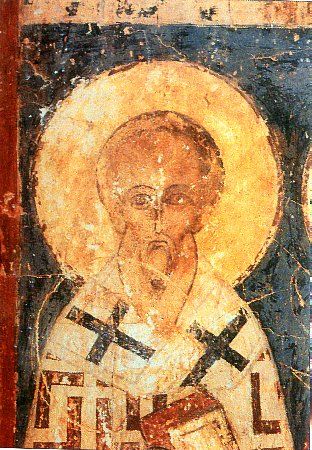
Baring-Gould’s sources: Gallican Martyrology. Authority:—S. Gregory of Tours (542) his kinsman.
S. Tetricus was the son of S. Gregory of Langres, whose life has been given on Jan. 4th. His mother's name was Armentaria. By her S. Gregory had two sons, Tetricus, who succeeded him in the see of Langres [a bishop’s “see” is his diocese, named from his seat (Latin sedes)], and Gregory, the father of Armentaria, mother of S. Gregory of Tours [bishop and historian of the Franks (d. 594)], the historian, who has recorded all that we know of the life of his great-uncle. This is not much. The choice of the clergy and people fell on Tetricus as a successor to his father, almost unanimously moved thereto by the hopes that he would inherit the virtues of S. Gregory. Nor were these hopes frustrated. Tetricus ruled with prudence, and was a burning and a shining light in his diocese. One Sunday at Dijon, as the prelate was ministering in the Church of S. John, Chramn, the rebel son of king Clothaire, entered it, and besought that he might be allowed to consult the divine Oracles on the future. Three books were accordingly placed on the altar, the Prophets, the Gospel, and the Epistles; and the clergy prayed along with Chramn that the future might be unfolded to him. Then he opened the book of the Prophets, and lighted on the words of Isaiah, v. 4, 5. "What could have been done more to my vineyard, that I have not done in it? Wherefore, when I looked that it should bring forth grapes, brought it forth wild grapes? And now, go to; I will tell you what I will do to my vineyard: I will take away the hedge thereof, and it shall be eaten up: and break down the wall thereof, and it shall be trodden down." Then the book of Epistles was opened at the place, "When they say, Peace and safety; then sudden destruction cometh upon them, as travail upon a woman with child; and they shall not escape," 1 Thess. v. 3; and the book of the Gospels when interrogated gave the following answer, Matt. vii. 26, 27, "A foolish man, which built his house upon the sand: and the rain descended, and the floods came, and the winds blew, and beat upon that house, and it fell: and great was the fall of it." Chramn went away much dispirited. Shortly after, hearing that his father was marching upon Dijon, he retired into Aquitaine, but being pursued by Clothaire, he fled into Brittany to Count Conovre. Shortly after Clothaire attacked them and defeated them in a battle in which the count fell. He then took his son and shut him up in a cottage with his wife and children, set fire to the place, and burnt them all.