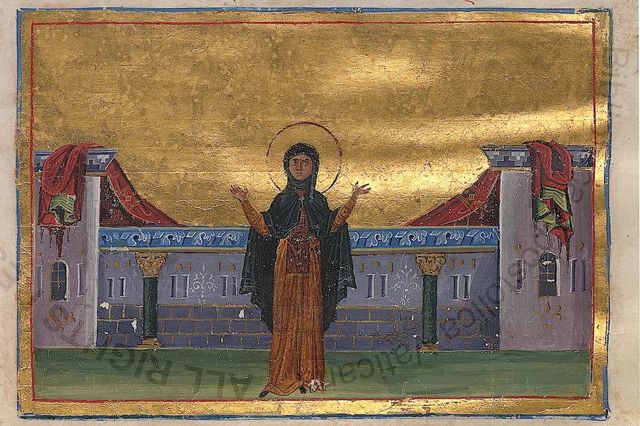
St. Theodora of Alexandria, Pen

She returned again to the desert, and only sent again to her husband when she felt herself dying.

Read the essentials →
September 11 · —

St. Theodora of…

St. Theodora of Alexandria, Pen

She returned again to the desert, and only sent again to her husband when she felt herself dying.

Traditional feast

September 11
1914 / pre-1969 calendar, per Baring-Gould (1897)

Current feast

September 11
Secondary source · Wikipedia

Represents

Feast

Their story

Adapted in modern English from Baring-Gould (1897–98) · original text below

(The surviving account on this page begins partway through the story.)

Theodora returned to the desert and sent for her husband only when she was dying; he arrived to attend her funeral. Baring-Gould thinks these are probably the facts, around which a Greek romancer wove a long tale borrowing from other lives, such as that of St. Marina.

More reliable writers preserved some of her sayings. To a Valentinian (a member of a Gnostic sect) who scorned all rules, she said a rule for the body gives the body to its Creator. She taught that humility, not fasting, vigils or solitude, makes a monk: demons told a hermit they neither eat nor sleep and live in solitude, but cannot endure humility. She told of a sick monk who said his office anyway and lost his fever, and of a hermit who tried to flee temptation, only to see his double putting on sandals beside him: "I am Self; wherever you go, I go too."

Early life

The book says little or nothing about early life. This is how the account begins.

She returned again to the desert, and only sent again to her husband when she felt herself dying. He arrived when she was dead, to assist at her obsequies. Such are probably the facts of her history, out of which a Sept, ii.] ♦S’.

What they represent

How they teach us to live

Drawn from themes in the original account

Make time for silence. Solitude and withdrawal to pray shape this life.

Practise small acts of self-denial. The account dwells on fasting and penance; a skipped snack or a phone-free hour is a start.

Choose humility over status. The account singles out humility.

Read more

The full original · 345 words

Read Baring-Gould’s full account

Baring-Gould’s sources: Greek Mentea, Menology, Russian, Coptic, and Abyssinian Kalendars. Inserted by Baronius in the Modern Roman Martyrology. Authority: — Two Lives of this saint exist, but both are merely historical romances, founded perhaps on some few facts. That such a person as Theodora did exist is however established by the retention of some of her sayings in the Lives of the Fathers of the Desert. The fabulous lives have been given by Lipomani and Surius, but not by the Bollandists.] Theodora was the wife of a prefect of Egypt, named Gregorius, and having fallen into sin and dishonour, she was ashamed to show her face before her husband. She dressed herself in some of his clothes, and ran away, and entered a monastery in the Thebaid, as a monk. After many years she was sent with some camels to Alexandria to the prefect, and suddenly, with the utmost emotion, Gregorius recognised in the poor camel-driver his lost wife.

She returned again to the desert, and only sent again to her husband when she felt herself dying. He arrived when she was dead, to assist at her obsequies. Such are probably the facts of her history, out of which a Sept, ii.] ♦S’. Theodora of Alexandria, Greek romancer has woven a long story pieced with incidents from other lives, one that of S. Marina (July 17). Some of her apophthegms have been preserved by more veracious historians than the romance writer who composed her history.

She met a Valentinian one day full of scorn for the Law, and exalting the freedom of the Gospel which emancipated man from all vexatious restraints. “A law for the body gives the body to the Creator,” said Theodora. “ It is not fasting, watching, nor solitude that makes a monk, but humility. There was once an anchorite [a hermit, sometimes walled into a cell beside a church] who drove out devils. And as they were fleeing away he asked them, ‘What has expelled you — fasting?’ ‘We neither eat nor drink/ they answered, ‘ meat and drink are no concern to us.’ ‘What then has expelled you — vigils?’ We never sleep/ they answered, 4 vigils interfere not with us.’ ‘ What then has expelled you— solitude ?’ ‘ We haunt solitudes/ ‘ Then tell me what has driven you out ?’ They answered, ‘ We cannot endure humility, from that we flee away/”

“ Once a brother was feverish and sick, and he said to himself, * I am too ill to pray/ Then after a while he thought, ‘ I can but die once/ and he got out of bed and said his office. And when he had done his office his fever left him.”

“ Once a hermit said, ‘ I am so surrounded with temptations that I must leave this place and go elsewhere/ So he went out of his door, and put on his sandals, and he saw near him his double putting on his sandals, and preparing to journey. ‘I am Self/ said the double, ‘wherever you go, I go too/ ”
Feast days

Feast: September 11

Nine days · Free

Pray the novena
with us.

One short email a day for nine days. The day's prayer, a line from St. Theodora of…'s story, and a nudge to keep going.

Also on September 11
P

Sts. Protus and Hyacinth

September 11 · Martyrs
Sts. Felix and Regula

Sts. Felix and Regula

September 11 · Martyr, Virgin
St. Paphnutius

St. Paphnutius

September 11 · Bishop, Confessor
← All 1726 saints in the library
Sources & notes

Feast-day sources

Story sources

Sources

Credits

Image: Theodora of Alexandria (Menologion of Basil II).jpg · Authors of Menologion of Basil II (circa 985 AC, Constantinople), Byzantine manuscript illuminators[1]: Pantoleon with G · Public domain, via Wikimedia Commons

From Sabine Baring-Gould, The Lives of the Saints, new edition in 16 vols. (London: John C. Nimmo, 1897–98); text from the Internet Archive scan (OCR, lightly cleaned; errors possible). Public domain.

Image: Authors of Menologion of Basil II (circa 985 AC, Constantinople), Byzantine manuscript illuminators[1]: Pantoleon with G, Wikimedia Commons (Public domain)

From Sabine Baring-Gould, The Lives of the Saints, new edition in 16 vols. (London: John C. Nimmo, 1897–98); text from the Internet Archive scan (OCR, lightly cleaned; errors possible). Public domain in the United States. Reproduced unedited, except for short bracketed notes in grey that we added to explain names and terms (“S.” is the old abbreviation for Saint). Some history and judgments reflect 19th-century scholarship.