Baring-Gould’s sources: Roman Martyrology. Usuardus, Ado, Bede, Sacramentary of S. Gregory, Mart, of Jerome, &c. Sarum, York, and Hereford Kalendars. By the Greeks on Feb. 17, and on the first Saturday in Lent Authority An Oration of S. Gregory of Nyssa on his festival.] |. GREGORY of Nyssa begins the panegyric which he pronounced upon this martyr on his festival, at his tomb near Amasea, by gratefully ascribing to his intercession the preservation of that county from the inroads of the Scythians, who had laid waste all the neighbouring provinces. Imploring his patronage, he says: “ As a soldier defend us; as a martyr speak for us — ask peace ! If we want a stronger intercession, gather together your brother martyrs, and with them all pray for us. Stir up Peter, Paul, and John, that they be solicitous for the Churches which they founded. May no heresies sprout up: may the Christian commonwealth become, by your and your companions' S. Theodore.
…prayers, a flourishing field.1’ The panegyrist testifies, that by his intercession devils were expelled, and distempers cured; that many resorted to his church, and admired the stateliness of the buildings, and the actions of the saint painted on the wall; approached the tomb, being persuaded that the touch thereof imparted a blessing; that they carried away the dust of the sepulchre as a treasure of great value, and if any were allowed the happiness to touch the sacred relics [the bodily remains of a saint, or objects they used, kept with honor], they respectfully applied them to their eyes, mouth, ears, and otherorgansof theirsenses. “Then,” says the same S. Gregory, “ they address themselves to the martyr as if he were present, and pray and invoke him, who is before God, and obtain gifts as he pleases.” The venerable panegyrist proceeds to give a short account of the martyr’s triumph. Theodore was a native of Syria or Armenia, young, and newly enlisted in the Roman army, on which account he was sumamed Tyro. With his legion he was sent into winter quarters in Pontus [a region on the Black Sea coast of Turkey], and was at Amasea when fresh edicts were published by Maximian [Diocletian’s co-emperor in the West, 286–305] Galerius [Diocletian’s co-emperor in the East and driving force of the Great Persecution] and Maximin for continuing with the utmost rigour the persecution which had been raised by Diocletian [Roman emperor 284–305, who began the ‘Great Persecution’ of Christians in 303]. The young soldier was seized and presented to the governor of the province and the tribune of his legion, and was asked by them how he dared to profess a religion which the emperors punished with death. He boldly replied, “ I know not your gods. Jesus Christ, the only son of God, is my God. Beat, tear, or bum me; and if my words offend you, cut out my tongue: every part of my body is ready when God calls for it as a sacrifice.” His judges feeling pity for his youth, dismissed him, thinking he would be persuaded by his companions to think differently, and unwilling, unless absolutely forced to do so, to proceed to extremities. Theodore, however, had no wish to be let off thus easily; and to compel his judges to take further notice of him he set fire to a temple of Cybele, which stood [Not. g.
upon the banks of the river Iris, in the middle of the city; and the fabric was reduced to ashes. When he was carried a second time before the governor and his assistant he was ready with his confession. They endeavoured to terrify him with threats of torture, and allure him by promising to make him the priest of the goddess, if he would offer sacrifice. His answer was, that such priests were of all idolaters the most miserable, because the most criminal. The magistrates reluctantly ordered him to execution. His body was tom with whips; and he was hoisted on the rack. Under all manner of torments the saint maintained his tranquillity and greatness of soul, and, seemingly insensible to the smart of his wounds, ceased not to repeat those words of the psalmist. “ I will bless the Lord at all times: His praises shall ever be in my mouth.” When the governor’s cruelty was tired, the martyr was remanded to prison, where, in the night, he was comforted by God and His holy angels. After a third examination Theodore was condemned to be burnt alive. The sentence was executed in the year 306, probably on the 17th of February, on which day the Greeks and Russians celebrate his festival, though the Latins keep it on the 9th of November. The body of this martyr was translated in the twelfth century to Brindisi, and is there enshrined, except the head, which is at Cajeta. The ancient church of Venice, of which he is titular saint, is said to have been built by Narses. A collegiate church in Rome, which originally was a temple of Romulus, and several churches in the East, bear his name.
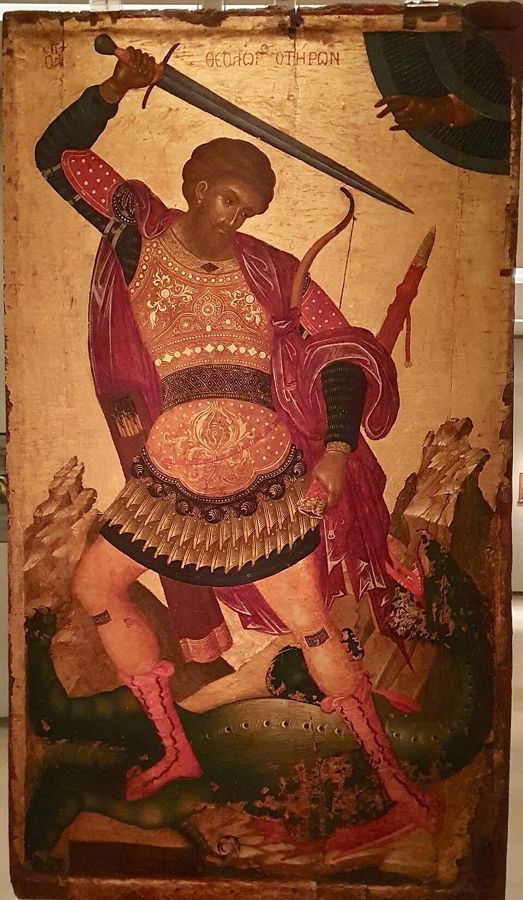
He is often confounded with S. Theodore of Heradea (February 7th). In art he is represented as a soldier with torch or furnace. Theodore with a dragon is the saint of Heraclea.
■S’. John the Dwarf.