St. Theodore of Heraclea

Faithfulness to Christ when it cost everything.

Read the essentials →
February 7 · Martyr

St. Theodore of Heraclea

St. Theodore of Heraclea

Faithfulness to Christ when it cost everything.

Traditional feast

February 7
1914 / pre-1969 calendar, per Baring-Gould (1897)

Current feast

February 7 (also listed: February 8)
Secondary source · Wikipedia

Represents

Martyr

Their story

Adapted in modern English from Baring-Gould (1897) · original text below

Theodore of Heraclea is not to be confused with St Theodore Tyro of Amasea, another soldier martyr. The Greek Church counts him among the Great Martyrs.

He was a general in the armies of Licinius (emperor in the East 308–324, who turned against Christians before Constantine defeated him) and governor of the country of the Mariandyni, whose capital was Heraclea of Pontus. There he was sentenced to death on the emperor's orders. He was scourged, his flesh was torn with hooks and burned with fire, and after hanging for a short time on a cross he was beheaded.

Mark Dandolo brought his body from Constantinople to Venice in 1260, and he became one of the chief patrons of the Venetian republic. In art he appears as a warrior in armour, usually trampling a dragon. He stands on foot, while St George is usually shown mounted.

Early life

The book says little or nothing about early life. This is how the account begins.

Thin entry · the 1897 book gives only 165 words. We have not filled the gap with invented detail.

S. Theodore of Heraclea, who is not to be confounded with S. Theodore of Amasea, surnamed Tyro, also a warrior martyr, is numbered among the Great Martyrs by the Greek Church. Theodore of Heraclea was a general of the forces of Licinius, and governor of the country of the Mariandyni, whose capital was Heraclea of Pontus. Here he was sentenced to death by order of the emperor.

What they represent

How they teach us to live

Drawn from themes in the original account

Learn from the kind of life it was. Faithfulness to Christ when it cost everything.

Keep their day. Remember them on February 7 with a short prayer, and ask for their help.

Read more

The full original · 165 words

Read Baring-Gould’s full account

Baring-Gould’s sources: Roman Martyrology on this day. By the modern Greeks on Feb. 8th, but anciently on the 7th. The Acts purport to be written by one Augarius, a notary; he says, "I, the Scribe Augarius, was present, and saw these cruel punishments, and hearing also the pain of his stifled sighs, casting aside my parchments, I threw myself weeping at his feet." He says also that he wrote this account at the request of the dying martyr. If this be not a forgery, the original Acts have been sadly tampered with. To the account of the martyrdom is prefixed—very probably by a later hand—a story of the fight of S. Theodore with a dragon, which belongs to the Western version of the story of S. George. These Acts certainly existed in their present condition in 550, for they were then translated into Latin.

S. Theodore of Heraclea, who is not to be confounded with S. Theodore of Amasea, surnamed Tyro, also a warrior martyr, is numbered among the Great Martyrs by the Greek Church.

Theodore of Heraclea was a general of the forces of Licinius [Roman emperor in the East 308–324], and governor of the country of the Mariandyni, whose capital was Heraclea of Pontus [a region on the Black Sea coast of Turkey]. Here he was sentenced to death by order of the emperor. After having been scourged, and his flesh torn by hooks, and burnt with fire, he was for a short while attached to a cross, and then beheaded.

Relics at S. Saviour's, Venice. S. Theodore is regarded as one of the chief patrons of the Venetian republic. The body of this glorious martyr was brought from Constantinople to Venice by Mark Dandolo, in 1260.

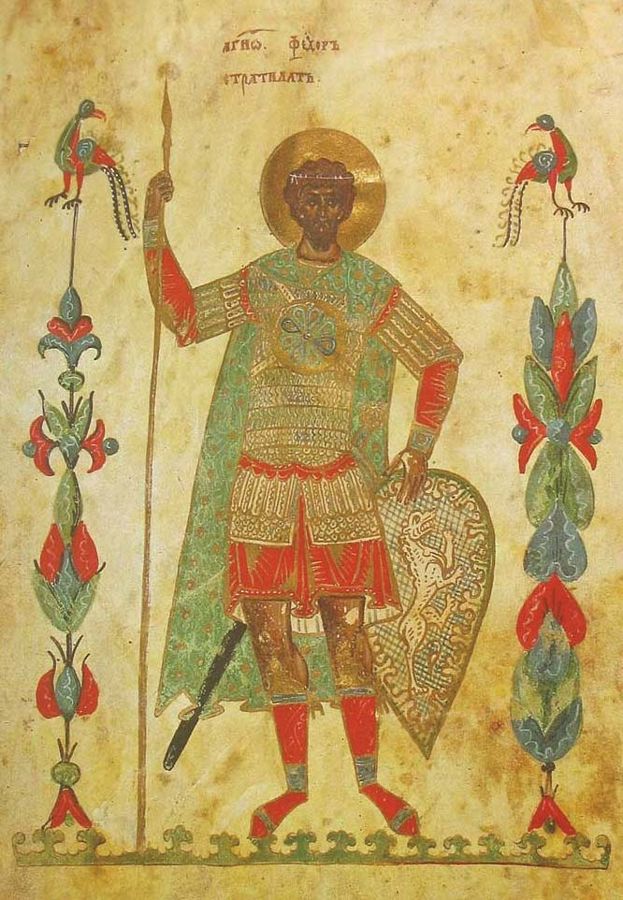
In Art, S. Theodore appears as a warrior in armour, very generally trampling on the dragon. He is to be distinguished from S. George by being represented on foot, whereas S. George usually appears mounted.

Feast days

Feast: February 7

Nine days · Free

Pray the novena
with us.

One short email a day for nine days. The day's prayer, a line from St. Theodore of Heraclea's story, and a nudge to keep going.

Also on February 7
C

St. Chrysolius

February 7 · Bishop, Martyr
A

St. Augulus

February 7 · Bishop, Martyr
P

St. Parthenius of…

February 7 · Bishop
← All 1726 saints in the library
Sources & notes

Feast-day sources

Story sources

Sources

Credits

Image: Fyodorstratelate.jpg · Unknown authorUnknown author · Public domain, via Wikimedia Commons

From Sabine Baring-Gould, The Lives of the Saints, new edition in 16 vols. (London: John C. Nimmo, 1897), digitized text from Project Gutenberg. Public domain.

Image: Unknown authorUnknown author, Wikimedia Commons (Public domain)

From Sabine Baring-Gould, The Lives of the Saints, new edition in 16 vols. (London: John C. Nimmo, 1897), digitized text from Project Gutenberg. Public domain in the United States. Reproduced unedited, except for short bracketed notes in grey that we added to explain names and terms (“S.” is the old abbreviation for Saint). Some history and judgments reflect 19th-century scholarship.