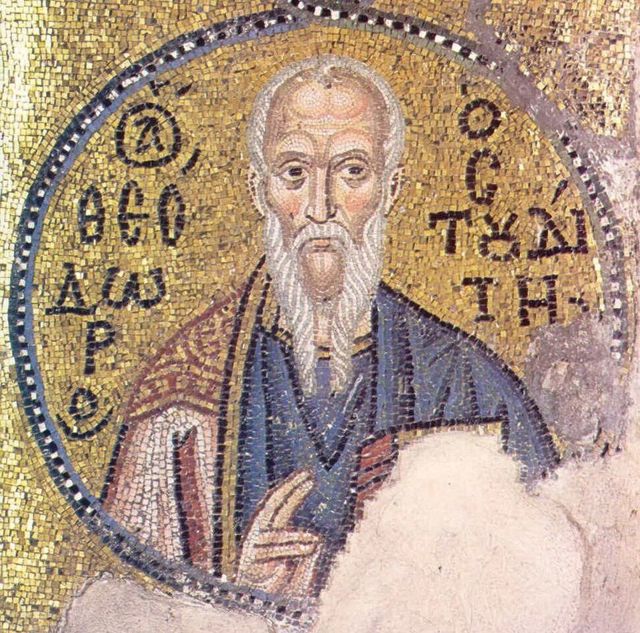
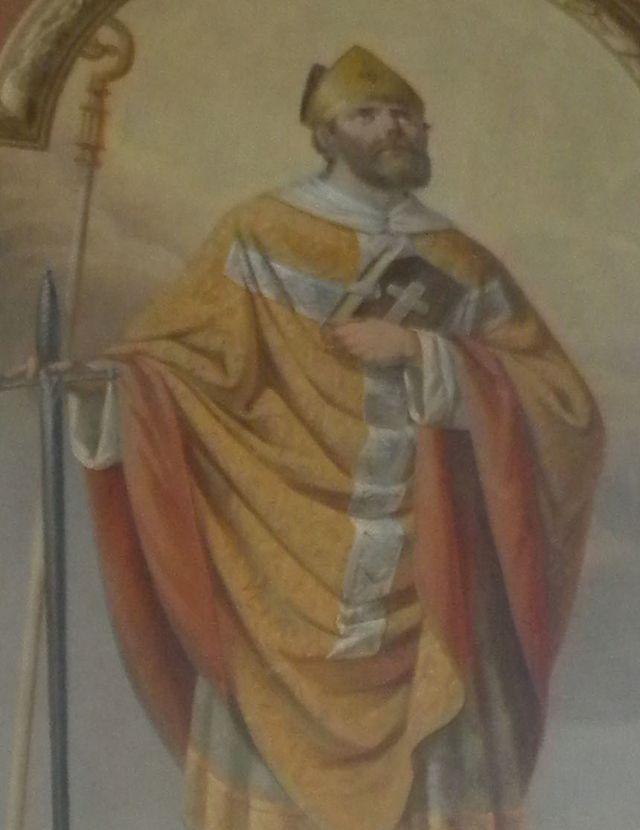
Baring-Gould’s sources: Modern Roman Martyrology on Nov. 12. Inserted by order ol Urban VIIL Greek Menseas and Menologies and Russian Kalendar on Nov. 1 1. Authorities: — A Life by Michael, a monk of Constantinople and a contemporary. Also the letters of S. Theodore; Theophanes, Cedrenus, &c.] S. Theodore was born in 759, and embraced the monastic life when aged twenty-three, under his uncle, S. Plato, at Constantinople. In 795 S. Plato was ill, and supposing he was about to die, he summoned his monks round him and bade them elect a successor. With one voice they chose Theodore, and Plato resigned the abbot’s office into his hands. He did not, however, die, but he was glad to be relieved of a burden which was more than he felt he could bear at his advanced age. Plato openly testified his disapproval of the marriage of Constantine VI. with Theodota. Constantine had married, before he was twenty, a young maiden of somewhat humble rank, named Mary. In 795 he fell passionately in love with Theodota, a kinswoman of Plato and Theodore, who was remarkably beautiful and engaging. The young emperor sought for excuses to get rid of his wife; he pretended that she had attempted his life with poison, sent for the patriarch Tarasius, exhibited a bowl of muddy liquid as a proof of her guilt, and insisted on being divorced. Tarasius replied that the proofs were insufficient, that the real reason that actuated the emperor was his passion for Theodota, and threatened him with excommunication should he persist in his design. The emperor in a rage expelled him the palace, forced Mary to take the veil, and had her hair cut in January, 795. In the month of August following Not. xx.] S. Theodore of the Stadium.
The declared Theodota empress, and affianced her to himself! But as he could not persuade Tarasius to perform the marriage ceremony, he had the nuptial benediction given in the palace of S. Mamas, on the 4th September following, by Joseph, the abbot and steward of the church of Constantinople. S. Plato and S. Theodore were the only two who openly opposed this scandalous union, by separating themselves from the communion of the emperor. For the patriarch [the title of the bishops of the great ancient sees: Rome, Constantinople, Alexandria, Antioch, Jerusalem] Tarasius did not venture to put his threat in execution, lest he should drive Constantine to favour the iconoclastic faction. He was nevertheless subjected to various petty but irritating insults by the emperor.
Theodore, abbot of the Saccudion monastery, in concert with his uncle Plato, refused to communicate with the patriarch Tarasius, for his half-heartedness in this matter. The emperor, irritated, threatened Plato with exile, scourging, and mutilation. Monks were sent to solicit his submission, letters were written to him, but all in vain. Theodore also boldly, publicly, excommunicated the emperor, and sent notice of what he had done to all the monasteries. Constantine disguised his resentment, and sent Theodota, his new wife, a cousin of the abbot, to persuade him to yield. Money was offered him. The advantage which would accrue to his family from being related to the emperor was pointed out, but without success. The emperor, seeing that Theodota had gained nothing by her visit, went himself to the Saccudion, under pretext of business; but neither the abbot, Theodore, nor any of the monks, would meet him at the gate, or approach to speak with him. Enraged at the insult, Constantine returned to the palace, and sent Bardanes, captain of the body-guard, and John, count of the household, to beat Theodore and such of his monks as had shown most obstinacy in this matter. They were tied up and lashed till their blood ran down in streams, and they were then sent [Nor. ix.
into banishment to Thessalonica. They were twelve in all, the abbot and eleven monks. As the emperor had forbidden any one receiving them, the monasteries could not open their gates to lodge them. Plato was brought before the emperor, but as he withstood him to the face, and declared that his marriage was illicit, Constantine ordered him to be imprisoned in a cell, in which he was fed through a hole in the wall, in the monastery of S. Michael, the abbot of which was Joseph, who had married Constantine to Theodota. The emperor sent bishops to Plato to persuade him to consent only by word of mouth, promising if he would yield so far he should be released. He was assailed by the scoffs of the monks, and the angry remonstrances of his relatives, who hoped to gain great advancement through their kinswoman the empress. But he remained firm, and his conduct and sufferings, as well as those of his nephew Theodore, had their effect; for the bishops of the Chersonese, of the Bosphorus, and the isles, declared the emperor excommunicate, and refused to be persuaded by flattery and bribes. They were therefore banished, only to spread further the general rising discontent against the emperor, eagerly fomented by his ambitious and designing mother.
S. Theodore reached Thessalonica on Saturday, the feast of the Annunciation, March 25, 797. From thence he wrote to S. Plato, telling him of all that had taken place since their separation, and giving him full details of his voyage. He wrote also to Pope Leo III., and received a reply full of praises of his firmness and prudence.
In the meantime the crafty Irene had been preparing her plans. She suddenly seized on the reins of government, and put out the eyes of her son whilst he slept (August iS, 797). Theodota she banished to a convent, and forced the only surviving child of Constantine, Euphrosyne, his daughter by Mary, to take the veil and the irrevocable vows. Not. xx.] S. Theodore of the Studium.
Leo, the son of Constantine and Theodota, bom shortly after their marriage, had died. Irene, ferocious tigress though she was, was strictly, sternly orthodox, the friend and patron of monks and images. She at once recalled the exiles. Plato was released from prison, Tarasius from his equivocal position. Joseph, abbot of S. Michael’s, who had performed the impious marriage, was deposed and banished.
S. Theodore gathered round him again in the Saccudion his scattered flock; it was increased by many others who came to place themselves under his direction. The incursions of the Mussulmans, who carried devastation to the gates of Constantinople, drove him within the walls of the capital with all his community. He was honourably received by the empress and the patriarch, and was lodged in the monastery of the Studium. This great abbey had been founded by Studius, a consul and patrician. Constantine Copronymus had expelled the monks. A few had since reestablished themselves within its empty halls, but they were not more than a dozen in number. Theodore at the head of a thousand monks occupied and filled it. S. Plato, fearing to be summoned to take the government of this huge community, embraced the life of a recluse, and took the vows of obedience to his nephew in the presence of witnesses.
Nicephorus snatched the reins of government from the hands of Irene in 802, and banished the empress to Lesbos, where she died in want next year. Nicephorus was crowned by the obsequious patriarch in the great church of Constantinople on October 31, 802.
The patriarch Tarasius died on February 25, 806, and is numbered among the saints by Greeks and Romans alike. After his death Nicephorus consulted the principal bishops and abbots and the senate about a successor. Amongst [Not. ss.
others consulted were S. Plato and S. Theodore. S. Plato gave his suffrage in writing. He even broke his retreat to visit in the night a monk who was a kinsman of the emperor, to give him advice. But his opinion was not followed. We have the reply of S. Theodore, in which he refuses to name any person in particular. But he exhorts the emperor to choose, not only among the bishops and abbots, but even among the stylites and recluses. The emperor fixed on Nicephorus, who had been secretary to his predecessors, and was so trained in the school of the court, that the emperor was satisfied that he would carry obsequiousness into the patriarchal chair. He was elected with the consent of the clergy and people, submissive to the will of the despot; but Plato and Theodore of the Studium vigorously opposed the appointment as unseemly. Nicephorus was a layman, and was it seemly to fill the most important see in the East with one who had not been proved in the lower orders of the Church ? Tarasius had been so raised; though a good man, he had been a servile one. Theodore and Plato did not approve of the patriarchal throne being used for pensioning off old servants of the imperial household, bred to sacrifice their conscience and self-respect to the caprices of their master. The emperor was so irritated at the opposition that he carried off Plato and kept him for twenty-four days in prison. He imprisoned and tortured some monks, and would have banished them, had it not been represented to him that by such conduct he would turn the tide of popular feeling against his favourite. Nicephorus was ordained patriarch on Easter day, April 12, 806. Plato and Theodore erred in their opposition to the new patriarch: he was a man in every way estimable, and admirably calculated to fill the post to which he had been designated.1 1 It is possible that Theodore expected the patriarchal throne either for himself or his unde. His letter hints at himself and Plato, by advising the emperor not to Nov. xx.] S. Theodore of the Studium.
He was bom about 758. His father Theodore had been secretary to the emperor Constantine Copronymus, had been accused of honouring images, had frankly avowed that he did so, and had been banished. He was recalled from exile, and tortured, and then banished again, to Nicaea, where he died. His wife Eudoxia, who had followed him, educated the young Nicephoms, their son, with great care. She finally embraced the monastic life, when his education was complete and he no more needed her guardian influence. Nicephorus exercised the office of secretary to Constantine Porphyrogenitus and Irene. He had acted as such in the Second Council of Nicaea. He was learned; a rhetorician, mathematician, and philosopher; pious, — he had founded a monastery in a desert spot, and retired to it when relieved of the stress of his official duties. He was humble, a lover of prayer and mortification. It was from his monastery that he was brought to receive the metropolitan [the archbishop who heads a group of dioceses] throne from the emperor. His hair was cut off by the hands of Stauracius the Caesar, the son of the emperor; he received all orders by accumulation. During his consecration he held in his hand a paper which contained a statement of his faith and devotion to the cause of images, and this he placed in a receptacle behind the altar, as a witness to his orthodoxy. In 806, Joseph, abbot of S. Michael’s, who had given the nuptial benediction to Constantine and Theodota, gained the favour of the Emperor Nicephorus by acting as mediator between him and Bardanes, the Turk who had assumed the imperial title. As a return for the favour he had afforded the emperor, he was recalled, and the patriarch Nicephorus, thinking that he had been sufficiently punished for what he had done, allowed him to resume his offices, and his conduct was sanctioned by a synod of fifteen bishops. forget looking among the abbots and recluses. Disappointed ambition may have influenced their opposition.
[Nor. xx. But Theodore of the Stadium and Plato were not disposed to pass the matter over so lightly. Theodore wrote a letter in his own name and that of his uncle, declaring that they withdrew from the communion of the patriarch on this account The separation did not, however, attract notice for a couple of years, but the logothete of the Drome, or officer in charge of public conveyances, having asked Joseph, archbishop of Thessalonica, the brother of Theodore, how it was that neither he nor the hegumen of the Stadium appeared in the great church at any of the great festivals, the archbishop answered, “ We will not communicate with the steward canonically excommunicated; we have nothing to say against the emperors1 and the patriarch.” The logothete answered, with dry severity, “The emperors have no particular need of your countenance at Thessalonica or anywhere else.” Public attention was now attracted to the fact of the abstention of Theodore, his brother, and uncle, from the communion of the patriarch and the steward, and a schism was at once effected. One party among the inhabitants of Constantinople sided with the recalcitrants, and refused to communicate with their bishop, another party held aloof from the Stadium and the family of Theodore.
S. Plato, or rather Theodore, under his name, wrote to the monk Simeon, kinsman of the emperor, who was a friend, and sorely distressed at the declaration of Joseph of Thessalonica. In this letter Theodore and Plato declared that the schism rose about the illicit marriage of Constantine, and that he who had performed the ceremony was deposed by Jesus Christ, speaking through two canons of the Church. The first forbids a priest from assisting at the festivities of a second marriage.* The second orders that, after the lapse of a year, a deposed priest may not appeal for his restoration.* 1 Nicephoros and his son Staumcius, crowned in December, 803. Nov. xi.] S. Theodore of the Stadium.
The first was not to the point, the second was only binding on the African Church. " It is now nine years since this man was deposed. If during the reign of an adulterous prince we held firm in spite of menace and persecution, how shall we betray the truth to the peril of our souls under so pious an emperor as now reigns? We will suffer death rather than communicate with the guilty one. Let him remain steward, but let not him who has been deposed from the priesthood celebrate the sacrifice. We have said nothing hitherto. we have dissembled during two years, since his restoration, to keep peace. But now, if he be not interdicted, let us at least be left as we were, and as we have been during ten years. As for those who communicate with him, bishops, priests, and abbots, even if they number ten thousand, where is the wonder ? They communicated with the adulterous prince, and said not a word.” In another letter Theodore says: “ Jesus Christ declares him guilty of adultery who leaves his wife; and this man, by presenting the adulterous prince before the altar, dared to pray before all the people, 4 Unite, O Lord, this Thy servant and this Thy handmaiden, as one flesh, after Thy good pleasure/ and the rest of the nuptial benediction. And this man, instead of weeping for his fault through life, and being held in execration, has publicly resumed his sacerdotal functions, as though he had done a fine thing. But let him not be deceived, and think that one thing is allowable to an emperor which is forbidden to a subject; for all men are subject to the law of God.”
Theodore wrote also to Theoctistus, master of the ceremonies, to say that if the steward were deposed, he and Plato would communicate with the patriarch, but on no other terms. The conduct of Theodore of the Studium was reported at Rome in an unfavourable light, and Basil, abbot of S. Sabas at Rome, wrote him a sharp letter of remon[Not. zz.
strance. Theodore replied, saying that Basil had been misinformed of the circumstances. After some free expressions of dissatisfaction with the Pope, he adds: “ As to what you observe and others assert, that I have taken this as a pretext for exhibiting my vexation at not having been appointed patriarch, I appeal to God, who knows what I have done.” The enemies of Theodore, persuaded that this was an ebullition of spite, said that even if the steward were deposed, Theodore would refuse to communicate with the patriarch because he had been too lenient Theodore therefore wrote again, saying that he certainly would communicate with the patriarch, were the steward deposed. There can be little question that Theodore stood out for the plain, broad principles of Christian morality. The conduct of Constantine had found many imitators, and more to argue that emperors might override the divine law. Such a doctrine he pronounced a heresy, a doctrine of antichrist Those who made light of the adulterous union of the emperor he stigmatized as Manichaeans. But as there can be no question that Theodore was right at first, there can be as little that he was wrong in the violence and obstinacy with which he promoted the schism. He spared neither Roman pontiff nor patriarch, bishop, nor abbot, in his denunciations, because it was generally felt that nine years of exclusion from office had sufficiently punished the indiscretion of Joseph the steward. The emperor, irritated at the conduct of Theodore and Plato, and unwilling to see the Church tom into factions by their obstinacy, sent a body of troops to surround the Studium, and the bishops of Nicaea and Chrysopolis to remonstrate with them. As they remained inflexible, he had them transferred to the monastery of Agathus, and there imprisoned. He called a council together in January, 809, to judge the case. S. Plato, too old to walk, was carried in on men’s shoulders, with his feet chained. The council of Not. iz.] S. Theodore of the Studium.
obsequious prelates declared that the marriage of Constantine and Theodota was made legitimate by the dispensation of the patriarch, who had allowed the steward to celebrate it without remonstrance or interference, and it decreed anathema against those who did not recognize the dispensations of saints.
The emperor announced their excommunication to the abbot Plato and his nephews, Theodore of the Studium and Joseph of Thessalonica. They were then imprisoned in separate cells in the palace of S. Mamas, and after a while were sent into some of the islands of the archipelago. As the monks of the Studium were faithful to their abbot, they were imprisoned or banished. From his prison Theodore wrote to Pope Leo III. to urge him to assemble a council to counteract the evil influence of the miserable assembly at Constantinople which had condemned him.
In 81 1 Nicephorus was killed in a campaign against the Bulgarians, and his skull turned into a drinking-cup by their king. Stauracius, his son, was at once recognized as emperor, but as he had been mortally wounded, Michael Curopalata, sumamed Rhangabe, who had married Procopia, daughter of Nicephorus, was proclaimed and crowned on the 2nd October in the great ambone of the church of Constantinople, by the patriarch. Stauracius thereupon had his hair cut, took the monastic habit, and died on the nth January following.
The Emperor Michael was orthodox, and jealous for the welfare of the Church. The schism in Constantinople afflicted him; he obtained the expulsion of Joseph from his stewardship, and the recall of Theodore, his brother, and Plato. Pope Leo III. approved the measure by letter. Next year Plato died, at the age of seventy-nine, and was buried by the patriarch Nicephorus, and his funeral oration was pronounced by Theodore of the Studium. In 813 [Not. ii.
Michael Rhangabe was deposed, and Leo the Armenian was crowned emperor. As Nicephoros put the crown on his head, his bristly hair pricked the hands of the patriarch, who took it as an evil omen. Leo had been asked by him before his coronation for a written statement of his belief, but the patriarch had been put off. When Nicephoros renewed the demand three days after the ceremony, and was again refused, he could not fail to suspect that there was a motive for the concealment which boded no good. The emperor, brought up in the army, had imbibed the prejudice against images which prevailed among the military and had become in the army a tradition. But before taking any step Leo consulted a few ecclesiastics of his own persuasion, and in particular directed one of them, John the Grammarian, to bring together a collection of declarations from the first fathers of the Church on the subject in question. Once, while he was attending Divine service, the words were recited from Isaiah xi., “To whom then will ye liken God?” &c., upon which the iconoclasts about him, seizing on the passage, endeavoured to persuade him that it was a voice from the Almighty calling upon him to destroy the worship of idols. In December, 814, he began to make preparations for the accomplishment of his designs. He sought gradually to gain over the patriarch, at least so far as that the first step against images might be taken without resistance on his part “The people,” said he, “take offence at imageworship; they look upon its prevalence as the cause of the public misfortunes, of the disastrous defeats we have suffered from infidel nations ” — and, so far as the army was concerned, he may have said the troth. He therefore begged the patriarch to give his consent that those images which were placed in inferior situations might be removed. But when the patriarch, who had good reason to fear that one step in yielding would soon lead to another, refused to suit his Nov. zx.] conduct to the shifting tone of popular feeling, the emperor demanded of him an express warrant from Scripture in favour of images. Such a warrant, the patriarch, of course, could not produce. The emperor then requested him to discuss the matter with those of his cleigy who disapproved of images, and to see whether he was able to refute their arguments. Nicephorus made several attempts to convert the emperor to another way of thinking, but these attempts proved ineffectual. Meanwhile the fury of the soldiers, who were bitterly opposed to images, broke out into open violence, and wreaked itself on the image of Christ in the Copper-market before the palace over a portico. Leo the Isaurian had removed the image, but it had been replaced by Irene, and was regarded as miraculous. This outbreak furnished a pretext to the emperor for taking away the figure again, so as to secure it from the insults of the soldiers. The patriarch looked upon these circumstances as betokening the danger that threatened the faith, and he assembled many bishops and abbots in his palace to consult on steps that should be taken in common. Leo, on learning this, dreaded the consequences of such a combination. At daybreak he sent for the patriarch, and charged him with fomenting schism, whilst the emperor was labouring for peace. He informed him that a party by no means small had seceded from the Church on account of the images, firmly believing that they had on their side the authority of Scripture. He therefore demanded, once more, that a conference should be held between the bishops and theologians of the two parties. The patriarch then asked to be allowed to introduce into the emperor's presence several witnesses of the principles he professed, and being permitted, he introduced S. Theodore, and many other abbots and bishops. Theodore had confronted two emperors, Constantine and Nicephorus, and he was not the man to wince before Leo. He boldly vol. xiil 18 {Nor. xs.
entered a protest against the very principle of Byzantine despotism. He told the emperor that the guidance of the affairs of State and the prosecution of war belonged to his duties, but that the care of the Church, the administration of the sacred services, the maintenance of the faith, did not belong to his province. S. Paul, in Ephesians iv., had said that Christ appointed apostles, prophets, and pastors in his Church, not kings. Said the emperor, “ Do not rulers, then, belong to the Church ?” “ When they do not wilfully exclude themselves from it by favouring heresy, yes." Upon this the emperor indignantly dismissed them. Still it was by no means his intention to stand forth as an avowed opponent of images. He wanted to establish a modus vivendi between the conflicting parties, to be a mediator, to be neutral, between them, and to effect, if possible, a compromise, so as to put a stop to the mutual recriminations, excommunications, and conflicts which were at once a weakness and a scandal in the Eastern Church. But the violence of the image-worshippers and the impatience of the military gradually propelled the emperor into the position of a decided partisan. After he had dismissed the ecclesiastics from the palace, the monks assembled in a body in the Studium, under the presidency of Theodore, and mutually encouraged one another to resistance. Leo sent orders that these meetings were forbidden, and required the monks to sign a promise not to hold conferences without his permission. Some subscribed; others, with Theodore at their head, refused to do so. Christmas was at hand, and the emperor was unwilling to disturb this solemn festival with strife; he therefore took no further steps. At Christmas, however, he prostrated himself on entering the sanctuary to receive the Eucharist, and as the sanctuary curtains were embroidered with the story of the Nativity, it was loudly proclaimed that Leo had adored the picture.
Jgl Jfl not. xx.] -S'- Theodore of the Studium. 275 On the feast of the Epiphany he omitted the prostration. Nicephorus wrote to Theodore to bid him take courage in the storm that threatened. This brought him into greater disgrace with the emperor, who forbade him to preach or celebrate, and finally deposed him from the see. Leo succeeded in inducing many bishops, even such as had previously united with the patriarch in defending the images, to acquiesce in his measures. These bishops were invited to assemble in a synod at Constantinople for the purpose of issuing the first ordinances against images. In the room of Nicephorus, Theodotus Cassiteras was elevated to the patriarchal chair. He was a layman of noble birth, belonging to an iconoclastic race, being a descendant of Constantine Copronymus. The orthodox refused to acknowledge the deposition of Nicephorus as just, and the ordination of Theodotus as valid. Theodore of the Studium was the soul of the party. He declared that the recognition of imageworship was one of the essentials of the faith, for with it was closely united true belief in the incarnation of the Word. The iconoclasts were, indeed, Arians [followers of Arius, who taught that the Son is a created being, not fully God] in disguise. They sought to substitute an ideal Christ for the Man Christ Jesus. Let Christ remain, they said, for the contemplation of the soul, as the perfect ideal of humanity, but do not represent Him as an individual, bom, living, and dying on earth. It is humbling, it is degrading, thus to conceive of Christ, thus to represent Him. It will be seen, iconoclasm struck at the root of Christianity, it practically denied the Incarnation. “ That which you consider humbling,” said Theodore, “ that is precisely what is exalting and worthy of God. Is it not the humiliation of self which glorifies the great ? So His condescension to us redounds to His glory. The Creator became flesh, and did not disdain to be called what He appeared. If the contemplation of the spirit had sufficed, then He need only have manifested Himself spiritually, and [Not. si.
we should regard as superfluous an appearance in human flesh. But God forbid 1 He, being a man, suffered as a man; He ate and drank, and was subject to all affections, like as we are, sin excepted; and thus what seems to be a humiliation, a debasement, redounded rather to the glory of the Eternal Word.” The representations of Christ kept alive in men’s minds the reality of His manhood, showed how the chasm between God and man had been bridged over. That is why art is divine. God made man in His image, especially so the Perfect Man, and man feebly, imperfectly, strives to copy the lineaments of that Perfect Man, tries to copy the work of God. On Palm Sunday, 815, Theodore directed his monks, as a solemn protest, to bear images in procession round the court of the monastery, chanting hymns in their praise. This excited the displeasure of the emperor. He directed that Theodore should be threatened with severe punishment, but such threats could make no impression on so dauntless a spirit.
The new patriarch, Theodotus, assembled a council at Constantinople, which abrogated the decrees of the second Nicene Council, and banished images from the churches. This council issued a circular letter, summoning all abbots to appear and assist in the common deliberations at Constantinople; but a large number of them declined to comply, on the ground that they did not recognize this as a regular assembly.
S. Theodore sent a letter to the synod, setting forth that according to ecclesiastical canons, they could not put their hands to anything in the Church without the consent and the presidency of Nicephorus, the rightful patriarch. As to the abbots who complied with the invitation, the emperor endeavoured to bring them over to his own views, first by friendly words, then by threats. If the latter had no effect, he caused them to be imprisoned or exiled; but after a while S. Theodore of the Studtum. 277 he recalled them, and promised them security if they would recognize Theodotus as their legitimate patriarch. It would seem that the emperor, finding himself unable to force them to subscribe the decrees against images, sought by winning them to acknowledge Theodotus, to secure their silence. Some yielded, others refused. Theodore was most resolute in his opposition. Unfortunately, with that vehemence of enthusiasm which characterized all his undertakings, he rushed in this case, as he had in that of the steward Joseph, into an extreme position, which was untenable and grotesque. He declared that he would hold no communion with the iconoclasts; but not so only, he refused to be in communion with any one who had been baptized, married, or communicated by one who favoured the destruction of images. Some of the monks, to escape persecution without giving up their convictions, had allowed themselves to resort to a mental reservation. They avowed that they remained in communion with the Church, meaning thereby the orthodox, and so overreached their examiners. Theodore raised his voice against this unmanly, dishonest equivocation. He who has convictions is bound by his conscience to utter them, whether they cause him personal inconvenience or not To hide them, to have recourse to subterfuge, is to insult the Spirit of Truth who speaks through the conscience of man. Theodore was exiled to Merope. There he heard with distress that many of the abbots had yielded. It was so important to gain them, that Theodotus had consented to celebrate in a church, the walls of which were rich with sacred paintings, and formally to declare before them “ Anathema to those who refuse honour to sacred images.” Satisfied with this, S. Nicetas, abbot of Medicon (see April 3), and many other abbots received the Eucharist at his hand. S. Theodore was not inactive, though a prisoner. His friends contrived to bribe his keepers, or the latter, out of [Not. is.
pity or respect for the venerable old man, connived at many things. Thus he found it in his power to maintain a correspondence with his friends, and by his words, while absent as a martyr, to accomplish so much the more for the cause he had at heart. In his cell he employed himself in composing works in defence of images, and these were circulated throughout the East It was impossible that this commerce of letters should remain concealed from the emperor. He therefore sent a certain Nicetas, on whom he could rely, to transfer Theodore to a lone spot named Bonitus, and there to guard him strictly, allowing none to see and converse with him. When Theodore was informed of this order, he told those who were to convey him away that they might oblige him to change his place of imprisonment, but he should consider every place as his own, for the whole earth was the Lord's, and they could not compel him to silence. The emperor had given further orders that he should be scourged. The old man readily threw off his mantle, and presented his back to the lash, saying, 41 This is what I have been long desiring.” But Nicetas, moved by the sight of the emaciated body of the venerable abbot, bade all the attendants go forth, and then, throwing a sheepskin over the back of Theodore, he beat that, so that the blows could be heard without, and cutting his own arm, he dabbled the thongs of his scourge in his own blood.
The abbot still found means of writing and despatching his letters. He had a faithful companion and sharer of his sufferings in his scholar Nicolas, who forgot his own afflictions to administer to the wants of his spiritual father. A nun provided him with the means of subsistence, at the hazard, of her life, and in despite of the insults to which she exposed herself; and was the means, perhaps, of his supplving himself with writing materials, and of conveying Nov. n.] S. Theodore of the Studium.
his letters from his dungeon. He wrote to the Pope, to the patriarch of Alexandria, to the patriarch of Antioch, to the abbots of Palestine.
The pious fraud of Nicetas was discovered. No marks of the scourge had been found on the back of the prisoner. A base informer named Anastasius hastened to Constantinople to report against the governor. The emperor had a hundred strokes given to the old confessor [in old usage, a saint who was not martyred, or who suffered for the faith without being killed], and shut him up with his disciple Nicolas in a dark and stinking dungeon. In this he spent three years, suffering acutely from the cold in winter and the heat in summer, eaten up by vermin, and afflicted with hunger; for bread was only given him alternate days, and that was cast into him through a hole. A man of rank and fortune passing along the road, and looking into the dungeon through the opening, was so horrified at what he saw, that he bribed the keepers to give Theodore a sufficiency of food every day. Yet, in spite of the strictness of his guards, Theodore still found means of writing and despatching letters. In one of these he thus describes his condition: “ After having beaten us with scourges, we two have been placed in a lofty chamber with the door shut, and the ladder by which access is got to it removed. Guards surround it to prevent any one from getting near, and all who enter the castle are watched. Strict orders are issued that no one is to give us anything but water and wood. We live on what is brought us and given us from time to time by the hole that serves as window. As long as last our provisions, and what the weekly porter gives us in secret, we live. When that comes to an end, we shall come to an end also. God is, notwithstanding, too gracious to us.” In another letter he consoles thirty nuns who had been driven from their convent and whipped. From him we learn that a secret police was established for the purpose of hunting out all the refuges of the orthodox. Hired spies were scattered in every direction, whose business it was to inform against every man who spoke offensively of the emperor, who refused to have any fellowship with iconoclasts, every one who wrote in defence of images, every one who kept representations of Christ or the saints in his house, who harboured a person banished for image-worship, or who ministered to the necessities of a person imprisoned for that cause: such were immediately seized, scourged, and banished. Great pains were taken to have the books used in schools so prepared as to infuse into the minds of children abhorrence of images. The old ecclesiastical hymns relating to images were expunged, and new ones introduced of an opposite tendency.
One of his letters having fallen into the hands of the emperor, Leo sent orders to the governor of the East that Theodore should be so severely chastised as to render recovery impossible. The officer of the governor asked Theodore if he admitted having written the letter, and when he did so, the officer first beat Nicolas, his disciple, who had written it, and then gave Theodore a hundred strokes with the scourge, and left them exposed to the frosts — it was February — with cut and bleeding backs. Theodore was long before he could sleep or swallow, and only recovered through the tender care of Nicolas, who forced soup down his throat; in his love for his master forgetting his own wounds. The frost had got into the gashes, and Nicolas was obliged to cut away some mortified flesh. Theodore was attacked with fever, and was three months hovering between life and death, and owed his life to the unwearied solicitude of Nicolas. The emperor, astonished to hear that Theodore was still alive, sent an officer to search the dungeon, thinking that the abbot must be supplied with money by his friends, and was thus able to obtain the necessary food for restoring him to health. Nothing, however, was found. Then Nov. xz.] S. Theodore of the Studium.
he had him transferred to Smyrna, and committed to the sectarian vigilance and hatred of the archbishop, a zealous iconoclast. The archbishop placed him in a dark subterranean dungeon, where he languished eighteen months, but still succeeded in transmitting letters and exhortations to the orthodox. At last, in 819, the archbishop departed for Constantinople with the avowed intention of obtaining permission from the emperor to have either the head or the tongue of the heroic sufferer cut off.
But on Christmas eve, 820, a conspiracy against the emperor was detected. Michael the Stammerer, the old companion in arms of Leo, was at the head of it Leo arrested him and condemned him to be suffocated in a furnace on the following day. The Empress Theophano entreated her husband not to profane the sacred festival by an execution, and the carrying out of the sentence was deferred. Michael was able to communicate with his confederates, and to warn them that unless they delivered him, he would betray them. Alarm for their own safety overcame their hesitation and scruples. On Christmas morning, disguised as choristers, they stole into the royal chapel, and when Leo entered to hear Lauds, fell on him and slew him before the altar.1 Michael was snatched from the furnace to occupy a throne. In the tumult and excitement of his elevation, it was forgotten to free him of his fetters, and with clanking chains beneath his purple he mounted the throne of Constantine.
The four sons of Leo were mutilated and sent into banishment. The death of Leo prevented the threat of the bishop of Smyrna from being put into execution. Michael II., a brutal soldier, released the orthodox because his predecessor had imprisoned them. The exiles returned, the prison doors 1 The signal for his assassination was the precenting of the hymn, “ For the love of the Lord, they despised the flames,** in honour of the Three Children in the furnace. Leo had a good voice and liked to sing, so he precented this hymn. opened, and the emaciated and filthy confessors staggered forth into the unaccustomed glare of day. For seven years Theodore had been in chains, from 815 till 821. He wrote at once to Michael a letter of thanks, exhorting him to unity, to expel Theodotus, who was disowned by the Pope of Rome, as by other patriarchs, and to restore the rightful occupant of the see, Nicephorus. On his way back to Constantinople, he visited Nicephorus at Chalcedon.
The return of Theodore to Constantinople was an ovation. Those who honoured images and respected his firmness, or pitied his sufferings, crowded to meet him. Some came soliciting advice. Among them was a hermit, Peter, whose severity of life had elicited remonstrances from bishops and abbots. Theodore gave him good advice: “ Do not cultivate vainglorious asceticism. Eat bread, drink wine occasionally, wear shoes, especially in winter, and take meat when you want it.”
On reaching Constantinople, Theodore, Nicephorus, and some bishops went to the emperor, to ask him to restore to them their churches, and expel the usurpers. Michael stammeringly replied that this was a matter for them to settle with their opponents. Theodore then delivered to him their protest, drawn up by himself, to all appearance. In this they declared that they could not enter into consultation with heretics, that the truth was fixed, and could not be altered even by an angel from heaven. The Pope of Rome had sent a declaration of his opinion in the matter of controversy, in every way conformable to theirs, and this they requested him to read and weigh. Michael coldly received the letter, but took no further notice of it He gave them, however, another audience, and listened to their account of the persecution they had undergone, and of the indignities which had been offered to sacred images. “ You have spoken well,” said the emperor, “but I cannot grant what you want, for till now I have never honoured any image. I shall remain as I am, and you follow your own convictions. I shall not interfere with you, but I cannot allow the public erection of any images in Constantinople."
Theodotus, the intruded patriarch, died; Nicephorus urged his own claims to be re-established in the see from which he had been uncanonically ejected. Michael replied that he would certainly reinstate him if he would withdraw his adhesion to the decrees of the councils held by Tarasius and the more famous one of Nicsea. As he refused to do so, Antony, metropolitan of Sylseum, a determined iconoclast, was appointed to the patriarchate. Thomas, a comrade in arms of Leo the Armenian, and Michael the Phrygian, was jealous of the success of his fellow soldiers, and thought it possible that he also might enjoy for a season the pleasure and authority of sovereignty. He therefore rose in revolt, and pretending to be Constantine, the son of Irene, come to avenge the death of Leo, he allied himself with the Saracens [medieval Christian name for Arab and Muslim peoples] and marched against Constantinople. Michael, fearing that the orthodox might favour his adversary in the hopes of obtaining better terms for themselves than the cold impartiality he had accorded them, proposed again that they should come to terms with the iconoclasts on a basis of mutual concessions. For his own part he was indifferent whether images were or were not to be venerated, the strife was raging about a question which, in his eyes, was insignificant beside the great obligation of Christian charity. But his appeal met with no response. Each party waited the success of the arms of Thomas to throw its influence into the descending scale.
Theodore wrote to Leo, treasurer of the emperor; he wrote also to the Empress Theodosia, widow of Leo the Armenian, and her son Basil, congratulating them on their conversion [Nov. ix.
from iconoclasm to respect for sacred images. It was afterwards fabled that this conversion was wrought by a signal miracle. Basil had obtained speech in presence of an image of S. Gregory Nazianzen. As Theodore knew nothing of this miracle, it existed probably only in the imaginations of the vulgar.
In November, 826, Theodore of the Studium fell ill On hearing this, a number of bishops, abbots, and monks hastened to see him. As he could not speak loudly, he whispered to his secretary what he desired to communicate to them. Recovering somewhat, he was able to walk to the church, and offer the holy Sacrifice, on Sunday, November 4. He administered the communion to his monks, and then returning to his bed, gave his final instructions to Naucratius, his disciple and steward. On the 6th November, the feast of S. Paul of Constantinople, he went again to church and celebrated the Divine mysteries. Next night his sickness increased, and he began from that time to sink. When unable to speak, he made the sign of the cross. On the nth November, the feast of S. Menas, he received unction and the viaticum, candles were lighted, and the commendatory prayers were read. He breathed forth his soul whilst the brethren were chanting the long 118th (A. V. 119th) Psalm round his bed. He died at the age of sixty-seven, on the peninsula of S. Trypho, as the Studium was in the hands of an iconoclastic, intruded abbot. Eighteen years after, his body was translated with pomp to the Studium. A man of iron resolution, all the efforts of emperors to break his determination failed. He never gave way when his conscience spoke, and he never for a moment swerved in his obedience to its voice. He was inflexible when family advancement prompted acquiescence in the marriage of Constantine, and when hunger and vermin were consuming him in a dungeon deprived of light His enthusiasm someNov. ix.] 5. Theodore of the Studium.
times carried him beyond the bounds which a sober judgment would have dictated, but the cowardice and subserviency of the bishops and abbots so exasperated him, a man who held the highest views of the sacredness of conscience, that extravagance becomes excusable. He stood out with calm dignity against the despotism of Byzantine imperialism, which was bent on ruling the Church as a department of the State, clipping the faith as it clipped the livery of the servants, and on ordering the ritual of the sanctuary as it ordered the ceremonial of the palace.
He protested also against the persecution of heretics. The growing tendency of ecclesiastical dogmatism was towards eradicating heresy with the sword of the imperial power. The unhappy Paulidans were cruelly ill-treated. The Emperor Nicephorus refused to listen to the cry of the bishops, and be employed as a tool to persecute them. A minority, at the head of which was Theodore, considered it an unchristian procedure to persecute heretics with the sword; and declared it contrary to the vocation of priests to be the occasion of bloodshed, it being their duty to lead the erring to repentance by gentleness, not to constrain them by violence. Theodore and this minority endeavoured by arguments of this kind to avert the execution of cruel orders of death issued against the Paulicians, by Michael Rhangabe, at the instigation of the patriarch, S. Nicephorus. To Theophilus, bishop of Ephesus, who had declared that to kill the Manichaeans was a glorious work, Theodore wrote, “What sayest thou? Our Lord has forbidden this in the Gospel (Matt xiii. 29), lest in rooting out the tares the wheat should be gathered up with them. Let both grow together until the harvest. How, then, canst thou call the rooting out of the tares a glorious work ?” He quotes a fine passage from S. John Chrysostom in confirmation of his views, and then goes on to say: “Nor ought we to pray (Norr. zz.
against the teachers of error; much rather are we bound to pray for them, as our Lord, when on the cross, prayed for those who knew not what they did. At this late day men should no longer appeal to the examples of Phineas and Elijah; for it is necessary to distinguish the different stages of conduct in the Old and in the New Testament; when the disciples would have acted in that spirit (against the Samaritans), Christ expressed His displeasure that they should depart so far from that meek and gentle Spirit, whose disciples they ought to have been.” Citing the passage in 2 Tim. ii. 25, he remarks: “ We ought not to punish, but to instruct the ignorant. Rulers, indeed, bear not the sword in vain; but neither do they bear it to be used against those against whom our Lord has forbidden it to be used. Their dominion is over the outward man; and it is incumbent on them to punish those who are found guilty of crimes against the outward man. But their power of punishing has no reference to that which is purely inward; this belongs exclusively to their province who have the cure of souls, and these can only threaten spiritual punishments, such, for example, as exclusion from the fellowship of the Church.” He, like his uncle Plato, was strongly opposed to slavery. Plato, on retiring from the world, manumitted all his slaves, and after that, refused to permit any slave to wait on him in the monastery. Theodore directed his disciple Nicolas not to employ men, created in the image of God, as slaves, either in his own service, or in that of the monastery under his care, or in the labour of the fields. He was a poet Dr. Neale says of his compositions: “ His hymns are, in my judgment, very far superior to those of S. Theophanes, and nearly, if not quite equal to the works of S. Cosmas. In those (comparatively few) which he has left for the festivals of saints, he does not appear to advantage: it is in his Lent [the forty days of fasting before Easter] canons, in the ‘Triodion,’ that Nov. ix.] S. Stephen of Servia.
his great excellency lies. The contrast there presented between the rigid, unbending, unyielding character of the man in his outward history, and die fervent gush of penitence and love which his inward life, as revealed by these compositions, manifests, is very striking; it forms a remarkable parallel to the characters of S. Gregory VII., Innocent III., and other holy men of the Western Church, whom the world, judging from a superficial view of their characters, has branded with unbending haughtiness, and the merest formality in religion, while their most secret writings show them to have been clinging to the cross in an ecstasy of love and sorrow.”1