Baring-Gould’s sources: Greek Menæa and Roman Martyrology. The life of S. Theodosius, written by a contemporary anonymous author, supposed by Baronius, but without sufficient grounds, to be Cyril, the author of the lives of SS. Euthemius, Saba, and John the Silent. But Cave says that the life of S. Theodosius was written by Theodore, Bishop of Pera.
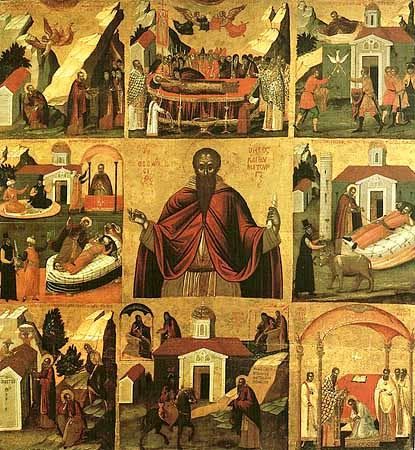
Theodosius [name of Roman emperors; Theodosius I (379–395) made Christianity the state religion] was born in the little town of Marissa, in Cappadocia [a region of central Turkey], in 423. He was ordained reader, but some time after, being moved by Abraham's example, to quit his country and friends, he resolved to visit the holy places. He accordingly set out for Jerusalem, and visited the famous S. Simeon Stylites, near Antioch, on his way. S. Simeon accosted him by name, and bade him ascend his pillar, when he embraced him, and foretold several circumstances of his life, giving him advice how to act under them. Having satisfied his devotion in visiting the holy places in Jerusalem, he betook himself to the cell of Longinus, a holy man, who dwelt near the tower of David, and to him he became dear, on account of his singular virtue. A lady, named Icelia, having built a church to the honour of the Virgin Mother of God, on the high road to Bethlehem, Longinus appointed his disciple, Theodosius, to the charge of this church. But he did not retain this charge long; loving solitude, he retired to the mountains, and took up his abode in the cave, where the Wise Men were traditionally held to have reposed on their way to Bethlehem. Here he passed his time in labouring with his hands, in fasting, and in prayer. His food was coarse pulse and herbs; for thirty years he did not taste bread. Many desired to serve God under his direction: he at first determined to admit six or seven, but was soon obliged to receive a greater number, and at length came to a resolution never to reject any that presented themselves with dispositions that seemed sincere. The first lesson he taught his monks was, that the continual remembrance of death is the foundation of religious perfection. To impress the thought of death more deeply on their minds, he caused a great sepulchre to be constructed as the common burying place of his monks. When it was complete, half seriously and half in jest, he said: "The tomb is finished, which of you will be its first inmate?" Then one, Basil, a priest, knelt at his feet, and asked to be the first to celebrate the dedication of the sepulchre. Therefore S. Theodosius ordered all the offices of the dead to be recited for Basil, first for three days, then for nine, and then for forty; and at the close of the forty days he died without sickness or pain, as though going to sleep. And for forty days after his death he was seen by the abbot Theodosius in his place among the brethren, chanting the praises of God. None others saw him, but one Aetius heard his voice. Then the abbot, hearing Aetius confess this, prayed to God to open his eyes, and seeing the dead monk again in choir, he pointed him out; and then Aetius saw him, and ran, and would have embraced him, but he vanished out of his sight.
Once, as Easter approached, there was a deficiency of food in the monastery, and they had not even bread for the Holy Sacrifice. This troubled them sore, for they feared that the holy feast would come, and pass, without their being able to celebrate the divine liturgy. Therefore they prayed with one accord to God, and behold! mules laden with provisions arrived at the monastery, and amongst the provisions was bread for the sacrifice.
The lustre of the sanctity of S. Theodosius drawing great numbers to him, who desired to serve God under his direction, he resolved on building a large monastery to receive them all; but where to build it he knew not. After some consideration, he took a censer, and put charcoal and incense thereon, but no fire, and he prayed: "O God who didst of old, by many and great miracles, confirm Israel; who didst to thy servant Moses persuade by many and various marvels, to take on him the burden of ruling that people; who didst turn the water of Egypt into blood, and then re-convert it again; who didst give to Gideon an earnest of his victory in the fleece and the dew; who didst assure Hezekiah of an addition to his days, by the return of the shadow on the dial; who didst at the cry of Elias send fire from heaven to consume his sacrifice. Thou art the same Lord, unto whom this day I plead! Hear thou the prayers of the servant, and show me where I shall build a temple to Thy honour, and a habitation for thy servants and my disciples. Show, O Lord! by the kindling of these coals, where the place shall be, to Thy glory, and to the acknowledgment of many, and the confirmation of the truth." Having uttered this prayer, he walked through the land with the censer in his hand. And when he came, after much wandering, to a desert spot called Gutilla, on the shores of the Dead Sea, he turned and came home, and as he neared his cave the coals kindled, and the smoke of the incense rose towards heaven, as a sign that thence should ascend the prayers of the faithful from age to age, in the daily sacrifice. There accordingly he erected his monastery, and it was soon filled with holy monks. To this monastery were annexed several infirmaries; one for the sick monks, two for sick lay folk; one for the aged and feeble monks, and one for persons deranged. All succours, spiritual and temporal, were afforded in these hospitals, which were kept in admirable order, and were attended by the monks with alacrity and care. S. Theodosius erected also several buildings for the reception of strangers, in which he exercised an unbounded hospitality, entertaining all that came, for whose use there were, on one occasion, above a hundred tables served with provisions. The monastery itself was like a city of saints in the midst of a desert; and in it reigned regularity, silence, charity, and peace. There were four churches belonging to it, one for each of the three nations of which his community was composed, each speaking a different language, and the fourth church was for the use of the recovering lunatics. The nations into which his community was divided were the Greeks, and all those using the liturgy in the Greek tongue; the second church was used by those having divine worship in the Armenian language; and in the third church the holy praises of God were sung, and the sacrifice was offered in the language of the Bessi, that is, of the wandering nations of Arab race. "Thus by them," says the contemporary writer; "the rule of hymnody was carried out, and seven times a day was it offered to the God of all. But when it behoved them to participate in the venerable Sacrament, the law was very beautifully constituted among them, that till after the Gospel, divinely inspired, each should hear in his own church and language the divine voice; but after that they were assembled into one—the possessed alone excepted—namely, into the large church of the Greeks, as is done to this day, and there they participate together of the sanctifying gifts."
At times not set apart for public prayer and necessary rest, every monk was obliged to apply himself to some trade or manual labour. Sallust, patriarch [the title of the bishops of the great ancient sees: Rome, Constantinople, Alexandria, Antioch, Jerusalem] of Jerusalem, appointed S. Sabas superior of all the hermits in Palestine, and S. Theodosius head of all the monks living in community, for which reason he obtained the title of Cœnobiarch.
These two great servants of God lived in close friendship, and together strove against the heresy of Eutyches, which then devastated the Church. For the Emperor Anastasius favoured the Eutychians [followers of Eutyches, who said Christ had only a divine nature; condemned at Chalcedon in 451]; he banished the patriarch of Antioch and the patriarch of Jerusalem, and introduced an heretical bishop, Severus, into the latter see, commanding the Syrians to obey and hold communion with him. Then these great ascetic saints, with those bodies of religious men whom they ruled, proved bulwarks of the faith, uncompromising defenders of the truth. Like rocks in the desert, they remained unchanged and immovable. In vain did the emperor employ persuasion, attempt bribery, and finally exile the Cenobiarch; he could not be moved, but journeyed through the land from which the bishops had been expelled, confirming the faithful, and denouncing the established heresy. At Jerusalem, having assembled the people together, he from the pulpit cried with a loud voice, "If any man receives not the four General Councils as the four Gospels, let him be anathema!" Such boldness in an old man, venerated for his sanctity, inspired with courage those whom the edicts had frightened. His discourses produced a wonderful effect on the people, and God gave a sanction to his zeal by miracles. The Emperor sent an order for his banishment, which was executed; but dying soon after, Theodosius was recalled by his successor Justin, who was a Catholic.
Our Saint survived his return eleven years. So great was his humility, that, seeing two monks at variance with each other, he threw himself at their feet, and would not rise till they were reconciled. Once, having excommunicated one of his monks for some offence, the man defiantly excommunicated Theodosius, and he meekly accepted the sentence, and acted as one cut off from the society of the faithful and participation in the Sacraments, till the guilty monk, confounded and repentant, removed the ban. During the last year of his life he was afflicted with a painful disease, which reduced him to a shadow. It was noticed by those who nursed him, that, even in his sleep, his lips murmured the familiar words of prayer. Perceiving the hour of his dissolution draw nigh, he gave his last exhortations to his disciples, and foretold many things which came to pass after his death; and then fell asleep in Christ, on the 11th Jan., 529. Peter, patriarch of Jerusalem, and the whole country, assisted at his interment. He was buried in the first cell the cave of the Magi.