St. Timothy of Ephesus

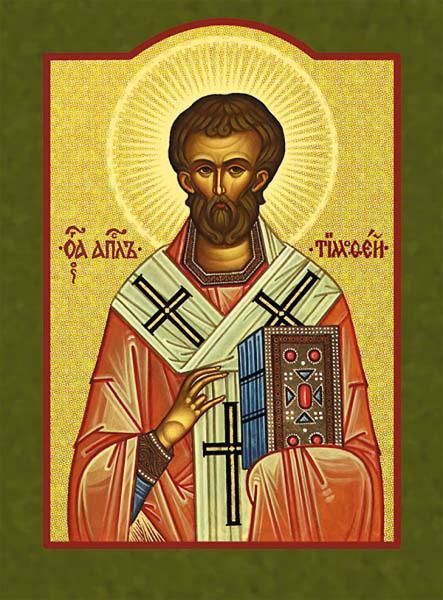
St. Timothy was St. Paul's young companion and the recipient of two New Testament letters. Tradition makes him the first bishop of Ephesus.

Read the essentials →
January 24 · Bishop

St. Timothy of Ephesus

St. Timothy of Ephesus

St. Timothy was St. Paul's young companion and the recipient of two New Testament letters. Tradition makes him the first bishop of Ephesus.

Traditional feast

January 24
1914 / pre-1969 calendar, per Baring-Gould (1914)

Current feast

January 26
Verified · General Roman Calendar

Represents

Bishop

Their story

Adapted in modern English from Baring-Gould (1914) · original text below

Timothy, the beloved disciple of St Paul, was born at Lystra in Lycaonia. His father was a Gentile and his mother, Eunice, was Jewish. She and Timothy's grandmother Lois became Christians, and Paul praised their faith. Timothy had studied the Old Testament from infancy. Paul took the young man as a companion in his work, but first had him circumcised at Lystra so as not to give offence to the Jews, since his mother was Jewish.

When Paul had to leave Beroea he left Timothy behind to strengthen the new converts, then sent for him at Athens and sent him on to Thessalonica, where the Christians were being persecuted. Timothy reported back to Paul at Corinth. Later Paul sent him with Erastus ahead through Macedonia, and charged him to go on to Corinth to correct abuses there.

Timothy seems to have been with Paul during his later imprisonment. He was made Bishop of Ephesus, probably in 64. Paul wrote him two letters, the second from his chains in Rome, urging him to come so they could meet again before Paul died.

Timothy was later associated with St John. At the great feast of the Catagogii, idols were carried in procession while women danced lewdly before them, and the feast ended in bloodshed. Timothy rushed into the temple portico and urged the frenzied crowd to decency. Enraged, they fell on him with sticks and stones and killed him.

Early life

Selected sentences from the original account, unaltered.

Saint Timothy, the beloved disciple of S. Paul, was born at Lystra in Lycaonia. His father was a Gentile, but his mother, Eunice, was a Jewess. S. Timothy had made the writings of the Old Testament his study from infancy. [117] S. Paul took the young man as the companion of his labours, [118] but first he had him circumcised at Lystra, as a condescension to the prejudices of the Jews.

What they represent

How they teach us to live

Drawn from themes in the original account

Share your faith, in words and by example. Preaching and conversion are central here.

Learn from the kind of life it was. Every young person who was told 'let no one despise your youth' (1 Timothy 4:12).

Read more

The full original · 409 words

Read Baring-Gould’s full account

Baring-Gould’s sources: By almost all the ancient Latin Martyrologies, S. Timothy is commemorated on this day, but by the Greeks on Jan. 22. The Martyrology called by the name of S. Jerome on Sept. 27. That of Wandelbert on May 16, possibly because of some translation of relics. Authorities: the Epistles of S. Paul, and the Acts of S. Timothy, by Polycrates, Bishop of Ephesus (210), which, however, we have not in their original form, but in a recension of the 5th or 6th century; other Acts of S. Timothy, also in Greek, and a life in Metaphrastes.

Saint Timothy, the beloved disciple of S. Paul, was born at Lystra in Lycaonia. His father was a Gentile, but his mother, Eunice, was a Jewess. She, with Lois, his grandmother, embraced Christianity, and S. Paul commends their faith. S. Timothy had made the writings of the Old Testament his study from infancy. [117] S. Paul took the young man as the companion of his labours, [118] but first he had him circumcised at Lystra, as a condescension to the prejudices of the Jews. He would not suffer S. Titus, born of Gentile parents, to be brought under the law, but Timothy, on account of his Jewish mother, to avoid scandal to the Jews, he submitted to circumcision.

When S. Paul was compelled to quit Beræa, he left Timothy behind him to confirm the new converts. But on his arrival at Athens S. Paul sent for him, and sent him to Thessalonica where the Christians were suffering persecution. Thence he returned to S. Paul, who was then at Corinth, to give an account of his mission. [119] From Corinth S. Paul went to Jerusalem, and thence to Ephesus. Here he formed the resolution of returning into Greece, and he sent Timothy and Erastus before him through Macedonia, to apprize the faithful in those parts of his intention of visiting them. Timothy had a special charge to go afterwards to Corinth, to correct certain abuses there. S. Paul awaited his return, in Asia, and then went with him into Macedonia and Achaia.

During the subsequent imprisonment of S. Paul, Timothy appears to have been with him. He was ordained Bishop of Ephesus, probably in the year 64. S. Paul wrote his first Epistle to Timothy from Macedonia, in 64; and his second in 65, from Rome, while there in chains, to press him to come to Rome, that he might see him again before he died.

S. Timothy was afterwards associated with S. John; and in the Apocalypse he is the Angel, or Bishop, of the Church of Ephesus, to whom Christ sends His message by S. John. [120] During the great annual feast of the Catagogii, which consisted of processions bearing idols, with women lewdly dancing before them, and ending in bloodshed, S. Timothy moved by righteous zeal, rushed into the portico of the temple, and exhorted the frenzied revellers to decency; but this so enraged them, that they fell upon him with sticks and stones, and killed him.
Feast days

Feast: January 26
Traditional: January 24

Nine days · Free

Pray the novena
with us.

One short email a day for nine days. The day's prayer, a line from St. Timothy of Ephesus's story, and a nudge to keep going.

Also on January 24
B

Sts. Babylus and…

January 24 · Bishop, Martyrs
M

St. Macedonius

January 24 · Hermit
C

St. Cadoc

January 24 · Abbot
← All 1726 saints in the library
Sources & notes

Feast-day sources

Story sources

Sources

Credits

Image: Saint Timothy.jpg · Unknown authorUnknown author · Public domain, via Wikimedia Commons

From Sabine Baring-Gould, The Lives of the Saints, new and revised edition (Edinburgh: John Grant, 1914; first edition 1872). Public domain.

Image: Unknown authorUnknown author, Wikimedia Commons (Public domain)

From Sabine Baring-Gould, The Lives of the Saints, new and revised edition (Edinburgh: John Grant, 1914; first edition 1872). Public domain in the United States. Reproduced unedited, except for short bracketed notes in grey that we added to explain names and terms (“S.” is the old abbreviation for Saint). Some history and judgments reflect 19th-century scholarship.