Faithfulness to Christ when it cost everything.
Read the essentials →Faithfulness to Christ when it cost everything.
May 17
April 29
Martyr
In art S. Torpes is represented with a boat RESTITUTA, V. M. (3RD CENT.) [Roman Martyrology. Venerated especially at Naples. Authority:— The Acts, which are not, however, in their primitive and genuine form, but have suffered amplifications and re-writings.
Learn from the kind of life it was. Faithfulness to Christ when it cost everything.
Keep their day. Remember them on May 17 with a short prayer, and ask for their help.
[May if. come ashore at the place now called S. Tropez. But the Portugese have a village called Sines, and so they claim to have the body there, and the Evora Breviary published in 1548, made the feast of ST Torpes a double on that account. This claim is, however, too absurd to receive credence. It seems to rest on no grounds except the similarity of the name Sines to Sinus, and on the forged chronicle of Dexter, by Higuera, in the 16th century. On the strength of this the clergy of Sines dug for the body and found it. The mistake of the Provengales has probably arisen from the church on the Gulf of Grimaud being dedicated to a saint Eutropius, who has been forgotten, and the popular corruption of the name into S. Tropez has led to the supposition that the dedication is to S. Torpes.
In art S. Torpes is represented with a boat RESTITUTA, V. M. (3RD CENT.) [Roman Martyrology. Venerated especially at Naples. Authority:— The Acts, which are not, however, in their primitive and genuine form, but have suffered amplifications and re-writings. Papebroeck the Bollandist, says, “The acts are sufficiently gravely and not inelegantly written; but seem to have been filled in with rhetorical and lengthy discussions between the martyr and the judge, and with the prayers she addressed to God, all out of the imagination of the author, as supposed to be appropriate to the time and the occasion. Would that writers had not made use of a similar liberty in amplifying the various tortures of the saint, and adding other circumstances.'' The same may be said of very many other Acts.] S. Restituta was an African, and lived in the reign of the Emperor Valerian [Roman emperor 253–260, who persecuted bishops and clergy]. A judge, named Proculus, who persecuted the Christians at Carthage, tried her for being a Christian, and ordered her to be placed in an old boat -S'. Madern.
filled with pitch and other combustibles, and sent adrift. She was accordingly bound in the boat, the pitch was lighted, the wind blew off shore, and the fiery boat containing the martyr, was carried rapidly out to sea, till it faded like a dying spark on the horizon. The burnt boat and the body of the virgin martyr were thrown up on the island of Ischia, near Naples, where the Emperor Constantine afterwards erected a magnificent church over her remains.
S. MADERN, H. (date uncertain.) [Honoured on this day in Brittany. Two churches in the diocese of S. Malo are dedicated to him,] Nothing is known of S. Madern except that he occupied a hermitage in Cornwall at the place called after him Madron, About a mile north-west of Madron church, in a desolate moor, is S. Madern’s well. About two hundred yards from it is S. Madern's Oratory, a ruined chapel about twenty-five feet long by sixteen feet broad. It contains an excavation which was probably used as a font, the water being supplied from the well, for which purpose a channel was made through the wall, and a drain ran along the west-end of the chapel to carry off the water. In the preface to a poem, “The petition of an old uninhabited house in Penzance/" published in 1823, is the following note: — “ Perhaps it may not be known, but I find it related in an old MS., that what appears a seat on the side of Maddem well was called S. Maddern's Bed, on which the patient who came to be cured reclined. Those who were benefited, left a donation at Maddern church for the poor. This may account for the preservation of the well. Donations were left so late as the middle of the 17th century/' The chapel was partially destroyed, in the time of Cromwell, by Mayor Ceely of S. Ives.
Bishop Hall of Exeter, in his last visitation of the diocese of Exeter, previous to his translation, in 1641, to the see of Norwich [a bishop’s “see” is his diocese, named from his seat (Latin sedes)], attests several miraculous cures performed by the water of the holy well of S. Madern. “The commerce that we have with the good spirits is not now discerned by the eye, but is, like themselves, spiritual. Yet not so, but that even in bodily occasions we have many times insensible helps from them; in such a manner as that by the effects we can boldly say, Here hath been an angel, though we see him not. Of this kind was that (no less than miraculous) cure which at S. Madern7 s in Cornwall was wrought upon a poor cripple, John Trelille, whereof (besides the attestation of many hundreds of neighbours) I took a strict and personal examination in that last visitation which I either did or ever shall hold. This man, that for sixteen years together was fain to walk upon his hands, by reason of the close contraction of the sinews of his legs (upon three admonitions in a dream to wash in that well), was suddenly so restored to his limbs, that I saw him able to walk and get his own maintenance. I found here was neither art nor collusion: the thing done, the author invisible.771 Another writer of the same period gives a fuller account of the same miraculous cure.2 “I will relate one miracle more done in our own country, to the great wonder of the neighbouring inhabitants, but a few years ago, viz., about the year 1640. The process of the business was told the king when at Oxford, which he caused to be farther ex1 Bishop Hall <f On the Invisible World.’* 3 Franciscus Coventriensis: Paralipom. Philosophise c. 4. S. Mctdern.
amined. It was this: — A certain boy of twelve years old, called John Trelille, in the county of Cornwall, not far from the Land’s End, as they were playing at foot-ball, snatching up the ball ran away with it; whereupon, a girl in anger struck him with a thick stick on the backbone, and so bruised or broke it, that for sixteen yeajrs after he was forced to go creeping on the ground. In this condition he arrived to the twenty-eighth year of his age, when he dreamed that if he did but bathe in St. Madern’s well, or in the stream running from it, he should recover his former strength and health. This is a place in Cornwall, from the remains of ancient devotion, still frequented by Protestants on the Thursdays in May, and especially on the feast of Corpus Christi; near to which well is a chapel dedicated to St. Madern, where is yet an altar, and right against it a grassy hillock (made every year anew by the country people) which they call St. Madern’s bed. The chapel roof is quite decayed 3 but a kind of thorn of itself shooting forth of the old walls, so extends its boughs that it covers the whole chapel, and supplies as it were a roof. On a Thursday in May, assisted by one Periman, his neighbour, entertaining great hopes from his dream, thither he crept, and lying before the altar, and praying very fervently that he might regain his health and the strength of his limbs, he washed his whole body in the stream that flowed from the well and ran through the chapel: after which, having slept about an hour and a half on S. Madern’s bed, through the extremity of pain he felt in his I nerves and arteries, he began to cry out, and his companion helping and lifting him up, he perceived his hams and joints somewhat extended, and himself becoming stronger, insomuch that partly wTith his feet, partly with his hands, he went much more erect than before. Before the following Thursday he got two crutches, resting on VOL. V.
which he could make a shift to walk, which before he could not do. And coming to the chapel as before, after having bathed himself, he slept on the same bed, and awaking found himself much stronger and more upright? and so, leaving one crutch in the chapel, he went home with the others. The third Thursday he returned to the chapel, and bathed as before, slept, and when he awoke, rose up quite cured; yea, grew so strong, that he wrought day labour among other hired servants; and four years after listed himself a soldier in the king’s army, where he behaved himself with great stoutness, both of mind and body: at length, in 1644, he was slain at Lyme, in Dorsetshire.”
Feast: April 29
Traditional: May 17
One short email a day for nine days. The day's prayer, a line from St. Torpes's story, and a nudge to keep going.
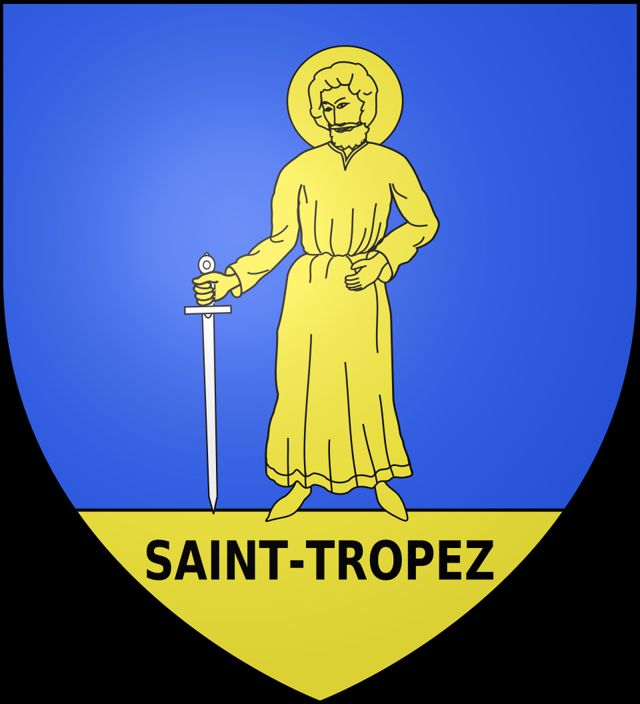
Image: Blason ville fr Saint-Tropez2 (Var).svg · Unknown · CC BY-SA 3.0, via Wikimedia Commons
From Sabine Baring-Gould, The Lives of the Saints, new edition in 16 vols. (London: John C. Nimmo, 1897–98); text from the Internet Archive scan (OCR, lightly cleaned; errors possible). Public domain.
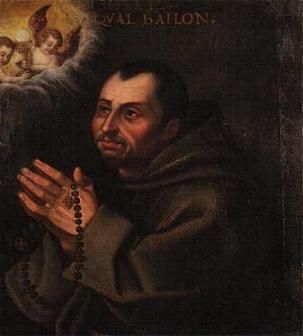
Image: Unknown, Wikimedia Commons (CC BY-SA 3.0)
From Sabine Baring-Gould, The Lives of the Saints, new edition in 16 vols. (London: John C. Nimmo, 1897–98); text from the Internet Archive scan (OCR, lightly cleaned; errors possible). Public domain in the United States. Reproduced unedited, except for short bracketed notes in grey that we added to explain names and terms (“S.” is the old abbreviation for Saint). Some history and judgments reflect 19th-century scholarship.