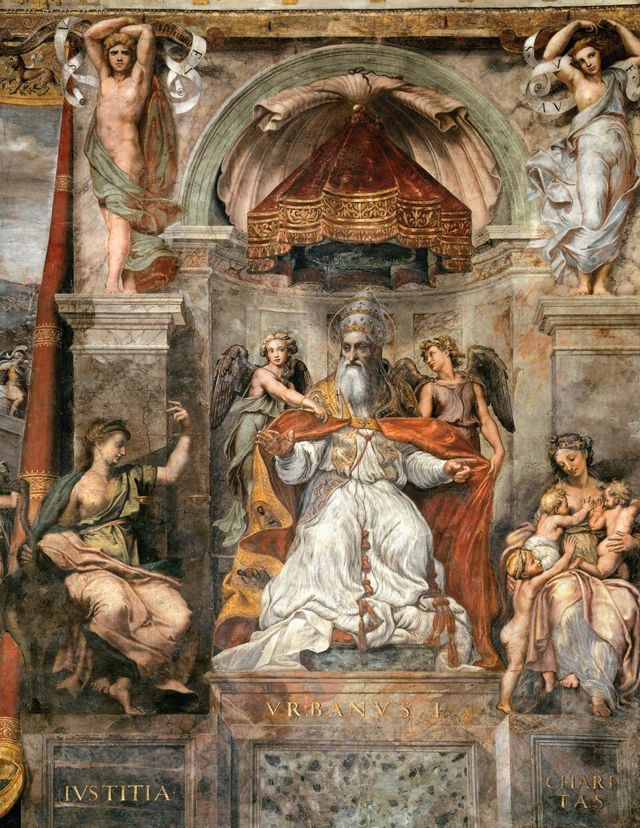
Reigned 222-30, date of birth unknown; died 23 May, 230. According to the "Liber Pontificalis," Urban was a Roman and his father's name was Pontianus. After the death of Callistus I (14 October, 222) Urban was elected Bishop of Rome, of which Church he was the head for eight years, according to Eusebius [Eusebius of Caesarea (d. c. 339), the first historian of the Church] (Hist. eccl., VI, 23). The document called the Liberian catalogue of popes puts the beginning of his pontificate in the year 223 and its close in the year 230. The dissension produced in the Roman Church by Hippolytus (q.v.) continued to exist during Urban's pontificate. Hippolytus and his adherents persisted in schism; it was probably during the reign of Urban that Hippolytus wrote his "Philosophumena", in which he attacked Pope Callistus severely. Urban maintained the same attitude towards the schismatical party and its leader that his predecessor had adopted. The historical authorities say nothing of any other factious troubles in the life of the Roman Church during this era. In 222 Alexander Severus became Roman emperor. He favoured a religious eclecticism and also protected Christianity. His mother, Julia Mammaea, was a friend of the Alexandrine teacher Origen, whom she summonded to Antioch. Hippolytus dedicated his work on the Resurrection to her. The result of the favourable opinion of Christianity held by the emperor and his mother was that Christians enjoyed complete peace in essentials, although their legal status was not changed. The historian Lampridius (Alex. Sever., c. xxii) says emphatically that Alexander Severus made no trouble for the Christians: "Christianos esse passus est." Undoubtedly the Roman Church experienced the happy results of these kindly intentions and was unmolested during this emperor's reign (222-235). The emperor even protected Roman Christians in a legal dispute over the ownership of a piece of land. When they wished to build a church on a piece of land in Rome which was also claimed by tavern-keepers, the matter was brought before the imperial court, and Severus decided in favour of the Christians, declaring it was better that God should be worshipped on that spot (Lampridius, "Alex. Sever.", c. xlix).
Nothing is known concerning the personal labours of Pope Urban. The increase in extent of various Roman Catacombs in the first half of the third century proves that Christians grew largely in numbers during this period. The legendary Acts of St. Cecilia connect the saint, as well as her husband and brother-in-law, with Urban, who is said to have baptized her husband and her brother-in-law. This narrative, however, is purely legendary, and has no historical value whatever; the same is true of the Acts of the martyrdom of Urban himself, which are of still later date than the legend of St. Cecilia. The statement of the "Liber Pontificalis" that Urban converted many by his sermons, rests on the Acts of St. Cecilia. Another statement on the same authority, that Urban had ordered the making of silver liturgical vessels, is only an invention of the later editor of the biography early in the sixth century, who arbitrarily attributed to Urban the making of certain vessels, including the patens for twenty-five titular churches of his own time. The particulars of the death of Urban are unknown, but, judging from the peace of his era, he must have died a natural death. The "Liber Pontificalis" states that he became a confessor [in old usage, a saint who was not martyred, or who suffered for the faith without being killed] in the reign of Diocletian [Roman emperor 284–305, who began the ‘Great Persecution’ of Christians in 303]; the date added is without authority. His name does not appear in the "Depositio Episcopoirum" of the fourth century in the "Kalendarium Philocalianum".
Two different statements are made in the early authorities as to the grave of Urban, of which, however, only one refers to the pope of this name. In the Acts of St. Cecilia and the "Liber Pontificalis" it is said that Pope Urban was buried in the Catacomb of Praetextatus on the Via Appia. The Itineraries of the seventh century to the graves of the Roman martyrs all mention the grave of an Urban in connexion with the graves of several martyrs who are buried in the Catacomb of Praetextatus. One of the Itineraries gives this Urban the title "Bishop and Confessor." Consequently, from the fourth century, all Roman tradition has venerated the pope of this name in the Urban of the Catacomb of Praetextatus. In excavating a double chamber of the Catacomb of St. Callistus, De Rossi found, however, a fragment of the lid of a sarcophagus that bore the inscription ΟΥΡΒΑΝΟϹ E[πίσκοπος]. He also proved that in the list of martyrs and confessors buried in the Catacomb of St. Callistus, drawn up by Sixtus III (432-40), the name of an Urban is to be found. The great archaeologist De Rossi therefore came to the conclusion that the Urban buried in St. Callistus was the pope, while the saint of the same name buried in St. Praetextatus was the bishop of another see who died at Rome and was buried in this catacomb. Most historians agree with this opinion, which, however, chiefly founded on the Acts of St. Cecilia. The lettering of the above-mentioned epitaph of an Urban in St. Callistus indicates a later period, as a comparison with the lettering of the papal epitaphs in the papal crypt proves. In the list prepared by Sixtus III and mentioned above, Urban is not given in the succession of popes, but appears among the foreign bishops who died at Rome and were buried in St. Callistus.
Read the rest of the article
Thus it seems necessary to accept the testimony that Pope Urban was buried in the Catacomb of Praetextatus, while the Urban lying in St. Callistus is a bishop of a later date from some other city. This view best reconciles the statements of the "Martyrologium Hieronymianum". Under date of 25 May (VIII kal. Jun.) is to be found the notice: "Via nomentana miliario VIII natale Urbani episcopi in cimiterio Praetextati" ("Martyr. Hieronym.", ed. De Rossi-Duchesne, 66). The catacomb on the Via Nomentana, however, is that which contains the grave of Pope Alexander, while the Catacomb of Praetextatus is on the Via Appia. Duchesne has proved (Lib. Pontif., I, xlvi-xlvii) that in the list of graves of the popes from which this notice is taken a line dropped out, and that it originally stated that the grave of Pope Alexander was on the Via Nomentana, and the grave of Pope Urban on the Via Appia in the Catacomb of Praetextatus. Consequently 25 May is the day of the burial of Urban in this catacomb. As the same martyrology contains under the date of 19 May (XIV kal. Jun.) a long list of martyrs headed by the two Roman martyrs Calocerus and Partenius, who are buried in the Catacomb of St. Callistus, and including an Urban, this Urban is apparently the foreign bishop of that name who lies buried in the same catacomb.