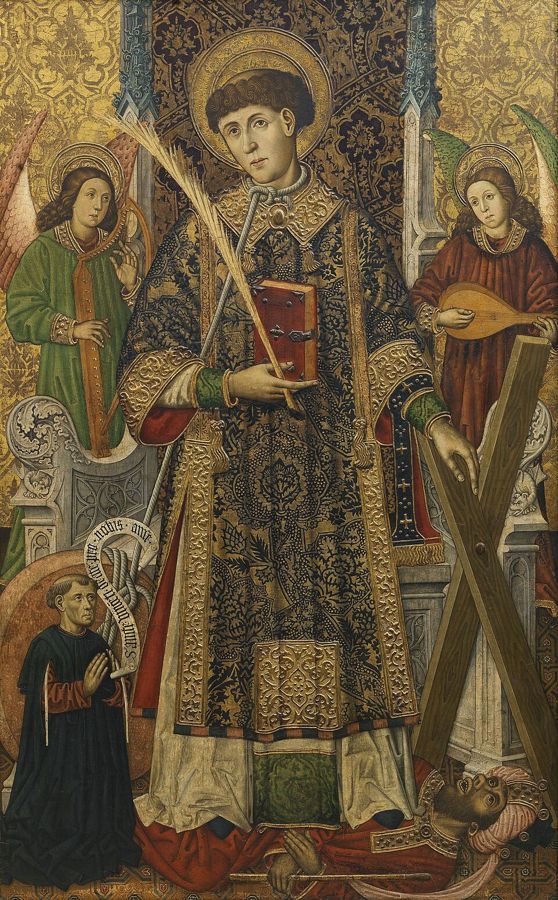
Baring-Gould’s sources: All Western Martyrologies, and by the Greeks on the same day, and Nov. 11th. The Acts, very ancient, quoted by Metaphrastes, are a very early recension of the original Acts by the notaries of the Church. Also, a hymn of Prudentius.
This most illustrious martyr of the Spanish Church was born at Saragossa in Arragon, the mother of martyrs, as Prudentius calls it. His parents are mentioned in his Acts, which are at least older than S. Augustine (August 28), in whose time they were publicly read in the church of Hippo. The name of his father was Eutychius; and his mother, Enola, was a native of Osca, or Huesca, which sometimes claims the honour of his birth. He was trained in the discipline of the Christian faith by Valerius, Bishop of Saragossa, and was in due time ordained to the office of deacon. The Bishop was a man of venerable piety, but laboured under an impediment in his speech. He therefore devoted himself to prayer and contemplation, and intrusted the care of teaching to S. Vincent, whom he also appointed his principal or archdeacon. Dacian was then Governor of Spain under Diocletian [Roman emperor 284–305, who began the ‘Great Persecution’ of Christians in 303] and Maximian [Diocletian’s co-emperor in the West, 286–305], and had already distinguished himself by his cruelty against the Christians. The imperial edict for the seizure of the clergy had just been published in the end of the year 303, in which the laity were not included until the following year. Valerius and his deacons were accordingly loaded with chains and carried to Valencia, where the Governor then was. The pains of hunger were added to their sufferings, in the hope of subduing their fortitude. When they were brought before Dacian he first tried the effect of mild language and promises of reward if they would obey the orders of the Emperors and sacrifice to the gods. He reminded Valerius of the influence which his episcopal dignity gave him; and to Vincent he represented the honour of his family, and the sweet joys of youth which still lay before him. But the confessors of Christ were not to be thus moved. Valerius, being unable from his infirmity to reply to the artful persuasions of the tempter, Vincent made a noble profession of the faith in the name of them both.
The Bishop was condemned to exile, where he seems afterwards to have finished his course by martyrdom; and Vincent was remanded to prison, thence to pass by a more painful but a speedier way to his crown. His body was stretched upon the rack and cruelly torn with iron hooks, but no torture could shake his resolution or disturb the calm which sat upon his countenance. He defied the utmost efforts of his tormentors; and, when they began to grow weary, Dacian ordered them to be beaten, suspecting that they spared the martyr. But the Governor himself was at last moved to a faint pity by the miserable spectacle, and entreated Vincent to purchase his deliverance by at least giving up the Christian books. Vincent, still continuing firm, was taken from the rack and led to a more terrible torture called the Question . It was an iron frame with bars running across it, sharp as scythes, and underneath a fire was kindled, which made the whole frame red hot. To this fearful agony the martyr walked with a willing step, and even went before the executioners. And, as he lay bound upon the bed of torture, his eyes were fixed on heaven, his lips moved as if in prayer, and a peaceful smile would sometimes pass across his countenance. No cruelty was spared that diabolical ingenuity could invent, but the love of Christ surpassed the wrath of man and won the day. When the malice of his enemies could do no more, he was carried back to prison, and laid in a dark dungeon strewn with broken potsherds, which allowed his wounded body no rest. His feet, too, were fastened in the stocks. But God was mindful of His servant, and sent His angels to comfort him, bestowing a foretaste of his reward while his trial was as yet unfinished. His cell was illuminated with the light of heaven, his bonds were loosed, and the floor of his prison seemed to be strewn with flowers. The martyr and his celestial visitants sang hymns together, and the unwonted sound astonished the jailer. He looked into the cell, and, overpowered by what he saw and heard, confessed the power of God and the truth of the Christian faith. When Dacian heard of it he shed tears of rage; but, finding it was useless to continue his cruelty, he gave orders that some repose should be allowed to the martyr. His motives for this act of clemency are variously represented; perhaps he only meant to recruit the strength of Vincent that he might endure further tortures; or perhaps he feared that, if he expired under them, the Christian faith might be exalted in the eyes of the people by his constancy. But, whatever was the policy of Dacian, God overruled it to obtain for His blessed servant an easy departure. The scattered remnant of Christians gathered round him, and tended him with anxious care. They provided a soft bed, on which he was no sooner laid than he yielded up his soul to the Lord, on January 22, a.d. 304. The rage of the Governor followed his poor remains. His body was cast out into a field to become the prey of wild beasts and birds; but was defended by a raven. Then, to add further indignities to it, it was taken out in a boat and thrown into the sea with a mill-stone about the neck. During the night it was washed ashore, and at last was privately buried by some good Christians in a humble chapel near Valencia. When the fury of the persecution had ceased, it was removed with great honour, and buried under the altar of the principal church.