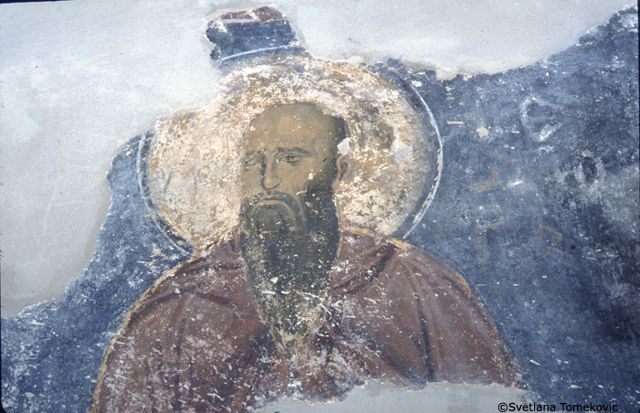
Baring-Gould’s sources: Anglican Martyrology of Wilson on May 31 and Sept. 9, as S. Wulfhilda; and again as S. Wilfreda onjuly 22. Menarduson Sept. 13, Bucelinus also; but in copies of Usuardus amplified in England, on Sept. 9. Solerius instances one he saw at Winchester with that entry. It is also stated in her life, that she died on Sept. 9. Authorities: — Mention by William of Malmesbury in his Gesta Reg. Aug., in the Life of S. Edith, in Malmesbury's Gesta Pontif. Ang., by John of Brompton. There is a Life in Capgrave, but it is legendary and fabulous.] S. Wilfreda was born of noble parents in England, but Osbert, the writer of the life of S. Dunstan, does not tell us their names. According to later legend, Wulfred, king of the West Saxons, was out hunting one day, when he heard the wailing of an infant at the top of one of the oaks of the forest in which he was riding. He sent one of his attendants up the tree, and he found an eagle’s nest, and a lovely little babe lying in it, wrapped in royal purple, with jewels on its S. Wilfreda.
…arms. The child was brought to the king, and he called it Nesting, and it grew up in his court. Nesting, when grown a man, married, and became father of Withburding, who was father of Wulfhelm, the father of Wulfhilda, the subject of this memoir, who, as soon as she was weaned, was given to the nuns of Wilton to be educated.
There the young girl grew up as a lily, lovely beyond any other maiden in England. Now it fell out one day that King Edgar saw her, and he fell in love with her so madly that he had no rest in his spirit, and he longed to make her his wife. But when he found that she was resolved to dedicate herself to the cloister, he communicated his distress to Wenfleda, her kinswoman, ana she, with woman’s tact, resolved to compass what the king desired. She sent word to Wilton that she was ill and dying, and desired to see her kinswoman before her death, as she purposed making her her heiress. Wulfhilda hastened to Wenfleda, and found the king seated feasting in her hall. The moment she entered, Wenfleda held her, put royal apparel upon her, and made her sit by the side of the king, between her and Edgar. And the king sent out messengers to invite all men to his wedding feast. But Wulfhilda wept, and withdrew to the chamber prepared for her, and guards watched at the door.
Then she let herself down from the window, and fled away to Werwell, spent the night there, and next morning pursued her road to Wilton. But Edgar, hearing of her flight, mounted his horse and pursued. He overtook her at the church door of Wilton, and, flinging himself from his horse? caught her hand, and dropping on one knee implored her to share his throne. But she left her hand in his, and fled into the church without it.
Now, when Edgar saw this marvel, he was so overcome, that he desisted from his attempt to obtain her heart — her hand he possessed — and endowed the Abbey of Wilton with large possessions.
Such is the legend, a very pretty one, but unfortunately not quite true in all particulars. As a fact, Edgar did obtain her hand in a less miraculous manner, and by her became the father of S. Edith of Wilton (Sept. 18); and it was after this that Wulfhilda retired to Wilton, if we may trust the biographer of S. Edith. William of Malmesbury also says that Edgar carried her off from her convent and became by her the father of S. Edith. He calls her Wilfrida, the biographer of S. Edith calls her Wulf_trude, and the legend in Capgrave calls her Wulfhilda. The Martyrologists give her variously the names of Wulfhilda, Wilfreda, Wulfruda, and Walftrudis. It was on account of the violation of a consecrated maiden that Edgar was for bidden by S. Dunstan to wear his crown for seven years.1 But the chronicler tells us that Wilfreda was not really a nun, only she had assumed the habit for the sake of concealment from the king. The king was at the time married to Elfrida the White, daughter of Earl Ordgar, according to Malmesbury, but the biographer of S. Edith hints that she was dead, and that the king wished to unite Wilfreda to him in legitimate marriage and royal dignity. Anyhow, Wilfreda returned to Wilton, where she led a most holy and mortified life, and received the veil from the hands of S. Ethelwold, Bishop of Winchester, in, or about a.d. 963. S. Edith was bom a.d. 962. She was elected abbess, and was present, along with her daughter Edith, in 979 at the translation [the solemn moving of a saint’s relics to a new shrine] of the body of S. Edward the Martyr. S. Edith died in 984, and her mother survived her at least thirteen years, for she was apparently alive at the elevation 1 It is not possible to reconcile dates, if the woman violated by Edgar be supposed to be Wilfreda.
of the body of her daughter in 087, and sent 2000 sous to pay the expenses. She cannot have long survived it Edgar was forbidden by S. Dunstan, as has been already said, to wear his crown for seven years for having violated a nun. It has been supposed that this nun was Wilfreda. But the date when he resumed his crown was 973, so that the crime must have been committed about 966. Edith died in 984 at the age of twenty-two, and was therefore born in 962. Moreover, as has been remarked, Wilfreda was not a nun when carried off by the king.
[Sept. io. September 10SS. Nemesianus, Felix, and Others, BB. AIM. in Africa; SS. Menodora, Metrodora, and Nymphodora, VV. MM. in Bithynia; circ. a.d. 305.
S. Barypsabas, H.M.iit the East. S. Agabius, B. of Noi'ara; ^th cent. S. Pulcheria, Empress, at Constantinople; a.d. 453. S. Veran, B. at Vence in Provence; 5 th cent. S. Hilarus, Pope of Rome; a.d- *68.
S. Salvius, B. o/Albi; a.d. 584. S. Theodard, B.M. of Maestricht; circ. a d. 668. S. Odger, D. at Ruremund, in the Netherlands; 8th cent. S. John of Salerno, C. at Florence; 13 th cent. S. Nicolas Tolentino. C. in the Marches of Ancona', a.d. 1305