S
St. Salaun
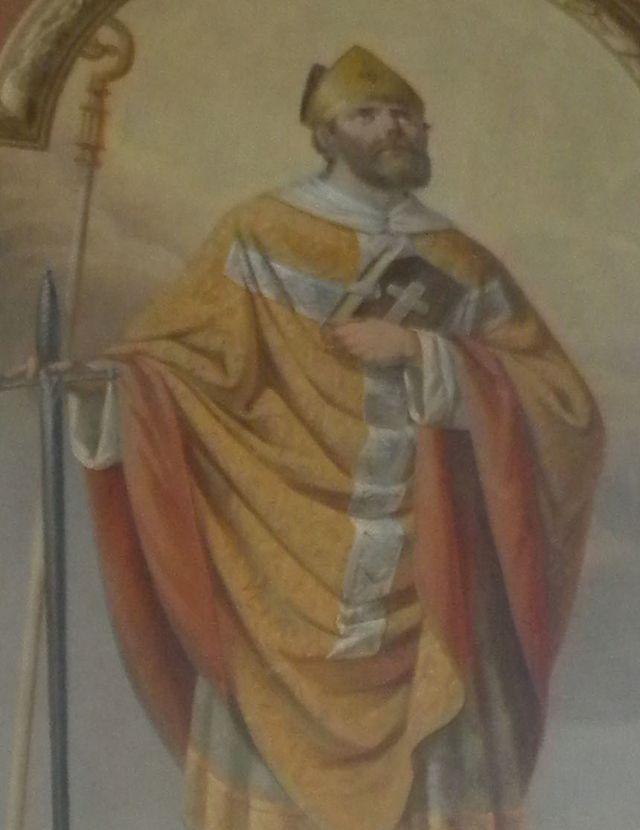
St. Victorinus
T
Witnessing to Christ by the way of life, not by death.
Read the essentials →Witnessing to Christ by the way of life, not by death.
November 9
Not verified yet
Confessor
He was, in fact, Albert von Calw, son of the noble house of Beutelsbach, which had given two popes to the Church, Leo II. and Gerard Count of Calw, bishop of Aichstadt in 1040, and sovereign pontiff in 1054, under the title of Victor II. The history of the young count gradually became known. His name was Albert, he had been brought up in wealth, but had gone forth in 1229 from the family castle and his parents, on a pilgrimage to the Holy Land, under the name of Willebold. His noble parents erected a monument over him, representing him in his pilgrim’s habit, staff in hand, treading on a dragon, and the inscription, “ Here rests Willebold, pure in body, who lived so that he is made associate with the saints.” Forty-three years after, Berchthold, conventual of MiinchNot. s.] S. Willebold of Berkheim.
Learn from the kind of life it was. Witnessing to Christ by the way of life, not by death.
Keep their day. Remember them on November 9 with a short prayer, and ask for their help.
He was, in fact, Albert von Calw, son of the noble house of Beutelsbach, which had given two popes to the Church, Leo II. and Gerard Count of Calw, bishop of Aichstadt in 1040, and sovereign pontiff in 1054, under the title of Victor II. The history of the young count gradually became known. His name was Albert, he had been brought up in wealth, but had gone forth in 1229 from the family castle and his parents, on a pilgrimage to the Holy Land, under the name of Willebold. No details of his adventures on this pilgrimage have reached us. We know nothing more of him till he died in the hayloft of the Crown at Berkheim. His noble parents erected a monument over him, representing him in his pilgrim’s habit, staff in hand, treading on a dragon, and the inscription, “ Here rests Willebold, pure in body, who lived so that he is made associate with the saints.” Forty-three years after, Berchthold, conventual of MiinchNot. s.] S. Willebold of Berkheim.
Roth, and pastor of Berkheim, in consequence of a vision, took the body up. Miracles attended the elevation. A shrivelled hand stretched to touch it was healed, a boy bom deaf and dumb obtained his speech and hearing, a maniac came to his right senses.
In 1703 Abbot Martus, vicar-general, built a new and larger church at Berkheim, and placed the sacred body before the altar of the Five Wounds. The bishop-rural, Ferdinand Conrad Geist of Constance, came in 1705 to Berkheim, to consecrate the new church, and sanctioned the veneration of S. Willebold, in accordance with the directions of the bull of Urban VIII. of May 12th, 1625, which permits veneration of a holy person not enrolled in the Martyrology, if it can be proved that this has been customary for over a century. In 1731, by permission of Bishop John Frank, the five hundredth anniversary of S. Willebold was celebrated with an imposing procession, in which the relics [the bodily remains of a saint, or objects they used, kept with honor] of the saint in a costly shrine were carried by the canons of MiinchRoth. The body was then enclosed in a shrine of tin, and laid under the altar. On this occasion S. Willebold was chosen as second patron of Berkheim. To this day crowds of pilgrims visit the church and shrine, and many miracles of healing are wrought by the intercession of the pilgrimsaint.
Feast: November 9
One short email a day for nine days. The day's prayer, a line from St. Willebold of Berkheim's story, and a nudge to keep going.
From Sabine Baring-Gould, The Lives of the Saints, new edition in 16 vols. (London: John C. Nimmo, 1897–98); text from the Internet Archive scan (OCR, lightly cleaned; errors possible). Public domain.
From Sabine Baring-Gould, The Lives of the Saints, new edition in 16 vols. (London: John C. Nimmo, 1897–98); text from the Internet Archive scan (OCR, lightly cleaned; errors possible). Public domain in the United States. Reproduced unedited, except for short bracketed notes in grey that we added to explain names and terms (“S.” is the old abbreviation for Saint). Some history and judgments reflect 19th-century scholarship.