Baring-Gould’s sources: Gallican Martyrologies. His life, written by a contemporary, was published, with the style altered and shortened, by Surius; the same is re-published by the Bollandists, together with a second life, written by another contemporary, from a MS. at Antwerp. Another life by a Canon of Bourges, date uncertain, was published by Labbe, Bibl. nova II., p. 379, 386.
On the death of Henry de Sully, Archbishop of Bourges, the clergy of that church, unable to agree upon a successor, requested Eudo, Bishop of Paris, to nominate. For this purpose, the bishop came to Beauvais, but found it no easy matter to decide, without causing an eruption of party feeling. In his desire to choose a good man, and one who would commend himself to all, in consultation with two friends, he resolved on committing the matter to God. Accordingly, all the most advisable names were written on slips of parchment, and were sealed, and then deposited beneath the corporal on the altar. The Bishop celebrated very early, with great devotion, and earnestly besought God to indicate him whom he had chosen. When mass was over, he put his hand beneath the corporal, and drew forth one of the billets. He broke the seal in the presence of his two friends, and saw that the name of William, abbot of Challis, was written on the parchment.
No one else was privy to this appeal. As he left the church, the clergy whom he had convened to elect cried out "that they desired William of Challis as their bishop," and on him the majority of votes fell. Then the bishopric was offered to William, but he recoiled from accepting it, with the greatest dismay, for he was a man of retiring habits and of singular humility. However, on an order coming to him from the superior of the society, the abbot of Citeaux, and also from the papal legate [an official representative sent by the pope], he was unable to refuse; and he was consecrated in the year 1200. After the ceremony was over, he laid aside the vestments in which he had received his ordination, and which were of little value, in a press, till his dying day.
In his new dignity he omitted nothing of the severity of his cloister life, disciplining himself more strictly than before, because his business was calculated to distract his thoughts, and his high position was dangerous to humility.
He was gentle and loving to penitent sinners; and towards the incorrigible he was stern, but he refused to have recourse to the civil power against them; he had a horror of shedding blood, so that he looked with the utmost repugnance upon the violence and warlike customs of his time. When the crusade against the Albigenses was resolved upon, William of Beauvais resolved on accompanying the expedition. Perhaps his earnestness would move the heretics to repentance, and his horror of bloodshed might serve as a check upon the crusaders. The Albigensian heresy, which was a revival of Paulicianism, ate as a canker into the Church of France. It was not even a form of Christianity, but was a heathen philosophical sect which had adopted a few Christian tenets.
The history of the sect was as follows:—Manes, a Persian heathen, flourished in the middle of the third century, dying about 277, the founder of a new religion, after having been, like Simon Magus, a temporary and nominal convert to the Gospel. He was not an inventor of his religion, but merely a blender of the earlier Gnostic heresies with the Persian doctrines of Zoroaster, added to a somewhat larger element of Christianity than the Gnostics had chosen to accept. The Paulicians were a sect which took shape about 660, out of Manichæism, or the religion of Manes. They were cruelly persecuted by the Byzantine Emperors, during two whole centuries, and spread to the West by degrees; one stream emigrated to Bohemia, where it became the parent of Hussitism; the other to the south of France, where it was called Albigensianism.
The fundamental dogma of this new Manichæism was a dualism of good and evil principles or gods, equally matched. The evil was the origin of the visible creation, the world and men's bodies; the good God was the creator of the invisible world and men's souls. The opposition of matter and spirit constituted the basis of their moral systems. These systems were diverse; some, regarding everything natural as evil, abstained from meat, from marriage, and from all employments; whilst others, regarding the soul as so distinct from the body as to be incapable of being soiled by any of its actions, gave themselves up to the grossest licentiousness.
The moral condition of Provence, where Albigensianism held sway, was like Sodom and Gomorrah, as may be seen by the poetry of the troubadours; so that God's wrath could not but fall on a land so polluted. The licentiousness which this creed encouraged, helped to make it spread, and the Christianity of the whole of the south of France was imperilled. At the head of these heretics, the Count of Toulouse invaded the lands of the King of Aragon, devastated them, robbed the churches, burnt the monasteries, and ill-treated the clergy, "and slaughtered the Christians of either sex, and every age, without mercy," says Matthew Paris. "But this being at length made known, their heretical aggression was put down by the faithful Christians, who, at the command of Pope Gregory, had come as crusaders from various parts of the West, for the defence of the Christian faith."
William of Beauvais was not, however, destined to play a part in that sanguinary war. He was called to his rest in January, 1209. Drawing near his end, he received first extreme unction, and then, as the Blessed Sacrament was brought to him, he struggled up in his bed, and falling on his knees, with many tears, and hands outspread in the shape of a cross, he adored the presence of his Saviour. The night following, he began as usual to recite the Office [the Divine Office, the Church’s daily cycle of prayer from the Psalms] of Nocturns, but was unable to pronounce more than the first two words, and sign himself with the cross. Then he was laid, at his desire, on ashes, and the vestments in which he had been consecrated bishop were produced, that he might be laid dressed in them in his grave. His body was buried in the Cathedral of Bourges, but was burnt, and the ashes scattered to the winds, by the Calvinists, on the occasion of their plundering the Cathedral in 1562.
Patron of Bourges, and of the ancient University of Paris.
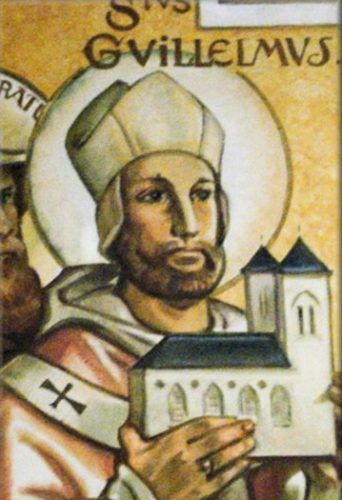
In art, he is represented holding a monstrance, or in adoration before one, to represent his great devotion towards the Blessed Sacrament. He is also represented with tears on his cheeks, for he is said to have wept whenever he was told of some scandal of his diocese, or wrong done to the poor. It may be noted, as a coincidence, that his festival was the day of Archbishop William Laud's martyrdom in 1644.